The PPI came in well below expectations. Energy prices were up as expected, but services pricing was flat. That’s welcome, but the US Congress still intends to debase the dollar into oblivion. Amazon is going to take on Elon Musk and SpaceX’s Starlink by acquiring Globalstar. Apple will have to change suppliers for its satellite consumer services. Regeneron signed a deal with Telix in the radiopharmaceutical and cancer drug space. This one is interesting as it pairs drug discovery expertise with manufacturing capability. It was a good 1Q for the big banks. M&A revenue was up as was trading revenue in a volatile market. Headcount is down in favor of more back-office technology. In this week’s educational topic, we address the reasons for comparable company analysis and explain the more commonly used metrics.
This week, we’ll address the following topics:
- PPI comes in below expectations. Energy prices were up, but in a big surprise, services prices were flat.
- Amazon is acquiring Globalstar in an effort to compete with SpaceX’s Starlink. Amazon is likely to become the provider for Apple’s satellite-enabled consumer services.
- Regeneron signs a big deal with Telix Pharma in the radiopharmaceutical and cancer drug space. There are multiple tiers and the price tag could exceed $4B.
- The big banks announce impressive revenue growth from dealmaking and trading. 1Q markets were more volatile creating opportunities. That’s a good sign for 2Q as well.
- Maybe you’ve heard of comparable company valuation analysis and wondered what it meant or why we use it. We explain in this week’s educational topic.
I know many of you like the weekly intern update so let’s get to it. Cashen Crowe departed with our thanks and applause. Samaksh Jain and Kunal Arora did their usual excellent work. It will be time for Samaksh to move on soon while Kunal stepped into Cashen’s role organizing the 5 Things in a seamless transition. I’m pleased to announce that we’re now joined by Elijah Killorin of Rutgers who was already a contributor in week 1. Much of each week’s 5 Things relies on research, writing, and image generation from these young finance professionals.
Those who track DKI intern details might notice that we are now without anyone from the University of Tennessee for the first time in years while we currently have an all-Rutgers intern squad. Was there an insurrection? Did Team Rutgers eliminate the UT Vols? Or is this just a coincidence? Stay tuned as we attempt to unravel this mystery in the coming weeks!
Ready for a week of zero services inflation? Let’s dive in:
1) PPI Comes in Cooler Than Expected:
The latest US Producer Price Index report showed wholesale inflation rising 0.5% vs last month, far below expectations of 1.1%. The Core PPI, which excludes food, energy, and trade, was up 0.2% vs last month which was well-below the forecast of 0.5%. On an annual basis, the PPI was up 4.0% and the Core PPI was up 3.6%. These aren’t great on an absolute basis, but were also below estimates.
The key driver of the downside surprise was in the previously-sticky services category where final demand prices were unchanged. This offset a 1.6% rise in goods driven by an 8.5% jump in energy costs. Despite sharp increases in gasoline and fuel-related inputs, there was limited evidence of this flowing through to the broader service categories. The data suggests that, at least for now, higher oil prices have not translated into widespread pricing pressure across the economy, even as intermediate goods data points to some buildup beneath the surface.
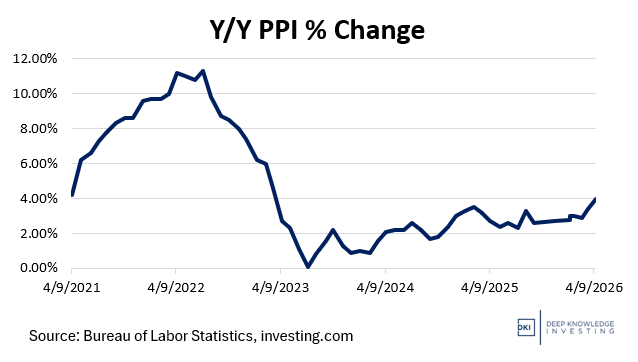
No great on an absolute basis, but better than expected.
DKI Takeaway: The more important signal in this report is not that inflation is easing, but where it is being absorbed. Flat services inflation in a services-driven economy suggests businesses are compressing margins rather than passing through higher input costs. At the same time, the absence of spillover from energy shocks into broader pricing suggests that supply chains remain intact, with no clear signs of disruption despite geopolitical pressure. We expect higher energy prices for a while, but the world economy has seen $100 oil before without collapsing. In addition, with the debasement of the dollar (and all fiat currencies), $100 oil in 2026 has less purchasing power than it did during the 2022 spike. Those who predicted tariff disaster a year ago have been wrong and those who predicted energy disaster this year, have not yet been proven right. DKI agrees with consensus that the Fed will leave the fed funds rate unchanged at the next meeting.
2) Amazon Acquiring Globalstar in $11.6 Billion Deal:
Amazon announced they’re planning to acquire satellite operator Globalstar for $11.6B. The deal is expected to close in 2027. Amazon will gain ownership of Globalstar’s low-Earth orbit (LEO) satellite fleet, mobile satellite services (MSS) spectrum licenses, and other infrastructure. This acquisition adds to Amazon’s own satellite initiatives such as its recent rebrand of Project Kuiper to Amazon Leo, which aims to serve high-speed internet globally, in an effort to challenge SpaceX’s Starlink.
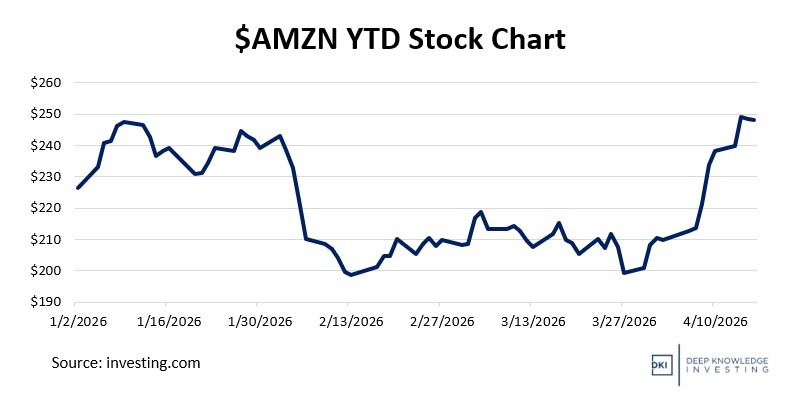
It’s been a volatile year, but if you zoom out, the stock hasn’t moved since early Jan.
DKI Takeaway: This acquisition is a significant step for Amazon, reducing the growing pains associated with developing and launching a massive satellite constellation from scratch. By integrating Globalstar’s existing, proven network and regulatory environment, Amazon can accelerate the path toward global connectivity. The acquisition will help them move past potential manufacturing bottlenecks and launch delays that have hindered independent progress. Amazon intends Leo to be a network of over 3,000 satellites, but as of now, the company has only 200 in orbit, with Globalstar adding 24. The deal alters the landscape for Apple, which had relied on Globalstar for its emergency satellite messaging features. Moving forward, Apple is expected to collaborate with Amazon’s expanded Leo network, causing a realignment where Amazon becomes the supplier for Apple’s satellite-enabled consumer services.
3) Regeneron Signs $4.3B Deal with Telix Pharma to Boost Manufacturing Capabilities:
Regeneron and Telix Pharma have entered a deal with a potential value of up to $4.3B. The intention is to bring Telix’s expertise in radiopharmaceutical platforms, manufacturing, and supply chain to Regeneron’s biologic knowledge, enabling Regeneron to enter the radiopharmaceutical market faster. Initially, Regeneron will provide Telix with $40M in upfront cash for the first four therapeutic programs with the option to expand into four additional programs that also require upfront payments. These additional programs could bring the total value to $4.3B. The deal is flexible for Telix and allows them to enter a 50/50 profit-and-cost split or opt out and receive up to $535M in milestones per program, plus royalties. Additionally, they will co-develop radio-diagnostics, with Telix leading commercialization and Regeneron receiving a share of the profits.
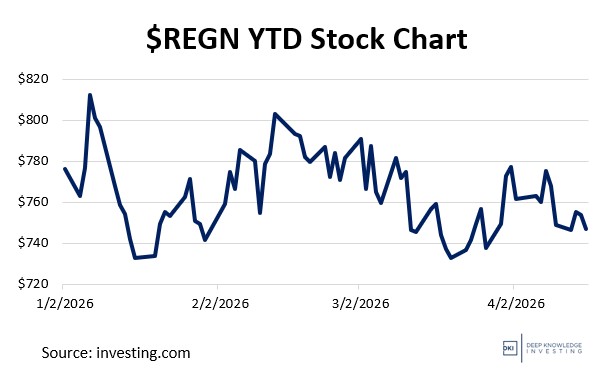
The stock market was unimpressed.
DKI Takeaway: This deal solves a logistics issue for Regeneron. The half-life of radiopharmaceuticals causes them to decay within days, creating a high barrier to entry. By using Telix’s already established manufacturing, Regeneron can enter an untapped market without building nuclear manufacturing sites. This avoids billions of dollars in capex and provides flexibility to pivot if the technology changes. This marks a turning point for pharmaceutical companies. As the bottleneck shifts from drug discovery to supply chain, Regeneron’s move forces competitors to either spend billions of dollars on nuclear infrastructure or secure similar partnerships with radiopharmaceutical firms.
4) Bank Earnings:
Major US banks offered a split picture this week. Revenue across Goldman Sachs, Citigroup, Morgan Stanley, Wells Fargo, JPMorgan, and Bank of America rose 17% vs last year. In comparison, dealmaking fees jumped 29%, leading to a $9.3B increase in revenue. Much of this was fueled by trading desks which capitalized on recent volatility. These six banks are also actively automating and reducing headcounts to help combat inflationary pressures. Furthermore, consumer credit has remained resilient, with banks such as Citigroup seeing a 6% increase in credit card spend volume. There are legitimate concerns regarding consumer credit quality, but that hasn’t affected results yet.
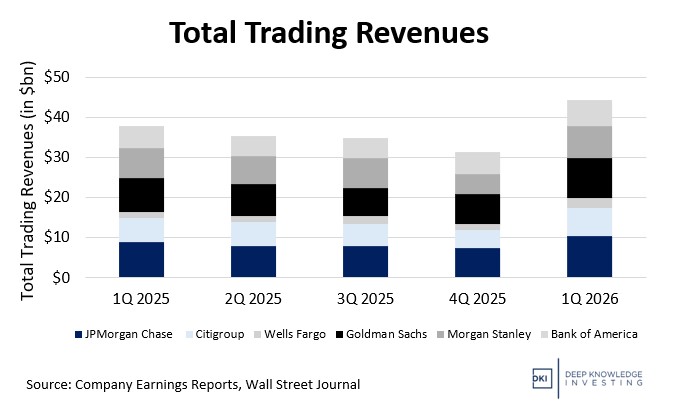
If the banks liked 1Q market volatility, just wait until this quarter.
DKI Takeaway: The increase in revenue and deal-making highlights took share from traditional lending. Actively decreasing headcount and increasing automation creates an efficiency moat for the banks with the largest ones using massive revenue gains to fund technological advancements. Teams are getting leaner with increased digital infrastructure for routine operations. This creates a high barrier to entry as smaller regional banks are unable to replicate the money-center banks’ technology budgets.
5) Educational Topic: Comparable Company Analysis:
Valuation multiples are financial ratios used to benchmark a company’s price against its peers or industry standards. The Price-to-Earnings (P/E) ratio and the EV/EBITDA multiple are two of the most common metrics. The P/E ratio is calculated by dividing a company’s current share price by its earnings per share, reflecting what investors are willing to pay for each dollar of profit. The EV/EBITDA multiple divides the total Enterprise Value (market capitalization plus net debt) by EBITDA to gauge profitability while backing out financing decisions. The EV/EBITDA multiple is often used in mergers and acquisitions and allows for a comparison of companies with different debt levels and tax structures.
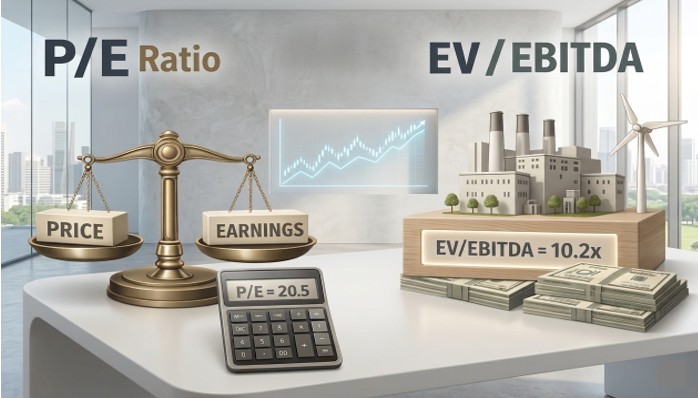
The market isn’t always right, but it’s useful to know what the valuation multiples of similar companies are.
DKI Takeaway: Multiples can show us a lot, but they aren’t everything. There are often good reasons for valuation disparities. For example, if a company’s P/E is high relative to its peers, it could be because that company has had higher growth. There could be a good reason for different valuations, or the company might be overvalued relative to competitors. The bottom line is that multiples can tell you what the market’s pricing in, but it’s your job to figure out why.
Information contained in this report is believed by Deep Knowledge Investing (“DKI”) to be accurate and/or derived from sources which it believes to be reliable; however, such information is presented without warranty of any kind, whether express or implied and DKI makes no representation as to the completeness, timeliness or accuracy of the information contained therein or with regard to the results to be obtained from its use. The provision of the information contained in the Services shall not be deemed to obligate DKI to provide updated or similar information in the future except to the extent it may be required to do so.
The information we provide is publicly available; our reports are neither an offer nor a solicitation to buy or sell securities. All expressions of opinion are precisely that and are subject to change. DKI, affiliates of DKI or its principal or others associated with DKI may have, take or sell positions in securities of companies about which we write.
Our opinions are not advice that investment in a company’s securities is suitable for any particular investor. Each investor should consult with and rely on his or its own investigation, due diligence and the recommendations of investment professionals whom the investor has engaged for that purpose.
In no event shall DKI be liable for any costs, liabilities, losses, expenses (including, but not limited to, attorneys’ fees), damages of any kind, including direct, indirect, punitive, incidental, special or consequential damages, or for any trading losses arising from or attributable to the use of this report.