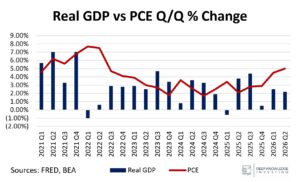
Kevin Warsh gets the big chair and the most glamorous job in finance. After months of reporters panicking about the loss of Fed independence (something that never existed), Warsh takes over with no room to cut rates. I said in the summer of ’24 that Powell shouldn’t cut. I stand by that assertion. eBay rejected the “takeover” attempt by GameStop. They used direct language in doing so. DKI Interns said the GME bid for eBay was about publicity. They stand by their assertion. Inspire Brands filed for a $20B IPO. You can now own stock in the company that sells you your morning coffee and a donut assuming you live in Boston. Let’s talk about mergers. Last week, we wrote about an Australian gold mining merger as an attempt to benefit from economies of scale. This week, we do the same with a North American gold mining merger. Unsurprisingly, in this week’s educational topic, we cover horizontal integration. Instead of up and down, it’s just a jump to the left.
This week, we’ll address the following topics:
- Kevin Warsh takes over a Federal Reserve facing a higher CPI. Predecessor, Powell, never did get inflation under control. Rate cuts are not on the way.
- The eBay Board rejected the “takeover” offer from GameStop. eBay didn’t want to own more than half of a business with long-term declining revenue and an unfinanced bid.
- Inspire Brands, the owner of Dunkin and Baskin-Robbins filed for an IPO. The plan is to raise $2B at a $20B valuation.
- Last week, we highlighted a merger of Australian gold miners. This week, we have the North American version.
- Last week, we wrote about vertical integration. In this week’s educational topic, we cover horizontal integration. Next week, we will not be covering diagonal integration.
DKI Interns, Kunal Arora and Elijah Killorin do their usual excellent job this week. Please extend to them a mental round of applause. Much of what you’re about to read reflects their efforts.
Ready for another week of a new Fed Chair same as the old Fed Chair? Let’s dive in:
1) CPI:
The CPI rose to 3.8% which was 0.1% above estimates. The Core CPI, which excludes food and energy, was up 2.8%, also 0.1% above expectations. The huge difference between the all-items and the Core number was related to energy prices. As usual, an increase in shelter (housing) costs were a big contributor to the month’s CPI print. Food was up 3.2% and up 0.5% for the month. I’ve been saying for years that this part of the data is understated. Given the amount of fertilizer that normally travels through the Strait of Hormuz, prepare for more increases in food prices later this year. Vehicle prices were flat to down which was welcome given the number of people still carrying monthly car payments above $1k.
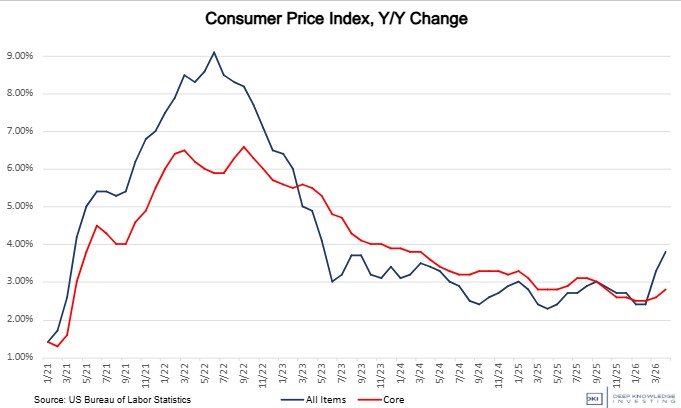
Easy to see where the price of oil entered the calculation.
DKI Takeaway: Kevin Warsh takes over from Jerome Powell as Chair of the Fed. We just got a hot inflation print. Even if we look through the energy spike as temporary, the Powell Fed never did get inflation under control. I’ve been saying for years that the Fed has quietly moved its inflation target from the publicly disclosed 2% (which is 2% too high) to something in the 3% – 4% range. As long as Congress keeps overspending by trillions of dollars a year, there’s nothing the Fed will be able to do. In order to make the national debt anything resembling serviceable, we’re going to have to pay back the dollars owed with dollars that have reduced value. Prepare for more inflation and a return of higher for longer. After months of public hysteria that Warsh will do the bidding of President Trump and immediately lower the fed funds rate to 1%, the new Chairman enters the office at a time when the implied rate cuts aren’t an option. I’d write more, but The Who covered it for me: Meet the new boss. Same as the old boss.
2) eBay Rejects GameStop’s $56B Bid:
eBay rejected GameStop’s $56B offer to “buy” the company. The Board called the offer “neither credible nor attractive.” The company cited concerns over financing, execution risk, and uncertainty about GameStop’s ability to handle the larger business. The rejection comes days after GameStop unveiled its plan to try to challenge Amazon in the larger e-commerce space. GME shares fell while eBay stock rose.
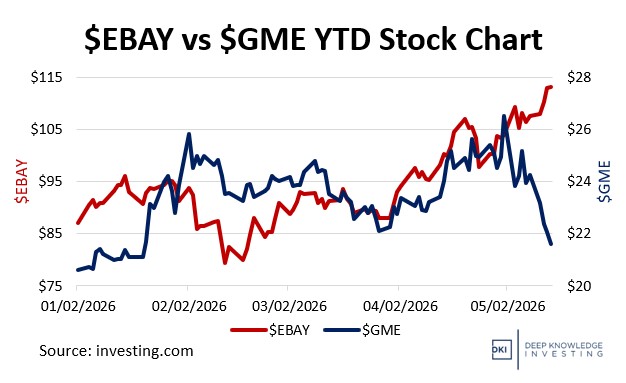
It was never really an “acquisition” offer.
DKI Takeaway: The specific and obvious reasons for the rejection reinforces the idea that the GME bid was more of an attempt to bring GameStop’s name back into the spotlight rather than a legitimate acquisition attempt, something DKI’s interns identified last week. eBay’s response to the bid was reasonable given the fact that they would have owned more than half of the combined company and that the GameStop offer was missing a couple of tens of billions of dollars of committed financing. In addition, despite $GME’s status as the darling of an army of meme “investing” apes, since Roaring Kitty first laid out his bullish case for the company in 2020, GameStop revenue has been cut by more than 50%. eBay management decided they didn’t want to own more than half of a declining business. This is a setback for GameStop CEO, Ryan Cohen’s attempts to push GameStop into the e-commerce and technology space.
3) Restaurant Giant, Inspire Brands, Files for IPO:
Inspire Brands filed for an IPO this week, seeking a valuation of $20B. They’re planning on raising $2B in the offering. Private equity firm Roark Capital, is a key investor, and will benefit from the IPO. The deal would be one of the largest public offerings in restaurant history. Inspire was first formed in 2018 through a merger of Arby’s and Buffalo Wild Wings. Since then, the company has expanded its portfolio to include Dunkin’, Baskin-Robbins, Sonic, and Jimmy John’s. Today, they oversee more than 33,000 locations worldwide, generating $33.4B in annual sales.
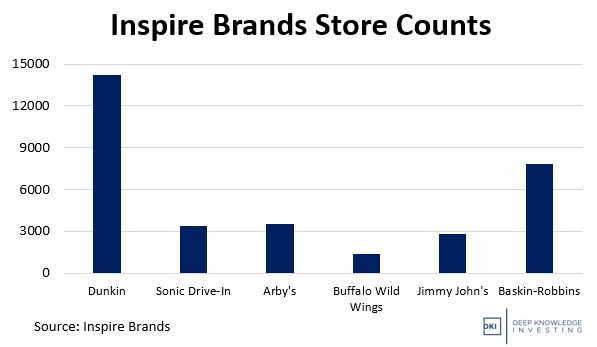
I admit to linking Dunkin’s donuts.
DKI Takeaway: While 2026 has been dominated by anticipated “Big Tech” listings, Inspire Brands offers much-needed diversity for investors looking toward the consumer staples and discretionary sectors. As the largest private multi-brand restaurant operator, Inspire’s aggressive acquisition strategy post-merger has left it with a large debt load. By going public, Inspire can tap into fresh capital from institutional and retail investors to reduce leverage. Long-term, this allows the company to transition from a phase of accumulation to operational scaling and a healthier balance sheet.
4) Equinox Gold and Orla Mining $18.5B Merger:
Equinox Gold and Orla Mining have agreed to an $18.5B merger, creating a combined North American gold producer that will keep the name Equinox Gold. It’s an all-stock merger. The deal aims to improve operational efficiency while expanding production scale. The new entity is expected to produce over 1MM ounces of gold annually with assets in Canada, the United States, Mexico, and Nicaragua.
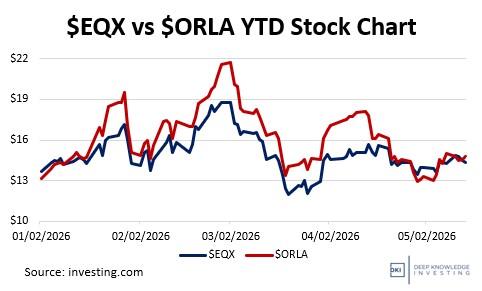
Both stocks roughly flat this year.
DKI Takeaway: This deal is the latest example of a gold mining industry that is consolidating. (Note that last week we highlighted a similar merger in Australia.) Companies are prioritizing scale and cost efficiency over standalone growth. This makes sense because mines can’t change the amount of gold underground or the price of gold. They do control their cost structure. Although gold prices are elevated compared to historical numbers, recent volatility has led to a desire for larger more resilient operations that can withstand price fluctuations and higher operating costs.
5) Educational Topic: Horizontal Integration:
As a follow-up to last week’s educational piece on vertical integration, this week we’re covering horizontal integration. Horizontal integration is when companies increase market share by acquiring/merging with other firms at the same industry level. In other words, if you’re a company that manufactures goods, you’re acquiring other manufacturers to increase your production capacity and efficiency. If you acquired a distributor or input producer instead, that would be considered vertical integration.
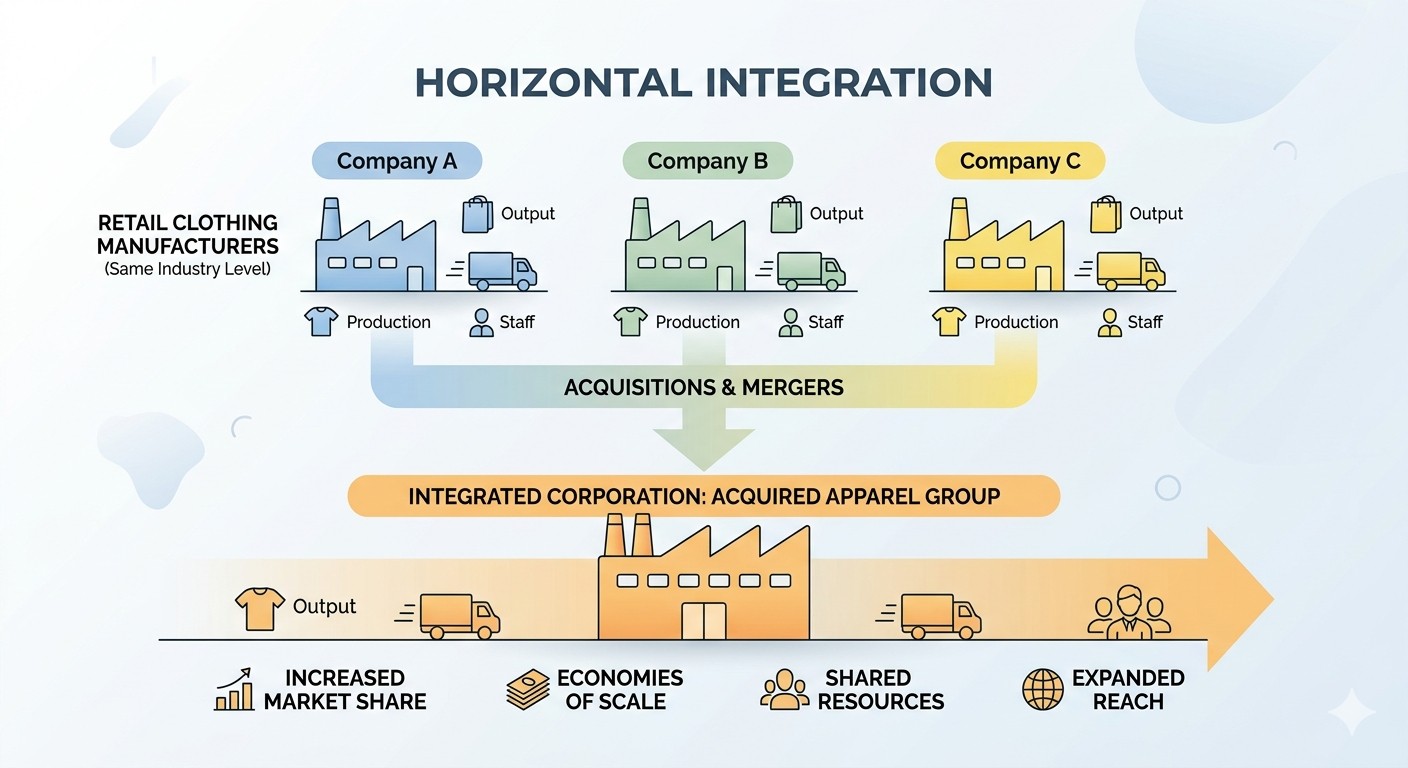
A larger operation spreads its operating costs wider.
DKI Takeaway: Most M&A deals are an attempt to gain scale using horizontal integration. The gold mining merger in the previous Thing is a perfect example. The idea is to expand operations, increase market share, achieve economies of scale to lower average costs, or penetrate new markets. The merged operations can cut costs from overlapping functions and boost revenues more efficiently together than they could alone. One of the biggest drawbacks is some of these companies take on too much debt. There could also be antitrust concerns and other regulatory issues. Left untouched, the consolidation process could create a monopoly attract government attention.
Information contained in this report is believed by Deep Knowledge Investing (“DKI”) to be accurate and/or derived from sources which it believes to be reliable; however, such information is presented without warranty of any kind, whether express or implied and DKI makes no representation as to the completeness, timeliness or accuracy of the information contained therein or with regard to the results to be obtained from its use. The provision of the information contained in the Services shall not be deemed to obligate DKI to provide updated or similar information in the future except to the extent it may be required to do so.
The information we provide is publicly available; our reports are neither an offer nor a solicitation to buy or sell securities. All expressions of opinion are precisely that and are subject to change. DKI, affiliates of DKI or its principal or others associated with DKI may have, take or sell positions in securities of companies about which we write.
Our opinions are not advice that investment in a company’s securities is suitable for any particular investor. Each investor should consult with and rely on his or its own investigation, due diligence and the recommendations of investment professionals whom the investor has engaged for that purpose.
In no event shall DKI be liable for any costs, liabilities, losses, expenses (including, but not limited to, attorneys’ fees), damages of any kind, including direct, indirect, punitive, incidental, special or consequential damages, or for any trading losses arising from or attributable to the use of this report.