
Kevin Warsh takes the big chair with no room to cut. The stock market yawns and I point out for the nth time that Fed rate cuts don’t lead to lower borrowing rates. The yield on the Japanese Government 30 year is up by even more leading to a reduced incentive for the carry trade. NextEra Energy and Dominion Energy announce a merger creating the largest utility in the country. More capital is required to provide for rising energy demand. I still think new nuclear is the answer. Google and Blackstone announce a $5B JV. Google will provide its TPU chips which is one reason Nvidia management is highlighting increasing competition. Aside from that warning, Nvidia announced higher-than-expected revenue and earnings and raised guidance. That good news was already in the stock. SpaceX filed for a possible $2T IPO and there are credible rumors that OpenAI is going to IPO and try for a $1T valuation. Of the two, I prefer SpaceX and explain why. We’ve all heard the term network effect tied to business conditions. In this week’s educational topic, we explain what that is and why it matters.
This week, we’ll address the following topics:
- Since the Fed started cutting, the yield on the US 30-year has risen from 4% to 5%. For the JGB, it’s gone from 2% to 4%. Still think a Warsh-led Fed can cut your borrowing rate?
- NextEra Energy and Dominion Energy Announce $67B Merger. Energy demand is rising and utilities need more capital to expand.
- Google and Blackstone announce a $5B AI joint venture. Google has tech know-how and TPUs while Blackstone has land, power, and capital.
- Nvidia has another spectacular quarter. They beat estimates and raised guidance. The stock market was unimpressed.
- SpaceX files for an IPO that might value the company at $2T. There’s talk that OpenAI might file as well for a $1T IPO. SpaceX is the leader in multiple fields while ChatGPT is losing share.
- In this week’s educational topic, we explain network effects and why they matter.
Credit to DKI Interns, Kunal Arora and Elijah Killorin, who did a fantastic job on this week’s 5 Things. Congratulations as well to Kunal who just received the good news that he was accepted into NYU’s Stern School and will be transferring. He becomes our first NYU Intern through the transfer portal.
Ready for a week of worrying that Kevin Warsh will do what he can’t do? Let’s dive in:
1) US and Japan 30-Year Yields Keep Rising:
The 30-year Treasury is yielding more than 5% again. It was close to 4% when the Fed began this cutting cycle. The movement in the Japanese Government 30-year Bond has been even greater. That yield has risen from around 2% to over 4% in the same time-frame. As the spread between US Treasuries and JGBs narrows, there is less incentive for investors to maintain the heavily-leveraged carry trade. That trade involves selling Japanese bonds and buying higher-yielding US Treasuries and pocketing the difference in interest payments. A smaller spread means investors have more of an incentive to sell US bonds and buy back the Japanese equivalent.

If you can’t see where the Fed cutting cycle began, then you should have less confidence the Fed can get us lower borrowing rates.
DKI Takeaway: I’m writing this a few hours before Kevin Warsh officially becomes Chairman of the Federal Reserve. He takes office with many in DC hoping for lower rates and others hoping he won’t lower rates. The above chart shows you that Warsh can’t do any more than predecessor Powell did. The Fed controls the overnight rate while the bond market determines the rest of the yield curve. If the Warsh Fed cuts the overnight rate, the bond market will price in higher long-term inflation and we’ll have higher yields for the bond durations that determine corporate borrowing rates and mortgage rates. Government interest expense will continue to rise which will necessitate additional money-printing. That leads to more inflation and higher bond rates. The higher and rising rates are a demonstration that the bond market is losing confidence in debt-fueled fiat.
2) NextEra Energy and Dominion Energy Announce $67B Merger:
NextEra Energy and Dominion Energy have announced a $67B merger. This creates the largest electric utility company in the world, with an enterprise value of $420B. Dominion will receive NextEra stock and will own 24.5% of the combined company. The expected cap-x budget will be $59B from 2027 to 2032 to meet increasing AI demand. The combined pipeline is 130 GW from major tech clients.
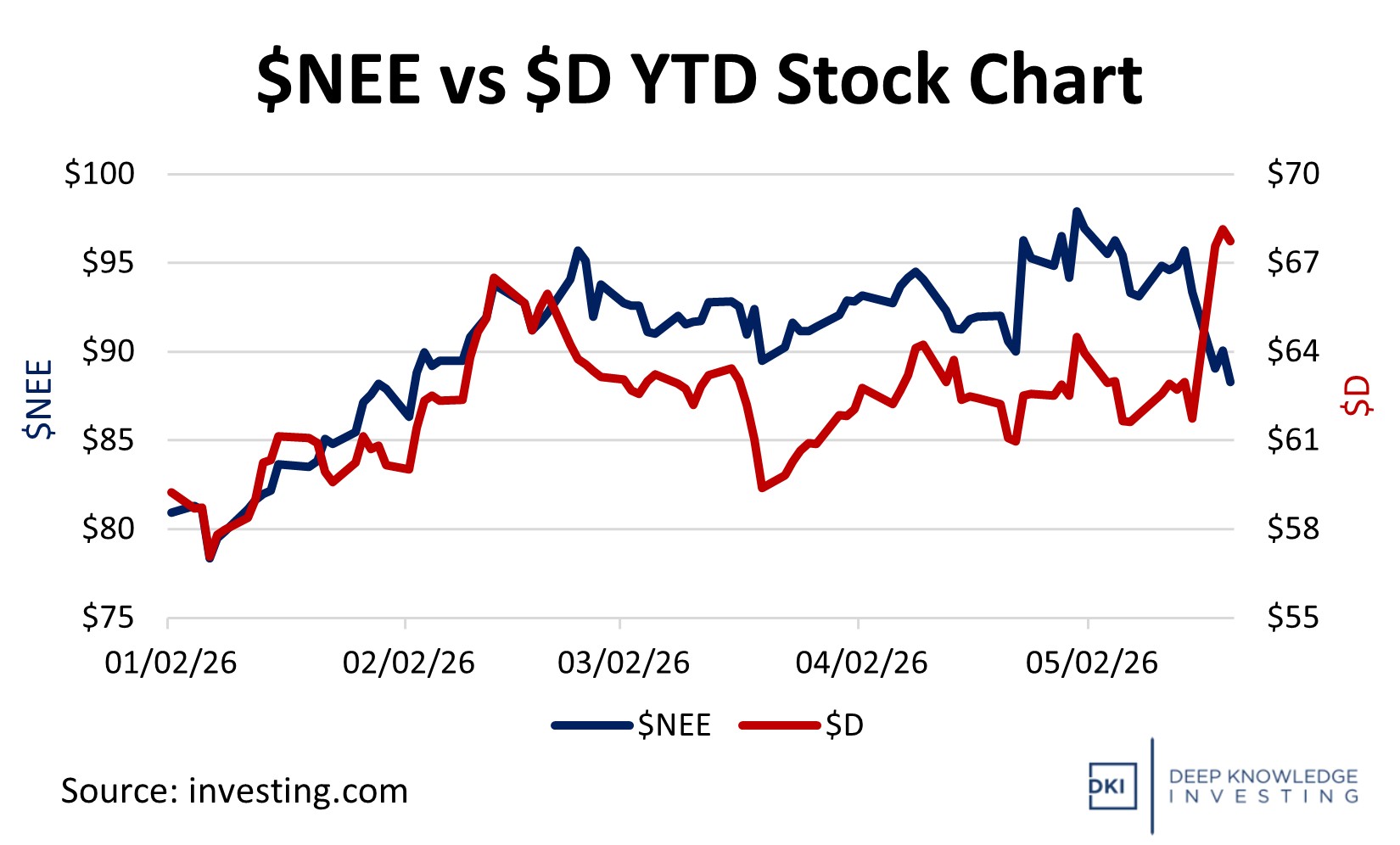
A nice deal premium for Dominion Energy shareholders.
DKI Takeaway: This merger highlights continued consolidation across the energy sector. Increased AI demand is pushing regional utilities to the limit. These utilities want to sell energy to tech firms that can pay any price, but have a regulatory obligation to serve individual homes where budgets are tight. Utility consolidation is an attempt to increase size and provide the capital necessary to match increased demand and complexity. DKI continues to maintain that the answer to the need for more generation without politically difficult additional carbon emissions is new nuclear. We own both new nuclear and uranium.
3) Google and Blackstone Launch AI Infrastructure Joint Venture:
Blackstone and Google have announced a new $5B joint venture to launch a U.S. cloud infrastructure company. The company is yet to be named, and Blackstone will act as the majority owner. Google will provide technical capability while Blackstone will supply land, power pipelines, data center real estate, and capital. The venture intends to provide 500 MW of power by 2027. Benjamin Treynor Sloss, former Google Chief Programs Officer, will be the CEO.
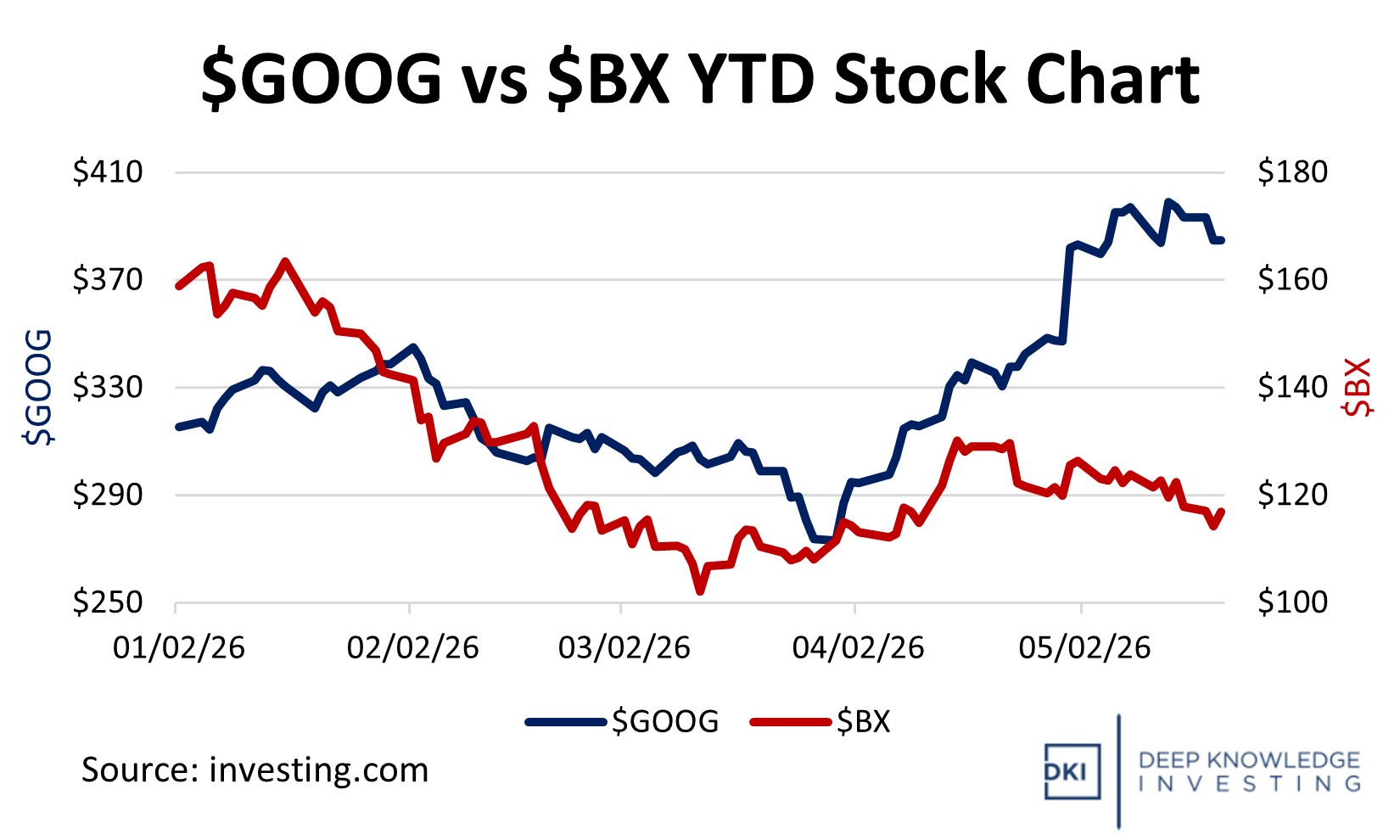
Strange to say, but $5B isn’t a lot for these companies.
DKI Takeaway: This joint venture creates a viable non-NVIDIA path for enterprises needing TPUs. TPU stands for tensor processing unit. It’s Google’s AI processor and is a better option than Nvidia GPUs for certain applications. The JV demonstrates the large amount of capital and power needed for the AI buildout. Tech companies like Google can fund their own operations, but still look to partner with others who will provide additional capital. Programming skill matters, but still needs to be supplemented with land, power, and supply chain expertise.
4) Nvidia Earnings:
1Q earnings season is almost complete, and once again, Nvidia beat revenue and earnings estimates and raised guidance. Revenue for the quarter was $81.6B which beat estimates of $78.9B. Adjusted EPS of $1.87 was well-above the $1.76 estimate. Data center revenue doubled, with CEO Jensen Huang noting that Nvidia is continuing to power every hyperscaler’s data processing and AI workloads. The Vera Rubin chips will be released later this year and will have a huge launch due to partnerships with every major hyperscaler. That market is worth hundreds of billions of dollars per year.
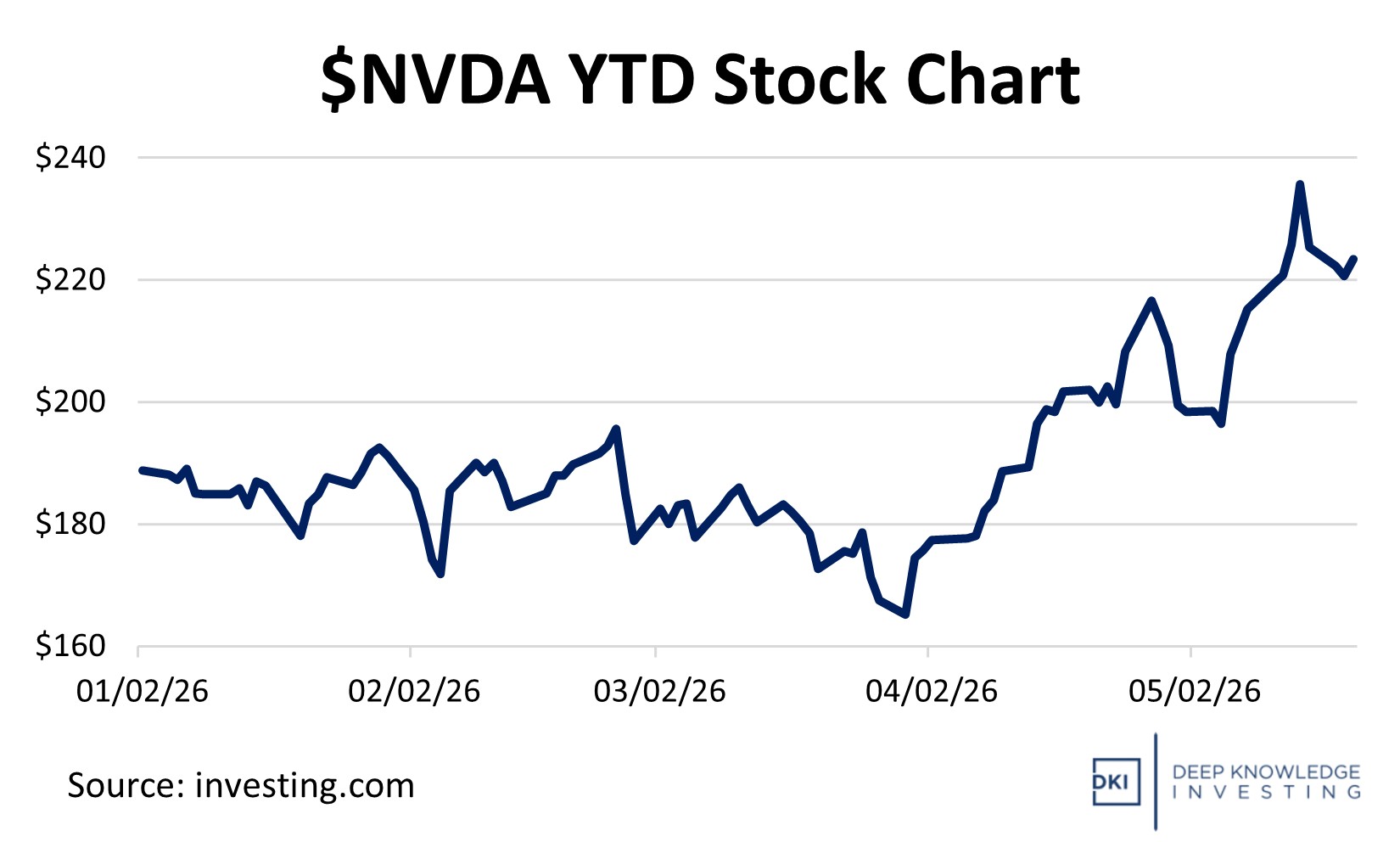
Imagine growing revenue 85% and earnings by 140% (Non-GAAP) / 214% (GAAP) and the market yawns.
DKI Takeaway: This report marked the fourth straight post-earnings slide for Nvidia’s stock, highlighting market expectations for a beat and raise each quarter. Revenue rose by 85% and earnings by 14% (Non-GAAP) / 214% (GAAP), but that was already in the stock price. Nvidia investors are telling the sell-side that they don’t believe the estimates. To management’s credit, they made an explicit acknowledgement of the fast-changing competitive landscape. They discussed the possibility of long-term headwinds as many hyperscalers begin to vertically integrate chip production (see Google’s TPUs above), posing some risk to the company’s dominant positioning. DKI continues to expect a shift in computing share from GPUs used for training to CPUs used for inference and agentic AI. As a result, we started buying Intel at $35 last November.
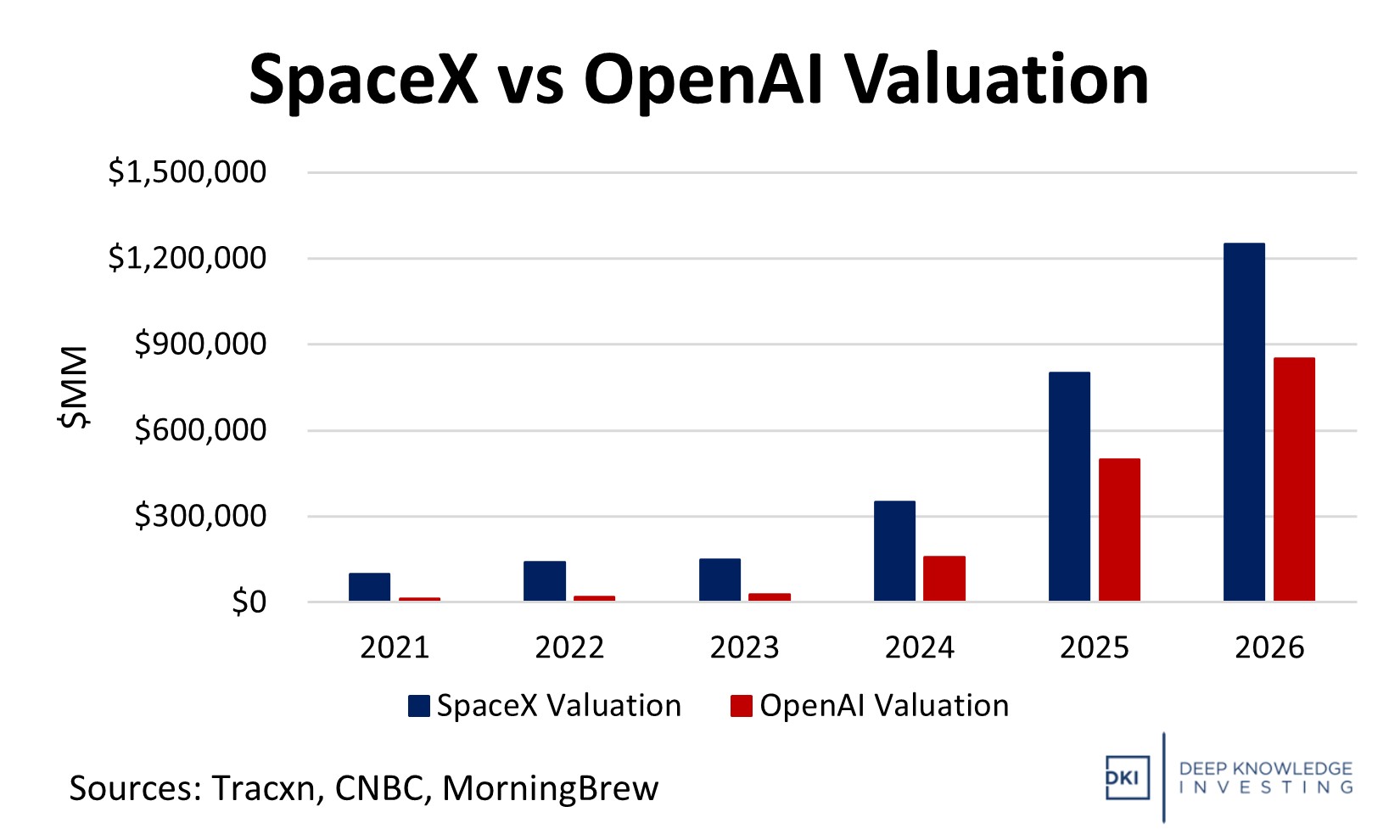
On Wednesday, SpaceX filed for an IPO, and many reports suggest OpenAI is preparing to do the same. SpaceX was valued at $1.3T in February, with an IPO target valuation of $1.8T – 2.0T. OpenAI was last valued at $852B, with a reported IPO target of at least $1T. Together, these two listings create the most significant IPO window in recent memory; bringing two of the most high-profile private companies to public markets at a time when investor appetite for tech infrastructure feels unlimited (for now).
OpenAI is facing more competition.
DKI Takeaway: While critics reasonably point to high valuations and negative free cash flow at both companies, the outlook for each is not the same. SpaceX has the best orbital delivery business in the world with leading rocket recovery technology. The company also has the premiere satellite internet provider and a growing datacenter business. It also has a CEO with a long history of making his doubters look foolish as investors support high valuations for his companies. OpenAI has the highest cash-burn rate in the history of startups, projected to burn through $27B this year alone (up from previous estimates of $14-17B). Supporters focus on the promise of profitability by 2030, yet the company recently missed internal targets for both revenue and monthly users. Spending plans have already been cut by $800B (something DKI warned about last year), and ChatGPT is losing share to Gemini and Claude. Based on our research and that of multiple members of the DKI Board of Advisors with expertise in AI, we think ChatGPT deserves to lose share.
6) Educational Piece: Network Effects:
The Network Effect occurs when an existing product or service becomes more valuable to the existing users as people adopt it. There are two types of network effects: direct and indirect. Direct network effects are when the value of a product increases directly as more users join the network. Social media platforms like LinkedIn are examples of companies that benefit from direct network effects. Indirect network effects are when the value of a product increases for one group of users as another complimentary group grows. For example, a platform like eBay is becoming more valuable to buyers as sellers join.
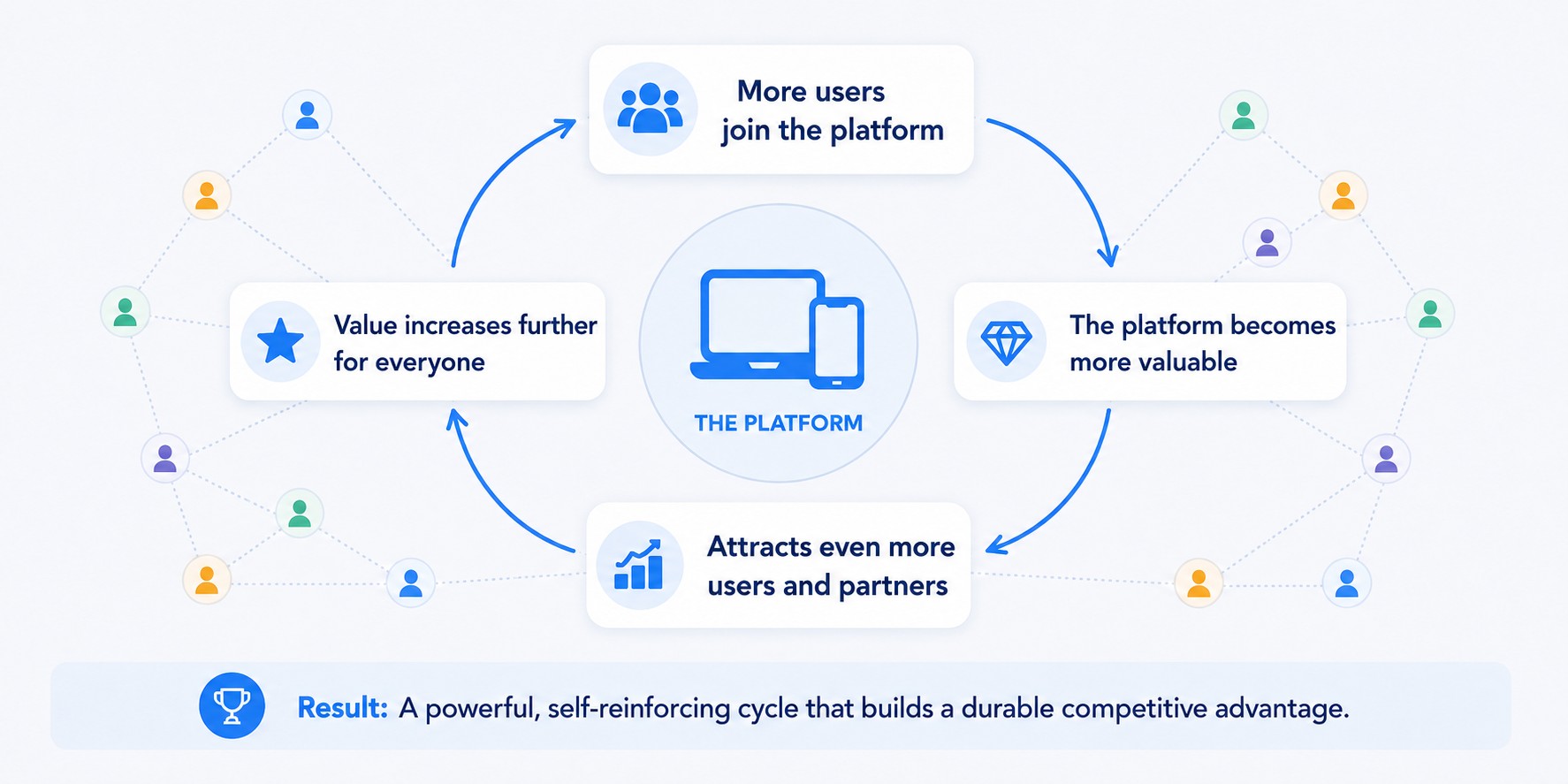 Network Effects – Less complicated than it seems.
DKI Takeaway: Network effects create a powerful economic moat because they create high switching costs for the users. More importantly, there is a disincentive for users to switch to a new and less popular platform. A competitor cannot disrupt a dominant network monopoly by writing better code or lowering prices 10%. They must deliver a product so disruptive that users abandon an ecosystem that all their peers, buyers, and data already use.
Information contained in this report is believed by Deep Knowledge Investing (“DKI”) to be accurate and/or derived from sources which it believes to be reliable; however, such information is presented without warranty of any kind, whether express or implied and DKI makes no representation as to the completeness, timeliness or accuracy of the information contained therein or with regard to the results to be obtained from its use. The provision of the information contained in the Services shall not be deemed to obligate DKI to provide updated or similar information in the future except to the extent it may be required to do so.
The information we provide is publicly available; our reports are neither an offer nor a solicitation to buy or sell securities. All expressions of opinion are precisely that and are subject to change. DKI, affiliates of DKI or its principal or others associated with DKI may have, take or sell positions in securities of companies about which we write.
Our opinions are not advice that investment in a company’s securities is suitable for any particular investor. Each investor should consult with and rely on his or its own investigation, due diligence and the recommendations of investment professionals whom the investor has engaged for that purpose.
In no event shall DKI be liable for any costs, liabilities, losses, expenses (including, but not limited to, attorneys’ fees), damages of any kind, including direct, indirect, punitive, incidental, special or consequential damages, or for any trading losses arising from or attributable to the use of this report.