A personal update: Friday’s surgery went well. I was in a lot of pain over the weekend, but am feeling better every day. I’m doing well, am able to work without limitations, and expect to make a full physical recovery on schedule. I’m so appreciative of all the nice messages I’ve received from the DKI community. For those of you who have sent kind notes, helpful pieces of advice, or just checked in on me, please know how grateful I am.
Now, on to oil.
As usual, the “news” regarding the situation with Iran means nothing. Previously, the market rose on reports the US and Iran had signed an agreement to end hostilities. Then, Iran attacked a Singaporean vessel in the Strait of Hormuz and the US replied with missiles. I’ve seen reports that Iran is still claiming it has the right to control traffic through the Strait. Somehow, reports from the US now indicate we’re back on track and still have a ceasefire. I’ve been saying all along the “news” is irrelevant and changes so often that it’s not tradeable. This is not insightful analysis; but rather, basic observation.
There are politics involved here. As I pointed out last week, there’s almost no overlap between what I believe to be the positions of the US and Iranian governments regarding an acceptable end to hostilities:
I further think that regardless of how either or both sides declare victory at the “end” of hostilities, that there isn’t enough overlap to ensure a lasting peace. The US wants/needs an Iran that stops enriching uranium to (near) weapons-grade, that won’t threaten international waters, and that won’t be a State sponsor of terrorism. I believe the Mullahs won’t agree to any of that, or if they do agree, it will only be a delay tactic while they wait for a better time to pursue the same long-term goals. Right now, it’s hard to see a situation where there’s a lasting agreement with good intentions to follow-through on both sides. I hope I’m wrong about this.
A lot of people have asked me if or how the White House has miscalculated. It’s hard to answer that because I’m not talking to anyone in that room right now. I suspect that to the extent events have played out differently than hoped or expected, it would be for two reasons. I think the Trump Administration believed that if they kept killing Iranian leadership, they’d eventually get to someone who would want to strike a deal rather than be the next to die. However, between Israeli surveillance and US technology, they’ve knocked out a lot of Iranian leaders. Either the IRGC put in place enough independent military actors to eliminate the ability of the US to change policy by killing leaders, or everyone somehow underestimated the willingness of the Mullahs to die. A friend who proofed this article noted that, “This has been a longstanding issue for US warmaking. We don’t tolerate casualties, we don’t know how to fight an enemy who does, and we feel a bit of moral repugnance on what is required to win against such an adversary.” I think his take is accurate.
The second thing the White House might have gotten wrong is they may have expected a bigger uprising from the Iranian people. Reasonable people can argue about whether the US should be involved in this war, but it’s clear to me that President Trump does not have a mandate to put American troops on the ground. The American people don’t want that and I don’t think Congress will support it. I suspect the Administration was hoping that the Iranian people who have been repressed by the IRGC for almost half a century would take a bigger risk in fighting for their own freedom. I don’t know what’s happening on the streets of Tehran right now, but it appears that the Iranian people have been more cautious than President Trump hoped they’d be when he told them to fight for their freedom.
I also think American politics are harming the situation and there’s blame on both sides. President Trump has a habit of making big unsupported claims. We’ve previously noted that his detractors take him literally but not seriously while his supporters take him seriously but not literally. The latter is the better lens, but at the start of the war, he was saying in public that everything would be wrapped up in a few weeks. While I understand the upside of telling the American people we hadn’t just started another “forever war”, putting a public timeline on military actions is asking for trouble as it allows the other side to claim victory just by lasting longer than the advertised schedule.
The President’s political rivals are not helping the situation. Some of President Trump’s critics in Congress previously slammed him for NOT taking out the Iranian leadership (claiming he was pro-dictator). These same people are now criticizing him for starting a war to take out the Iranian leadership. It’s clear their position is not based on values; but rather, opposition to the President. They’re communicating to the Mullahs that the US doesn’t have a foreign policy; just partisan interests. They’re also communicating to the Mullahs that they don’t need to win. They just need to last long enough to see a change of control in Congress or in the White House.
There were projections early on that oil prices would rise past $150/barrel. I think that hasn’t happened for two reasons. First, many countries had reserves. The US, China, and Japan all had some oil saved and have used “rainy day” barrels to keep prices from rising as far as many feared. There was also a lot of oil in tankers already on the water when the war started which provided some extra cushion. By definition, these reserves provide only a temporary benefit.
More importantly, the ability of some Gulf States to move oil without going through the Strait of Hormuz was underestimated. While there has been a deficit due to Iran closing the Strait (followed by the US blockade), more oil has gone around the Strait and through pipelines than had been expected. At the beginning of the war, the fear was that we’d be missing up to 20MM barrels of capacity per day. The reality has been less severe. Plus, oil is its own regulator. The old expression is that the cure for high oil prices is high oil prices because high prices incentivize people to reduce usage.
Finally, I think people are looking at oil prices incorrectly out of habit. Americans tend to get edgy when the price of gas gets to $4 a gallon and get angry around $5 a gallon. At $6 a gallon, a lot of people wouldn’t care whether Iran had nuclear weapons or not or whether they attacked US military bases. When people are feeling financial pressure from filling up the tank in their car just to get to work or pick the kids up from school, it’s normal to focus on that. Right now, a lot of the country is feeling financial pressure. That’s a problem that’s been decades in the making and has as its primary source decisions made in Congress by both parties.
No one likes high oil prices. As someone who travels constantly, I see these commodity price movements as a rachet. When oil prices rise, the airlines raise baggage fees and charge to reserve a seat. When oil prices return to “normal” levels, the extra charges don’t disappear. Access to energy defines the material quality of life for nations and higher energy prices make us all poorer. In this matter, the real issue isn’t the Strait of Hormuz; but rather, inflation.
I am aware that as I write this, the price of oil has declined to the low $70s, a much more reasonable level. I still think this analysis is worthwhile because Iran is continuing to assert control over the Strait. Any signed agreement to end the war won’t eliminate Iran’s ability to drop mines and send attack drones in the future.
Congressional overspending has debased the dollar and crushed its purchasing power. Check out the chart below. Nominal oil prices have risen over time (blue line). When you adjust for inflation, the price we pay for oil now is about what we were paying for it 20 years ago (red line). The war with Iran is the primary reason oil prices are higher now than they were at the beginning of the year. The constant debasement of the dollar is the reason the price of oil has risen over decades.
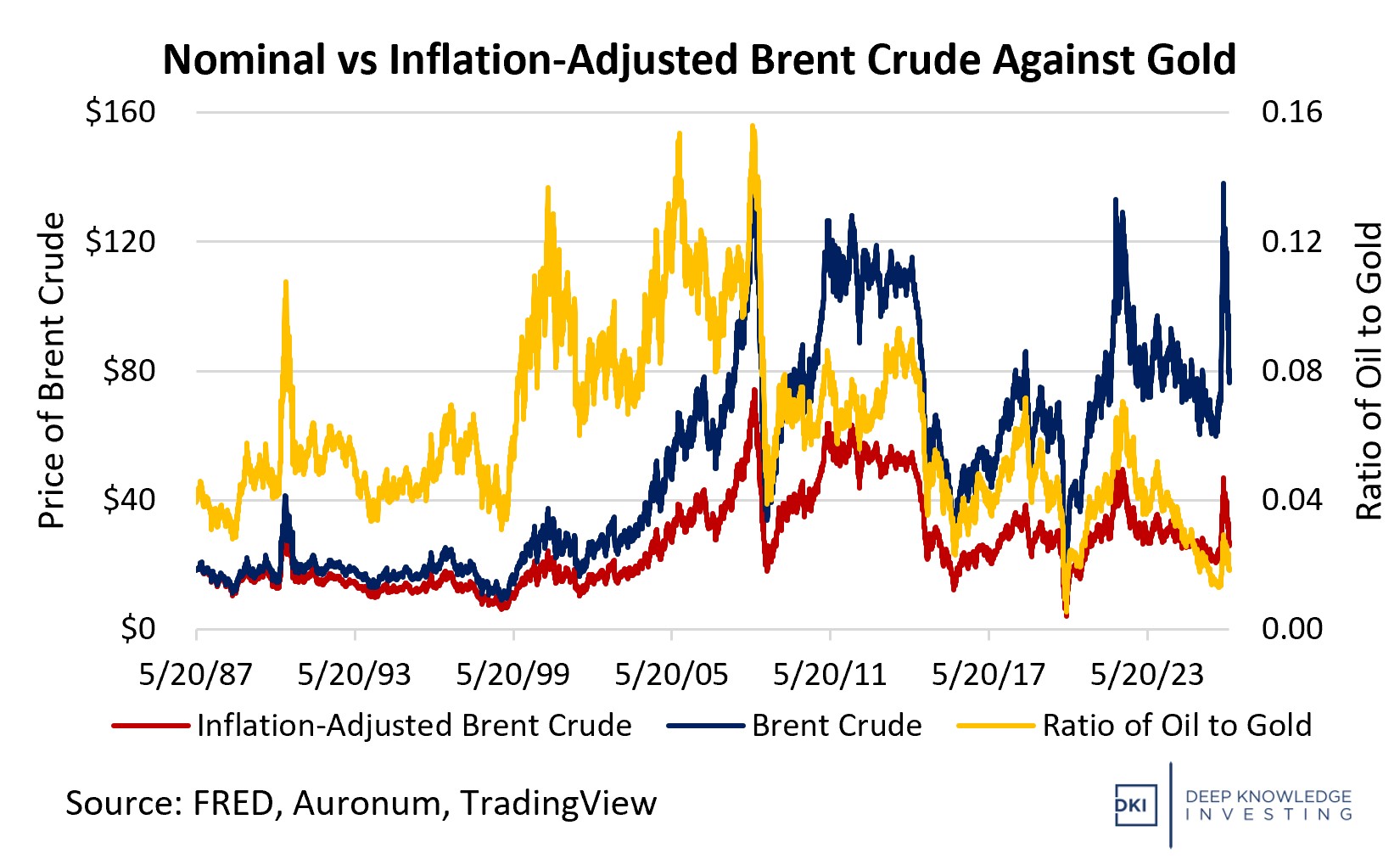
This becomes clearer when we stop pricing oil in fiat and look at hard money. The amount of gold you could buy with a barrel of oil (gold line) has fallen by approximately 3x since 1987. If we used gold as money rather than fiat, it would cost you 1/3 as much to fill your tank today as it would have cost me back when I was a senior in high school. The reason for that is the supply of gold rises by around 1.5% – 2.0% a year while better exploration, production, and drilling techniques has led to a huge increase in the supply of oil. Our real problem isn’t the price of energy. It’s the dollar.
Information contained in this report is believed by Deep Knowledge Investing (“DKI”) to be accurate and/or derived from sources which it believes to be reliable; however, such information is presented without warranty of any kind, whether express or implied and DKI makes no representation as to the completeness, timeliness or accuracy of the information contained therein or with regard to the results to be obtained from its use. The provision of the information contained in the Services shall not be deemed to obligate DKI to provide updated or similar information in the future except to the extent it may be required to do so.
The information we provide is publicly available; our reports are neither an offer nor a solicitation to buy or sell securities. All expressions of opinion are precisely that and are subject to change. DKI, affiliates of DKI or its principal or others associated with DKI may have, take or sell positions in securities of companies about which we write.
Our opinions are not advice that investment in a company’s securities is suitable for any particular investor. Each investor should consult with and rely on his or its own investigation, due diligence and the recommendations of investment professionals whom the investor has engaged for that purpose.
In no event shall DKI be liable for any costs, liabilities, losses, expenses (including, but not limited to, attorneys’ fees), damages of any kind, including direct, indirect, punitive, incidental, special or consequential damages, or for any trading losses arising from or attributable to the use of this report.