I’d like to start this week with a personal note. As many of you know, I had surgery on Friday. Everything went well, and while I’m in considerable pain, I have every reason to expect that I’ll make a full recovery. My current situation represents the best-case scenario and the outlook is excellent. I expect to be on a plane and traveling again in a few weeks and am already back at my desk working.
I’d like to thank my friends and neighbors (many of whom are on the DKI Board of Advisors) who have checked in on me and provided assistance. A special round of applause for DKI’s young interns who stepped up this week and delivered meaningful high-quality work when I was limited. I’ve also been humbled by the number of personal messages I’ve received from DKI readers and subscribers. For every one of you who reached out to check on me, please know how grateful I am for your care and kindness. And for every one of you reading this now, thank you for being part of Deep Knowledge Investing.
This week’s financial news was dominated by DRAM pricing. Micron announced an incredible quarter with volumes and pricing up huge. In an effort to secure supply of what is currently the most limited part of the AI stack, Anthropic signed an infrastructure deal with $MU. AbbVie is paying a massive premium to acquire Apogee Therapeutics. Apogee has drugs in the pipeline which require less frequent dosing meaning more convenience for patients and better compliance from them (assuming the drugs get FDA approval). AMD is acquiring MEXT which makes inexpensive flash memory perform like increasingly expensive and difficult to obtain DRAM. This comes as Apple raised prices on some Mac computers by $300. If and when DRAM pricing comes down again, it will be interesting to see if Apple lowers prices. I think this is a smart acquisition by AMD and would love to see Intel make a similar kind of move. Just two weeks after Fox announced the acquisition of Roku, Walmart is buying Vibe.co which delivers advertising through smart televisions. As viewing continues to move from linear television to streaming, companies want to secure a direct line to consumers. I wrote about this back in 2012 in an eBook called TV is Next. In this week’s educational topic, we explain capital gains and explore some of the basics of how those gains and losses are treated for tax purposes. If you need an expert in this area, reach out and I’ll be happy to make an introduction.
I’ll be on The Business Briefing Daily Show on SiriusXM with Janet Alvarez this Thursday at 10am. Our conversations are always interesting and listener questions are smart. Please check it out if you subscribe.
This week, we’ll address the following topics:
- With DRAM prices skyrocketing and $MU announcing a record quarter, Micron and Anthropic sign an AI infrastructure partnership.
- AbbVie is paying almost $11B to acquire Apogee Therapeutics because the company has immunology drugs in the pipeline with friendly dosing schedules. Read on for more.
- In a response to skyrocketing DRAM prices, $AMD is acquiring MEXT, a company that specializes in making inexpensive flash memory perform like expensive DRAM.
- Walmart is acquiring Vibe.co, a company that delivers advertising through smart televisions. This comes shortly after the announced acquisition of Roku by Fox.
- Ever wonder how capital gains work? We give you the basics in this week’s educational topic.
I’m so proud of our interns this week. As noted above, I had surgery on Friday (all went well) and they came through like stars. Kunal Arora and Eli Killorin delivered a first version of this week’s 5 Things that was heavy on high-quality research and strong themes. New intern, Param Shah, got off to a quick and productive start and is working with me on a stock idea where we’re trying to figure out if the market is misunderstanding an opportunity. Even with me unavailable for a day, they each delivered outstanding work.
1) Micron and Anthropic Sign AI Infrastructure Partnership:
Micron and Anthropic have signed a strategic partnership deal. While Anthropic named Micron as an infrastructure partner at the end of its Series H funding round in May, the companies provided additional detail this week. They will work together to analyze how memory and storage perform across various infrastructures and how to improve performance/energy efficiency. In addition, Micron will support Anthropic’s compute scaling by supplying it with memory and storage. Given the massive DRAM shortages highlighted this week by Apple having to raise prices due to lack of supply, Anthropic’s deal to secure supply is significant. Micron has deployed Claude models across its business to accelerate coding and enable advanced engineering and manufacturing. $MU announced an incredible Q3 this week. Revenue of $41.5B beat estimates of $35.8B and were up 346% vs last year. Earnings of $28.9B crushed estimates of $23.5B, up 1,223% vs last year. Gross margins improved to a record 84.9%, up from Q2’s 74.9% and 37.7% a year ago. Note that the above represent adjusted non-GAAP earnings.
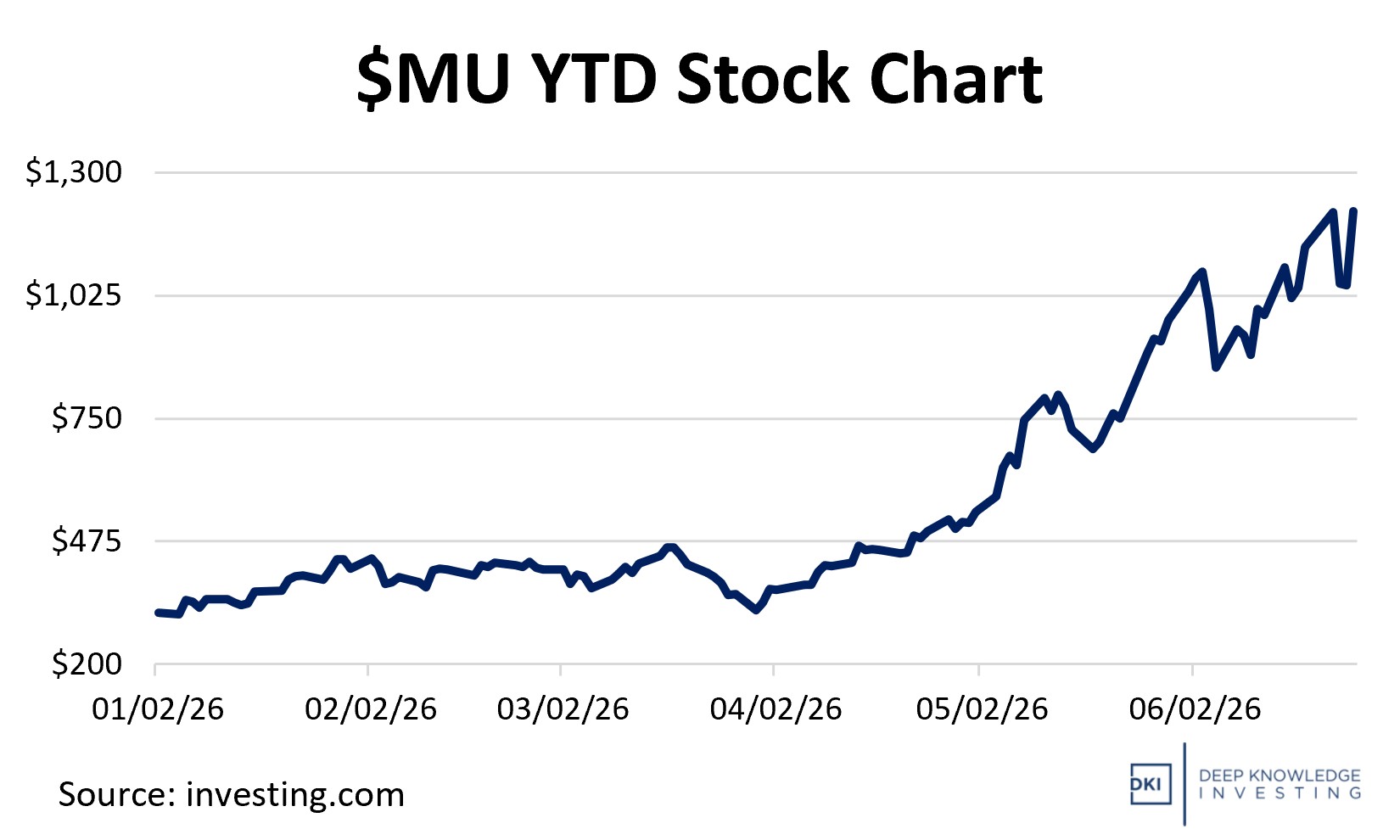
This is the other side of a $300 price increase on a MacBook Pro.
DKI Takeaway: Anthropic needs massive memory and storage to scale Claude. Micron provided this supply contract while also taking an equity stake in Anthropic. It positions Micron as a structural beneficiary of AI growth embedded directly in the development stack (the layers of hardware and software that power AI systems). Samsung and SK Hynix joined the same Series H round, with complete details of those partnerships yet to be disclosed. Those two companies also partnered with OpenAI to supply memory to Stargate (a multi-site data center buildout), suggesting that integration between memory manufacturers and frontier AI labs is becoming the norm.
2) AbbVie Enters Agreement to Acquire Apogee Therapeutics for $10.9B:
AbbVie has entered an agreement to acquire Apogee Therapeutics. AbbVie intends to acquire all Apogee shares at $135.11/share in cash, valuing the deal at $10.9B. Approval by Apogee shareholders also appears probable as the purchase price is almost a 50% premium to the pre-announcement stock price. The deal, is expected to close in Q3 2026.
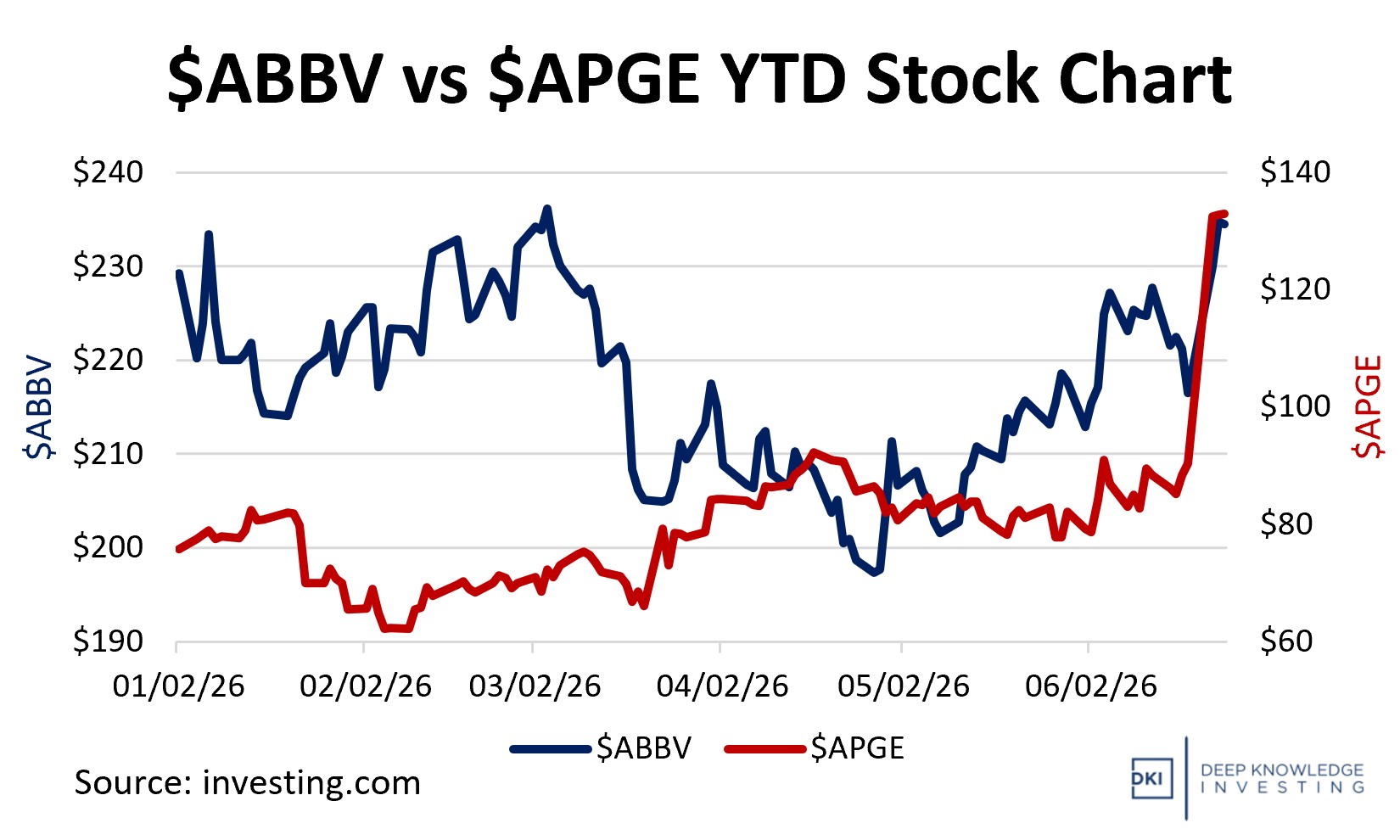
With a premium that large, it’s hard to imagine shareholders would reject it.
DKI Takeaway: AbbVie was willing to pay a premium price due to Apogee’s promising pipeline of immunology drugs. For its leading drug, zumilokibart, Apogee is initiating Phase 3 trials for atopic dermatitis (eczema) and advancing towards Phase 2b for asthma. They’re not ready for the NDA (New Drug Application) yet with the FDA, but AbbVie would have done due diligence and expects these drugs to win approval. Zumilokibart would require one dose every 3-6 months after the induction phase, whereas the leading drug on the market, Dupixent, requires a dose every 2 weeks. If approved, these drugs would give AbbVie a massive competitive edge in offering convenience to customers.
3) AMD Acquires MEXT to Increase Memory Efficiency:
AMD announced its acquisition of MEXT, a startup specializing in AI memory optimization technology. MEXT’s predictive memory technology is designed to make Flash memory (a lower cost, high-capacity storage) behave more like DRAM (Dynamic Random Access Memory, a much faster but more expensive type of memory). It does so by analyzing memory access patterns and moving frequently needed data into DRAM before applications request it. This allows systems to access larger amounts of data at near-DRAM speeds while reducing costs. DDR4 16 Gigabit averaged $72.32 on the spot market versus $3.91 for SLC 2 Gigabit flash as of late June 2026, according to DRAMeXchange. The newer and faster DDR5 is available at retail for well-over $200 for 16GB.
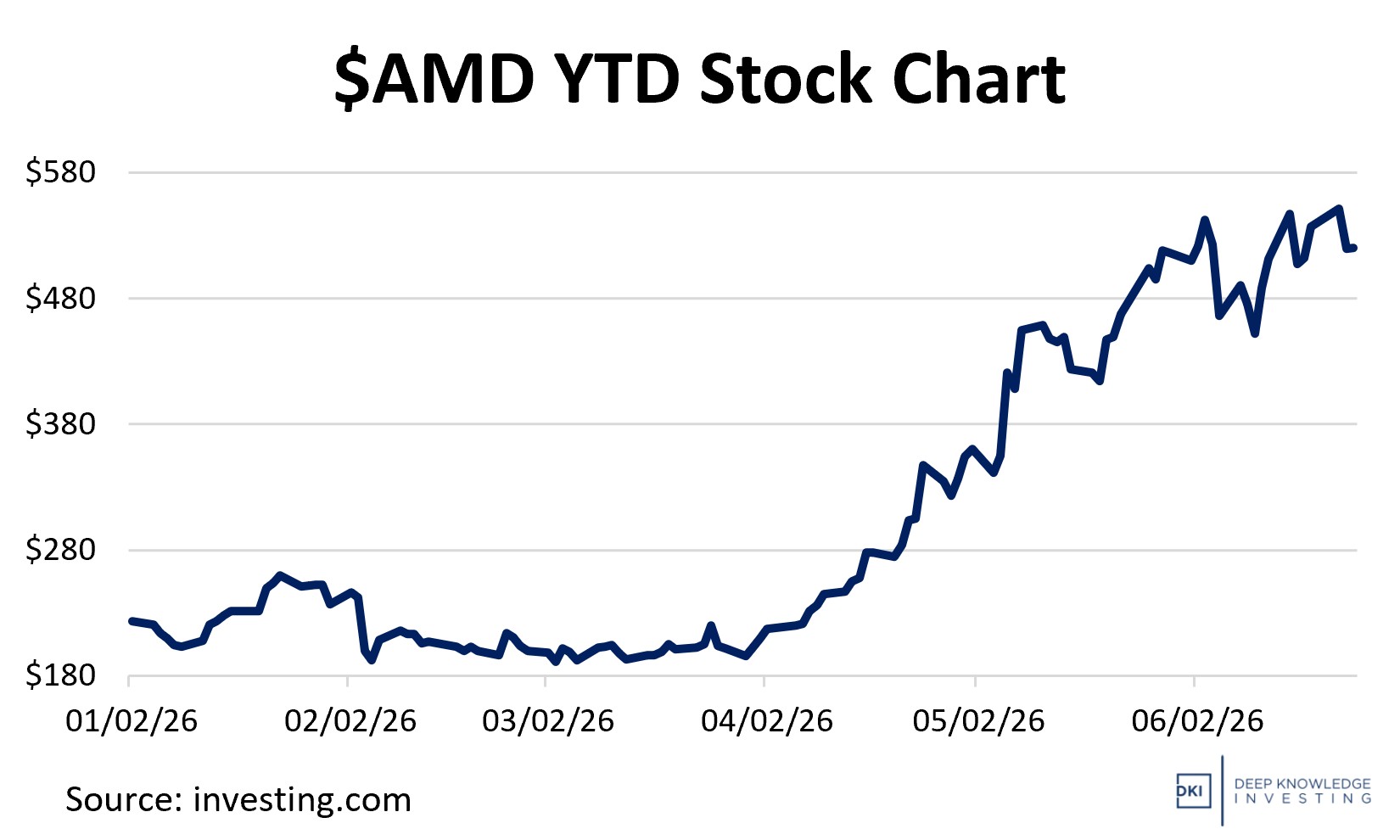
Both $AMD and $INTC have been benefitting from CPU demand.
DKI Takeaway: As AI and high-performance computing workloads balloon, memory bottlenecks have become a primary constraint on system performance. This acquisition highlights AMD’s strategy to expand beyond processors and optimize the entire AI infrastructure stack, allowing them to deliver more scalable, cost-effective enterprise solutions. This issue is also why Anthropic wanted a supply deal with Micron (see Thing 1 above) and why Apple and other laptop manufacturers are demanding huge price increases on consumer electronics.
4) Walmart Enters Agreement to Acquire Vibe.co for $1.4B:
Walmart has agreed to acquire Vibe.co, a self-serve connected TV (CTV). Vibe.co delivers advertising through streaming platforms on smart TVs and owns an advertising platform designed to simplify ad buying for small and mid-sized businesses. This acquisition advances Walmart’s strategy to build more accessible advertising solutions at scale through Walmart Connect (Walmart’s retail media and advertising business).
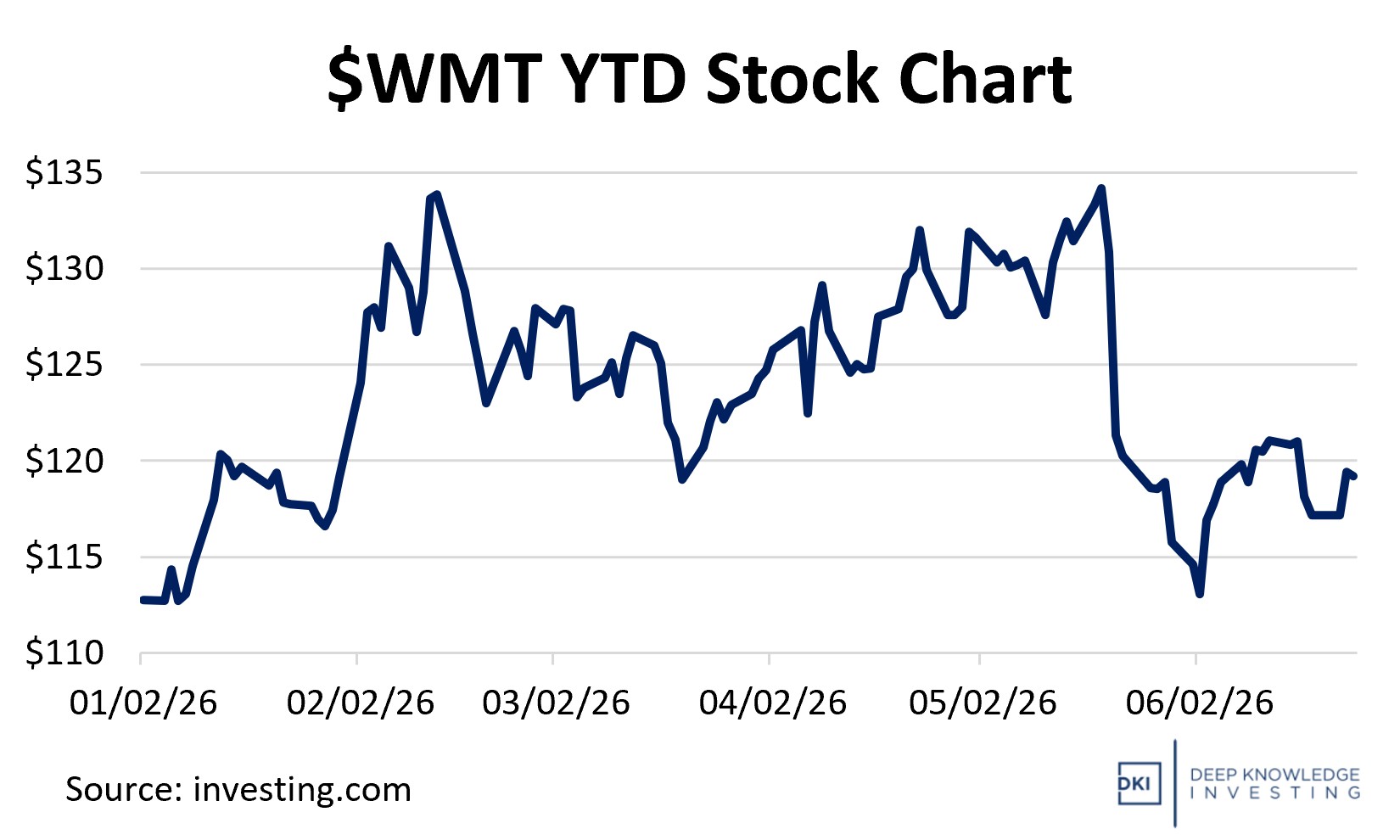
An up and down year for $WMT stock due to concerns about the economy.
DKI Takeaway: By integrating Vibe.co’s self-serve CTV capabilities with Walmart Connect and its VIZIO advertising assets, Walmart is moving toward a more unified advertising platform. Instead of advertisers needing multiple tools to create, manage, and distribute ads, Walmart can offer a single ecosystem that covers the full workflow from ad creation to targeted delivery across streaming and retail channels. This strengthens Walmart’s position in high-margin advertising revenue while making its platform more attractive to smaller advertisers who want simplicity and scale. Note that DKI recently featured the planned acquisition by Fox of Roku, a comparable business to Vibe.co. Companies are trying to lock up direct access to television viewers, a long-term trend as streaming has displaced traditional linear TV.
5) Educational Topic: Capital Gains:
Capital gains are the profits earned from selling an asset for more than you paid for it, and they’re often taxable. Most asset types qualify, including stocks, bonds, and real estate. Under current laws, gains are only counted when realized, meaning stock that has appreciated in value does not trigger a taxable event until you sell. The holding period also matters. Short-term gains (held for one year or less) are taxed at your ordinary income tax rate. Most long-term gains (held for over a year) are taxed at preferential rates of 0%, 15%, or 20%, depending on your taxable income and filing status. The opposite is a capital loss. It occurs when an asset is sold below its purchase price and can be used to offset gains with certain limitations.

I’m among those who believe taxing gains on already-taxed money distorts the system.
DKI Takeaway: If you sell a stock at a loss, that loss reduces your net capital gains, which can reduce your taxable income. Sell a stock for a $500 gain and another for a $500 loss, and those two cancel out, leaving you with no capital gains tax owed. If your losses exceed your gains in a given year, you can typically deduct up to $3,000 from your regular income. Anything remaining is carried forward to future tax years. Doing this in a strategic manner is called tax-loss harvesting.
DKI does not provide tax advice and does not have a qualified CPA on staff. If relevant to you, we suggest contacting a professional tax advisor to discuss your specific situation. DKI works with some excellent RIAs who specialize in this kind of planning and we are always happy to make an introduction.
Information contained in this report is believed by Deep Knowledge Investing (“DKI”) to be accurate and/or derived from sources which it believes to be reliable; however, such information is presented without warranty of any kind, whether express or implied and DKI makes no representation as to the completeness, timeliness or accuracy of the information contained therein or with regard to the results to be obtained from its use. The provision of the information contained in the Services shall not be deemed to obligate DKI to provide updated or similar information in the future except to the extent it may be required to do so.
The information we provide is publicly available; our reports are neither an offer nor a solicitation to buy or sell securities. All expressions of opinion are precisely that and are subject to change. DKI, affiliates of DKI or its principal or others associated with DKI may have, take or sell positions in securities of companies about which we write.
Our opinions are not advice that investment in a company’s securities is suitable for any particular investor. Each investor should consult with and rely on his or its own investigation, due diligence and the recommendations of investment professionals whom the investor has engaged for that purpose.
In no event shall DKI be liable for any costs, liabilities, losses, expenses (including, but not limited to, attorneys’ fees), damages of any kind, including direct, indirect, punitive, incidental, special or consequential damages, or for any trading losses arising from or attributable to the use of this report.