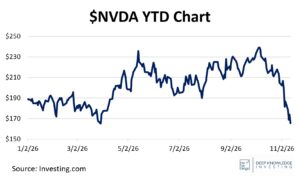
Unsurprisingly, there’s been a movement among Nvidia shareholders to bring back Jensen Huang. Huang has indicated an interest. The press keeps dragging up stories that he belittled people while Nvidia engineers keep posting on X that he both drove them to perform at their best and cared about them as people. High-performing founders can be tough on people and also be loved by them. Two things can be true at the same time. Steve Jobs and Elon Musk are obvious examples. I don’t think the Nvidia Board can bring Huang back, and it’s not because of the extra-marital sex.
Right now, I don’t have an opinion on whether Alice Huang of Megaspeed was a spy. I did put in writing two years ago that “It’s an open secret that Chinese companies have been circumventing US sanctions by paying for processing power on the best Nvidia chips outside of the US by renting it.” As of now, we don’t have definitive proof that Nvidia was knowingly arranging for Chinese access to high-end product, but the company will need to investigate, and I’ll be shocked if AI accelerators weren’t being funnneled to Chinese firms through Singapore and Vietnam, and through rental firms like Megaspeed.
That’s going to create a problem for Jensen Huang. It might also create a problem for the Board which either knew about these practices or should have known. Nvidia will announce 3Q earnings after the close today. They will face two problems. First, there’s an issue of how much of Nvidia’s sales were to China (through intermediaries) and what actual non-Chinese demand is. Second, Nvidia has been financing so many of its customers that it earned the nickname “The Bank of AI”. Huang was in the process of reducing those financing commitments, something the new and temporary CEO will reign in even faster. This means company executives and Wall Street analysts will need to figure out what actual demand is when not financed by the Nvidia balance sheet.
If I were in their position, I’d say recent events are causing the company to examine all prior business practices and that as a new and temporary CEO who’s been on the job for a week, I’m not in a position to endorse prior guidance. I’d then pull guidance, or write it down to what I absolutely knew to be US domiciled AI-based demand without any financing guarantees. That would be a negative for the stock price, but the probability of criminal charges here isn’t zero. In that position, wouldn’t you worry a lot more about staying out of jail than where the stock price is tomorrow?
I think all of this is affecting Bitcoin. In the long term, both Bitcoin and gold are the best way to play the debasement trade and will benefit from an overspending US Congress that finances trillions of dollars a year through debt (currency creation). In the short-term, Bitcoin often trades on global liquidity. In recent years, the AI trade has caused market indexes to rise. That’s been amplified by huge amounts of leverage in the system.
Even before the recent downfall of Jensen Huang and the associated carnage of what had been the stock with the largest market cap in the world, AI investors were starting to think about the probability of earning a return on trillions of dollars of capital investments. Suddenly, spending more due to demand (some of which was being financed by Nvidia) didn’t result in higher stock prices. When stock prices fall, people and institutions using leverage get margin calls. They need to sell assets and raise cash immediately. In those moments, they don’t necessarily sell what they want to sell; but rather, they sell what they can. Gold is one of the largest most liquid markets in the world and Bitcoin is the only major asset class traded by institutions which trades 24 hours a day 365 days a year. When traders go “risk off” and want to reduce exposure, or when they get margin calls and need to reduce exposure, they often sell Bitcoin and gold.
Huge IPOs are also draining the market of cash. The SpaceX IPO and this week’s Anthropic IPO raised close to $200B between them. So, we have falling stock prices, Nvidia withdrawing financing (and possibly guidance), deleveraging, and mega-cap IPOs. These all reduce market liquidity which is a big part of what’s dragging down the price of Bitcoin.
Higher interest rates add to this. The 10-year Treasury is currently yielding 5.11%. Prior to a brief period earlier this year when it peaked at 5.35%, that’s the highest it’s been in the past 20 years. As zero-yield assets, gold and Bitcoin trade down when interest rates rise because the reward for holding fiat dollars is comparatively larger. This is a short-term trading anomaly because in the long-term, higher inflation destroys the spending power of the dollar faster. Higher interest rates are due to higher inflation. For more details on how this works, please revisit the blog post titled It’s Recursive.
Bitcoin is down less than 50% from its all-time high. Prior mid-cycle drawdowns tended to be in the 75% – 90% range. In 2024 and 2025, when Bitcoin was on its way to an all-time high of $126k, I got a lot of questions from people who wanted to know if they had missed the trade. Was it too late to buy Bitcoin? I always tell people I have no opinion on the short-term direction of Bitcoin. There aren’t a lot of fundamentals to track and research. But if you believe Congress (and their counterparts in every other major economy) will continue to debase the currency, then Bitcoin is my favorite long-term response to that. I’m not getting those questions now.
It reminds me of a situation a colleague had. He recommended a few stocks to a group of people. They avoided action by saying they wanted to buy those same stocks when they were down 40% (a random number they thought they’d never see). My colleague noted that when stocks are down 40%, most people look to sell instead of to buy. The same people who thought they had missed the opportunity in Bitcoin at $80k aren’t buying it at $64k. I suspect that when it’s back above $100k, they’ll tell me again that they missed it or want to buy it then.
Further compounding this is the leverage previously being used to buy AI stocks is also being used by institutions buying Bitcoin. A lot of the gaps down are being caused by smaller (but normal) price drops that cause leveraged accounts to sell immediately. Michael Saylor’s Strategy ($MSTR) is a potential future contributor to this as well. His firm owns about 4% of Bitcoin’s supply and has taken on a lot of debt to do so. This works great when prices are rising and equally poorly when prices are falling. The firm is now sitting on billions of dollars of losses and was just removed from several indexes because they’ve decided to only include operating companies. Saylor was an effective evangelist several years ago, but at this point, $MSTR is an overhang on the market.
I’m less concerned than others about potential regulation coming from the new Democratic Congress. They’ve been anti-Bitcoin for the past few years and some have said they want to regulate it. President Trump has been pro-Bitcoin and pro-crypto and has a veto pen. I don’t think much will pass. Of greater importance, US governmental regulation can only affect institutions that want to hold Bitcoin in regulated accounts. The asset itself is permissionless. No government can affect the worldwide market nor prevent you from owning Bitcoin.
DKI first bought Bitcoin in 2020 when it was around $15k. It ran up to $64k and then round tripped back to $15k. We bought more then. It’s a volatile asset, although less so than in previous cycles; at least so far. I want to own it and have found it’s been profitable to remain calm during difficult moments. Reach out if you have questions.
Information contained in this report is believed by Deep Knowledge Investing (“DKI”) to be accurate and/or derived from sources which it believes to be reliable; however, such information is presented without warranty of any kind, whether express or implied and DKI makes no representation as to the completeness, timeliness or accuracy of the information contained therein or with regard to the results to be obtained from its use. The provision of the information contained in the Services shall not be deemed to obligate DKI to provide updated or similar information in the future except to the extent it may be required to do so.
The information we provide is publicly available; our reports are neither an offer nor a solicitation to buy or sell securities. All expressions of opinion are precisely that and are subject to change. DKI, affiliates of DKI or its principal or others associated with DKI may have, take or sell positions in securities of companies about which we write.
Our opinions are not advice that investment in a company’s securities is suitable for any particular investor. Each investor should consult with and rely on his or its own investigation, due diligence and the recommendations of investment professionals whom the investor has engaged for that purpose.
In no event shall DKI be liable for any costs, liabilities, losses, expenses (including, but not limited to, attorneys’ fees), damages of any kind, including direct, indirect, punitive, incidental, special or consequential damages, or for any trading losses arising from or attributable to the use of this report.