Sorry about the click-bait headline; evidently social media is influencing me, regardless of how much I despise it. Right now, opinions on what happens next in the economy and the market are coalescing around four scenarios:
- Pour Gas on the Fire: More stimulus and an accommodating Fed lead to continued nominal growth and a higher stock market.
- The Party is Over: The stock market is at all-time highs with almost all the growth coming from a few high-multiple companies in one industry. We’re due for a correction/bear market.
- Deleveraging Deflation: We have a recession and credit crunch that causes the money supply to contract and people to stop spending leading to deflation.
- Star Trek: Cheap limitless power from nuclear energy combined with AI-driven advances lead us to utopia. Everyone’s needs are met and few have to work.
Let’s go over all four and I’ll let you know how each one would affect the DKI portfolio and what I think the probability of each is.
Pour Gas on the Fire:
Here’s the current state of affairs:
- We’re at close to full employment and while the labor market has cooled, it’s still pretty good.
- Wage growth has been strong although not as strong as real inflation.
- Inflation is below the peak from a couple of years ago, but Washington DC and the Fed are acting like it’s under control.
- The reality is inflation is still well-above the 2% target (which itself is 2% too high) and has risen recently.
- The tariff inflation doom predicted by fiat economists hasn’t occurred, but the Fed appears to have changed its inflation target to something in the 3% – 4% range.
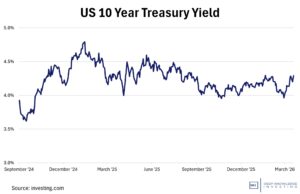
The response from the Fed has been to end quantitative tightening (QT) and to lower the fed funds rate. Congress continues to overspend by trillions as it always does. President Trump and Elon Musk have unfortunately walked away from DOGE without any meaningful levels of cost cutting. The White House is going to announce a highly-dovish shadow Fed Chair to replace Chairman Powell in mid-2026. If Powell doesn’t lower rates sometime between now and soon, we’ll see more rate cuts in the second half of 2026 possibly accompanied by quantitative easing (QE). The government is now throwing tens/hundreds of billions at AI and the nuclear power plants needed to run AI datacenters.
The probability of this outcome is high. In this scenario, the DKI market hedge would perform poorly, portfolio positions in energy and technology would perform very well, and DKI dollar hedges like Bitcoin, gold, and silver do extremely well.
The Party is Over – Prepare for your Hangover:
The market is at all-time nominal highs. Earnings multiples are around dot-com boom levels. Almost all market performance is concentrated in a small number of companies in the same industry with the same AI thesis. Anything that would reduce growth estimates at Nvidia ($NVDA) could take down the entire market. Potential triggering events could include:
- A Chinese Deep-Seek type competitor.
- Competitors like Google (TPU chips) or AMD (GPU chips) taking share.
- China figuring out how to make GPUs that are good enough.
- Someone figuring out that no one has a revenue model designed to earn a return on the hundreds of billions of dollars being competitively spent on AI datacenters and training.
This market is so precarious that just changing the depreciation schedule for Nvidia chips changes the market multiple. Apple ($APPL) is at a $4T valuation with anemic unit growth. Alphabet’s ($GOOG) search business is likely to see pressure from AI offerings where it doesn’t have monopoly share and power. There’s a lot that can go wrong.
We’re currently in scenario 1, but this second scenario has to happen eventually. Nothing grows forever and Nvidia can’t keep doubling revenue every year indefinitely. In this scenario, DKI’s market hedges perform extremely well (and we start to buy put options), stock positions decline, Bitcoin would fall, and stimulus out of DC and the Fed would support gold and silver. DKI’s portfolio would likely outperform the market.
Deleveraging Deflation:
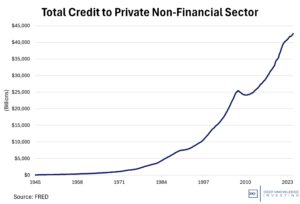
There are some people who think that we’ll have a recession/depression. This would lead to a collapse of consumer spending accompanied by a reduction in credit use. The money supply would decrease and we’d have deflation. I think this logic makes sense and could have happened in another time. I believe the probability of such an event is very low; 1% – 2% because Washington DC would start sending out stimulus checks. The Fed would cut the fed funds rate to zero and engage in trillions of dollars of QE.
The press focuses on our consumer-driven economy despite the fact that consumption and production aren’t the same thing. Our ability to consume more than we produce ends when foreigners stop buying trillions of dollars of Treasuries. I think we won’t see this scenario happen because at the first hint of it, the government will throw so much stimulus at the situation that the dollar declines in value. That’s another way of describing inflation.
The Star Trek Fallacy:
In the Star Trek universe, warp cores and replicators meant that humanity had access to unlimited energy and unlimited material goods. Humanity responded by becoming explorer warrior poets. Adventurers joined a military expedition to “seek out new worlds”. In their spare time, they practiced martial arts, learned to play instruments, wrote poetry, performed classical music for each other, and put on Shakespearean plays. Many are predicting a similar world of unlimited abundance from a combination of nuclear energy, 3D printing (replicators), and AI.
The first problem with this scenario is I don’t trust the people designing artificial intelligence to use it to set us free. The more likely outcome is an attempt to gain greater control of humanity (for our own good of course). Unfortunately, that’s not the biggest problem.
Humanity isn’t designed to handle unlimited leisure well. Look at places where people are freed from the need to work all day to provide themselves with housing, food, and other necessities. It leads to disaster consistently. This is the case both for poor communities with huge amounts of government assistance, and the ultra-wealthy where it’s a challenge to go three generations without disasters. It’s not just money-related idleness that leads to trouble. It’s common for retirees to die surprisingly soon after leaving their jobs.
With just the internet, AI, and TikTok, professors are complaining the college students don’t know how to read a book. They’re in college and have never read one. If we make it all easy, we’ll lose everything. We are meant to work, try, struggle, and do. Life is often hard AND that usually leads to more happiness than long-term easy.
Information contained in this report is believed by Deep Knowledge Investing (“DKI”) to be accurate and/or derived from sources which it believes to be reliable; however, such information is presented without warranty of any kind, whether express or implied and DKI makes no representation as to the completeness, timeliness or accuracy of the information contained therein or with regard to the results to be obtained from its use. The provision of the information contained in the Services shall not be deemed to obligate DKI to provide updated or similar information in the future except to the extent it may be required to do so.
The information we provide is publicly available; our reports are neither an offer nor a solicitation to buy or sell securities. All expressions of opinion are precisely that and are subject to change. DKI, affiliates of DKI or its principal or others associated with DKI may have, take or sell positions in securities of companies about which we write.
Our opinions are not advice that investment in a company’s securities is suitable for any particular investor. Each investor should consult with and rely on his or its own investigation, due diligence and the recommendations of investment professionals whom the investor has engaged for that purpose.
In no event shall DKI be liable for any costs, liabilities, losses, expenses (including, but not limited to, attorneys’ fees), damages of any kind, including direct, indirect, punitive, incidental, special or consequential damages, or for any trading losses arising from or attributable to the use of this report.