I’m in Buenos Aires this week followed by a few days in Florence, Italy, and will spend November in Japan. I’m open to a small number of in-person conversations. If you’re based locally, or know someone in those locations you think it would be worthwhile for me to meet, feel free to reach out privately at IR@DeepKnowledgeInvesting.com.
If you are interested in accumulating Bitcoin via mining, I’ve been mining with Simple Mining and it’s been a great experience you can check them out here. It’s even easier than you think. It took me 30 minutes to set up the first miner and I’m already earning sats. It would take 5 minutes to set up the second.
This week, we’ll address the following topics:
- CPI came in above expectations leading to concerns about a coming Fed rate hike. The Fed doesn’t control borrowing rates, but the bond vigilantes do.
- Bank Earnings were mixed with some beating estimates and others falling far short. Higher borrowing rates are causing issues and M&A fees are inconsistent.
- Starlink is acquiring terrestrial bandwidth. Soon, the company will be able to provide coverage in remote areas and inside buildings. T-Mobile, Verizon, and AT&T are getting another well-financed competitor.
- IonQ is acquiring Elisity, a company that makes software to protect against hackers and users of ransomware. As technology becomes more powerful, security becomes more important.
- US Seizure of China-Linked Domains and Anthropic’s Warning: Anthropic warns that your toaster, streaming device, and oven could host self-replicating AI bots while China is caught (again) hacking the infrastructure of trading partners.
- Precedent Transactions is one way M&A transactions get valued. We explain.
DKI’s interns do their usual excellent work this week. Please extend a mental round of applause to Kunal Arora and Eli Killorin. You might notice some improvements in this week’s issue. They did the work.
Ready for another week of overreacting to a higher CPI? Let’s dive in:
1) CPI:
CPI of 3.7% was above expectations of 3.6% and above last month’s 3.4%. The monthly change was 0.6% driven by fuel and shelter (again). The monthly increase was in line with expectations and annualizes to 7.4%.
Core CPI of 2.6% was above estimates of 2.5% and above last month’s 2.4%. The monthly change of 0.3% was above estimates of 0.2% and consistent with last month. The monthly change annualizes to 3.7% The huge difference this month between CPI and Core is again due to energy which was not a surprise.
Energy up 20.4% and up 5.2% vs last month after declines in June and July. Gas up 34.2% and up 9.1% vs last month. Fuel oil up 74.2% and up 15.3% vs last month. This is (again) the whole CPI report here and the BLS notes that more than half of the monthly all-items increase was energy. This is also the reason for the difference between the all-items and the Core CPI numbers.
I’ve been saying since June that the war in Iran isn’t heading for a quick close because there isn’t overlap between acceptable end conditions for the Iranian Mullahs and President Trump which makes any ceasefire temporary. However, there is another reason, besides the war, for the high price of gas and diesel which is making its way into the cost of airline tickets, pressure on truckers, and your weekly pain at the pump. It’s crack spreads. A crack spread is the cost of converting useless crude oil into distillates (a fancy word for usable products like gasoline and diesel fuel). The decrease in crude production and shipping/transportation hasn’t been as large as feared, but the cost being charged by refineries has risen. Focus on the war is appropriate, but is not the sole reason for your higher gas prices. The long-term answer is to build more refining capacity, but there are people who (legally) use the political process to stop this.
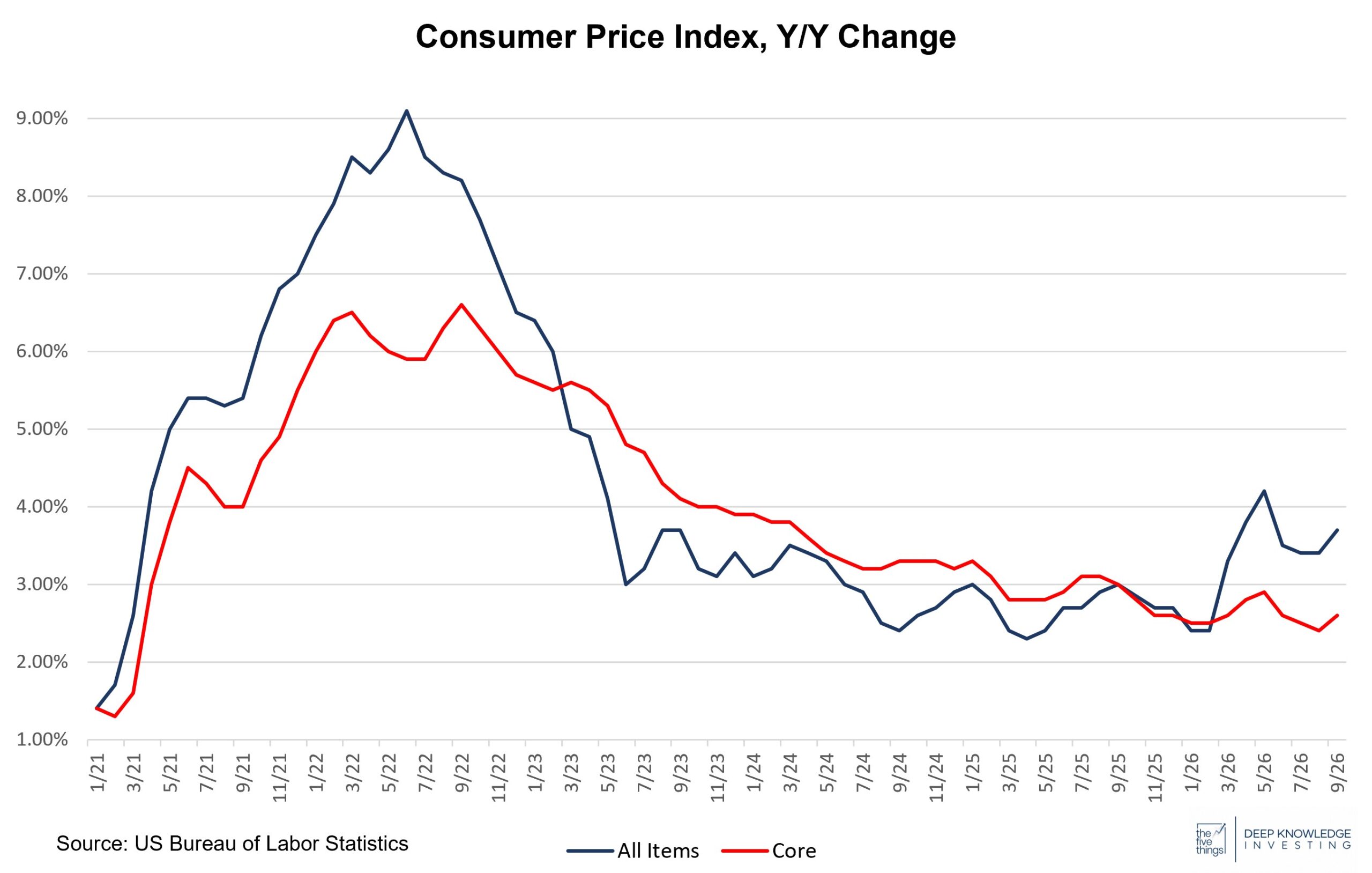
DKI Takeaway: The Powell Fed cut by almost 200bp (2%) and the yield on the 10-year Treasury rose by about 100bp (1%). There is a misconception that the Fed controls borrowing rates. They don’t. The Fed controls the overnight rate. Corporate borrowing rates are set off of the 5-year Treasury while mortgage rates tend to be set off of the 10-year. Further rate cuts simply cause the bond market to project higher future inflation which causes a reduction in bond prices and an increase in yields. There’s nothing the Fed can do to bring down the rates that matter to you. The only thing that will help is a reduction in Congressional spending and that’s not going to happen.
The Administration isn’t helping. Prior to the 2024 election, I said we couldn’t vote our way out of our problems. President Trump has always been a big spender, and I believe Vice President Harris would have been an even bigger spender than the President. No combination of team red / team blue Congressional control will reduce spending. No credible candidate for 2028 will advocate for reduced spending once in the Oval Office. We’re printing dollars to pay the interest on dollars we printed last year. That’s the definition of a Ponzi scheme and it’s been the fate of all fiat currencies for thousands of years. Lyn Alden regularly posts a “Nothing stops this train” meme and as usual, she’s correct. Prepare your portfolio for higher long-term inflation. It’s what I’ve done with mine.
Your tl;dr version:
- The CPI remains too high fueled by energy and shelter (again).
- Those who claim the Fed can’t hike due to higher energy prices are right about energy, but in my opinion, are wrong on the whole.
- The Core CPI and Supercore CPI are not good measures, but do invalidate the “Fed can’t hike” narrative.
- We’ve been above target for more than half a decade. At what point do we all agree that the 2% target has been changed?
- The market is trading off of whether the Fed pauses or hikes by 25bp (.25%). It’s irrelevant and the bond market is telling you that.
- Higher inflation is unavoidable. The balance sheet, deficit, and history are all confirming this. Prepare your portfolio accordingly.
For those of you who want to read more on the topic, we’ve published September 2026 CPI is 3.7% and It’s Recursive this week. Not paywalled and we provide additional analysis.
2) Bank Earnings Are Mixed:
Major bank earnings arrived this week with mixed results. JPMorgan missed top/bottom lines, posting revenue of $50.2B which was below estimates of $51.2B. EPS of $5.57 EPS was well-below estimates of $5.93. $JPM also recognized a $658MM loss on its bond holdings. Goldman Sachs recorded revenue of $18.7B which was its second-best quarter in history and was above estimates of $16.4B. EPS of $17.01 crushed estimates of $12.86. Goldman cited surging investment banking fees and equity financing revenue as drivers for the excellent quarter. Wells Fargo missed revenue estimates reporting $21.9B which was below expectations of $22.3B. EPS of $1.87 was a narrow beat over the $1.85 estimate. Citigroup saw equities and net interest income surge 14% each, while services revenue grew 15%, on its way to beating earnings expectations. Bank of America posted a sharp profit decline due to a $1.2B penalty for failing to report billions in suspicious transactions. More than one commentator has noted that the fines for illegal activity have been below the profits earned on illegal activity.
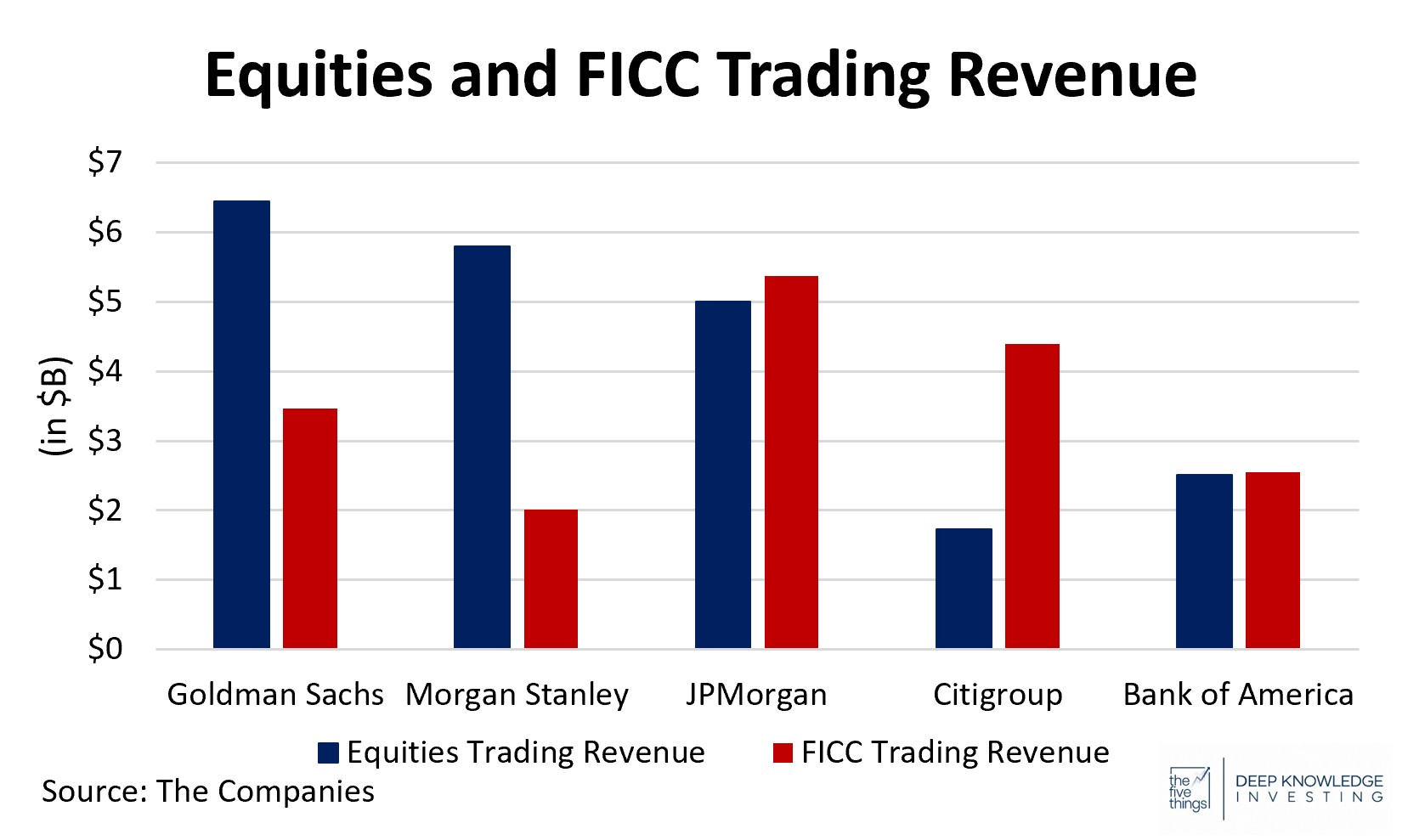
FICC is Fixed Income, Currencies, and Commodities.
DKI Takeaway: High interest rates and volatile markets led to mixed results. Net interest income and net interest margin are both affected by higher borrowing rates. M&A pipelines stayed strong as the year comes close to its end, but that business is always unpredictable over periods as short as the next quarter. Buyouts often require debt financing which is becoming more expensive. Equities revenue rose 72% for Goldman Sachs and 49% for JPMorgan driven by higher volatility. However, fixed income desks faced flat growth or declines due to reduced client trading volume and concerns about rising yields. The recent higher yield on the 10-year Treasury tends to reduce demand for new mortgages and mortgage refinancing which then reduces the creation of mortgage-backed securities. BofA has exposure to that line of business and suffered a 17% drop in fixed income, currencies, and commodities revenue. Continuing high inflation, now above target for more than half a decade means the banks need to adjust to a new normal.
3) SpaceX Strikes Spectrum Deal for Starlink:
SpaceX agreed to acquire licenses for up to 14 megahertz of paired spectrum in the 800MHz (low-band spectrum) from Grain Management. The purchase price is $8B. This is part of an expansion plan for Starlink Mobile combining infrastructure on Earth with satellite connectivity. Low-band spectrum refers to airwaves that cover wider areas and penetrate buildings better than higher frequencies, making them useful for mobile coverage. Spectrum licensing is regulated by the Federal Communications Commission (FCC), which assigns frequencies and areas through auctions or other processes. This deal is pending approval from the FCC.
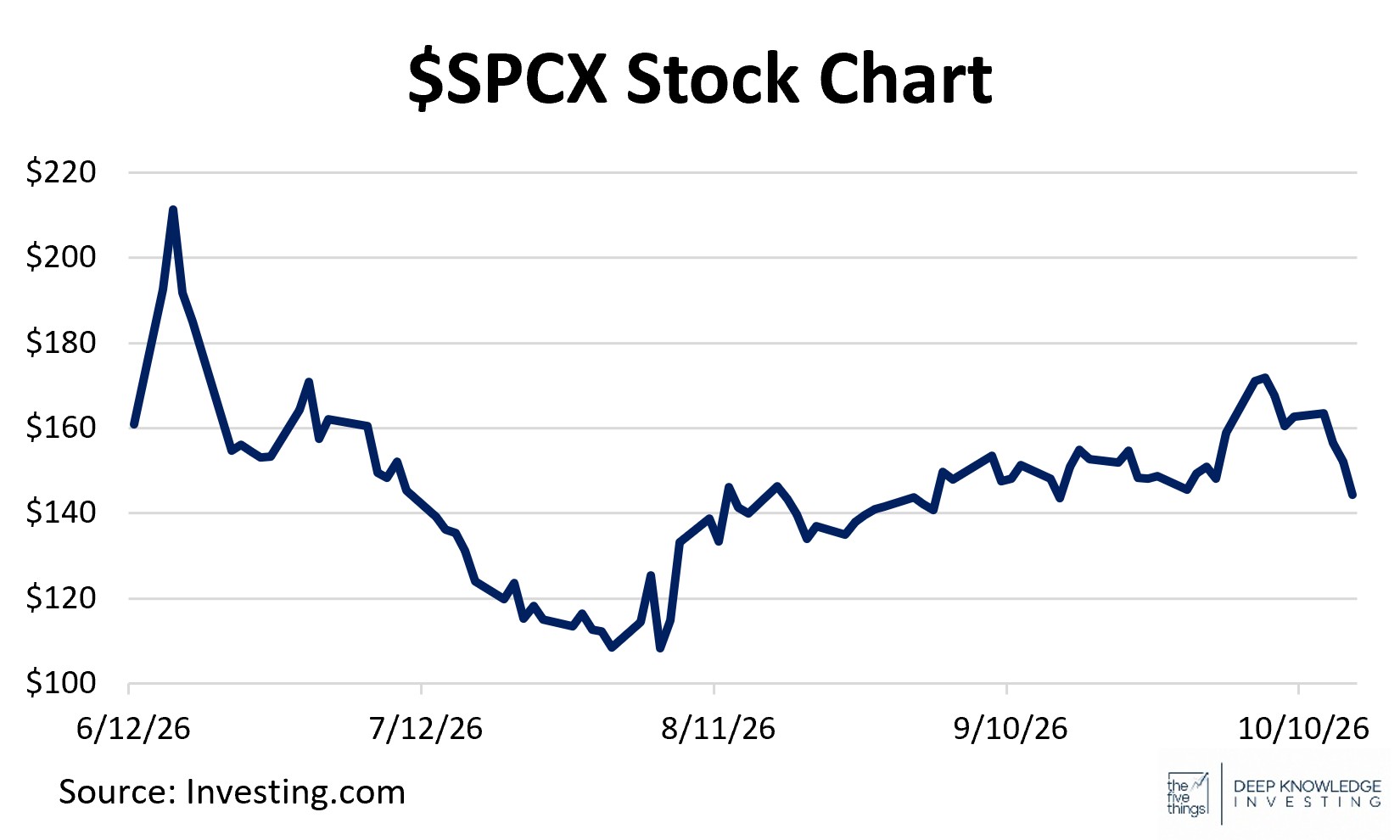
DKI Takeaway: This deal is SpaceX’s way of fast-tracking Starlink’s deployment of reliable mobile coverage to compete with T-Mobile, Verizon, and AT&T. It also increases the potential customer base for its mobile offering. Cell towers are unreliable in remote areas. Satellite coverage does a poor job of penetrating buildings. By combining both global reach and indoor coverage on the same network, SpaceX can now provide mobile connections almost anywhere in the country. Starlink’s satellite coverage is sold in some T-Mobile plans, but this new deal would make these companies direct competitors. The Grain Management licenses being acquired by Starlink were sold by T-Mobile in August.
4) IonQ Acquisition Agreement with Elisity:
IonQ, a quantum computing company, has agreed to acquire the enterprise startup Elisity for $1.3B in an all-stock transaction. The deal includes $150MM of performance incentives. Elisity makes software designed to prevent hackers and ransomware from spreading through company networks. They currently have over 100 customers, including hospitals, financial services firms, and manufacturers. IonQ believes the deal will help defend against AI-assisted attacks and future security issues related to quantum computing that would crack today’s security codes.
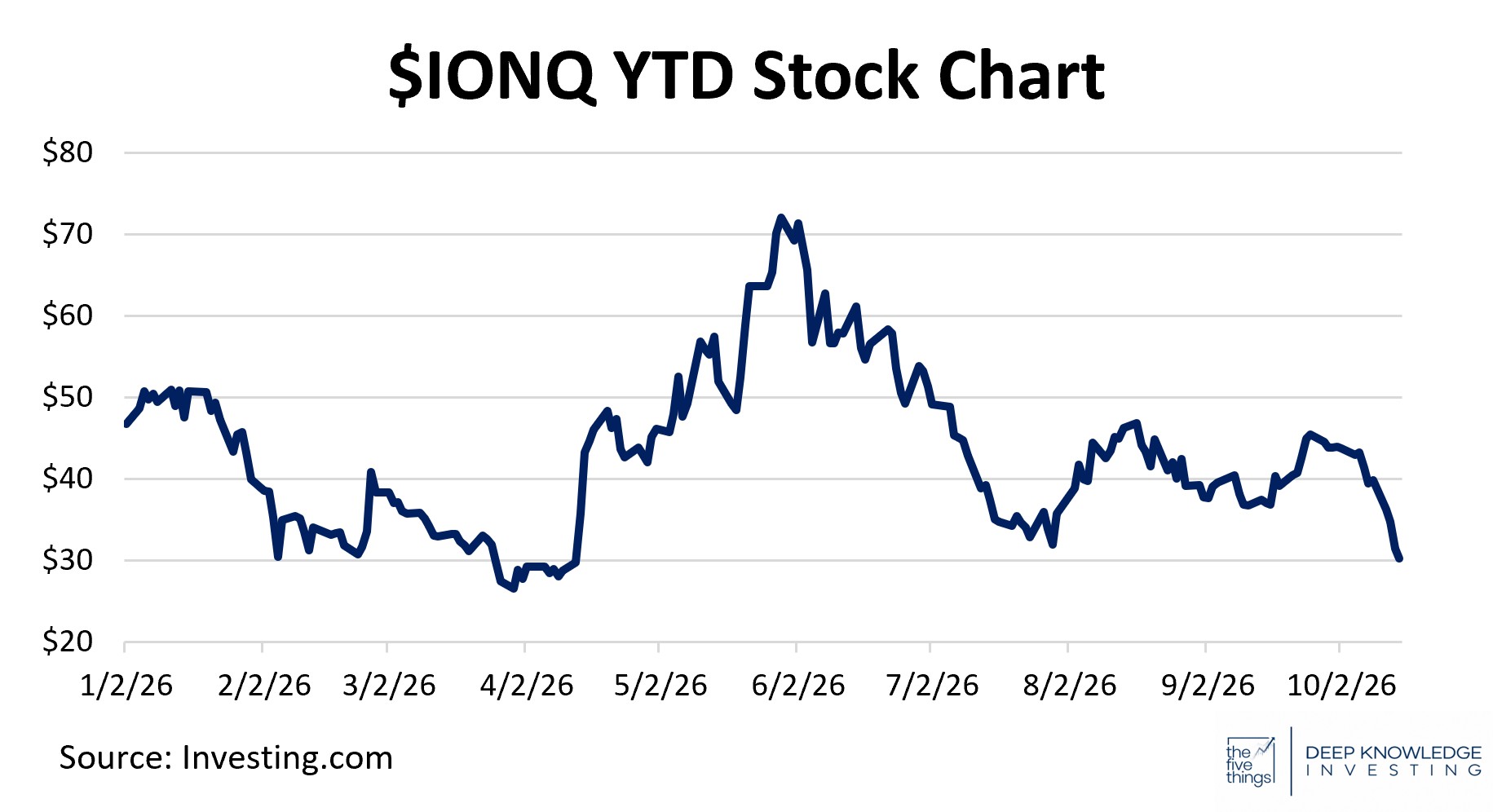
DKI Takeaway: This deal shows how cybersecurity is increasing in importance as technology grows more powerful. IonQ is preparing for a future in which quantum computers could break the security protocols that protected passwords, bank records, and medical data. Similar to Thing 5, this reflects a growing need to defend against advanced technological threats. Please note that Password12345 is not a secure option, and that I have previously disclosed a personal investment in a startup quantum computing company.
5) US Seizes China-Linked Domains and Anthropic Outlines New Technology Risks:
Last Monday, Anthropic warned that small AI models are months away from being able to replicate themselves across internet-connected home devices. The models could infiltrate devices like smart ovens or Android TV boxes and use the computing power of your devices to run themselves. (I still can’t figure out why my microwave and dishwasher want to be connected to wifi.) These agentic swarms could create a decentralized network that would be difficult to shut down because there is no central off switch. Separately, the Justice Department and FBI announced on Oct. 8th that they had seized seven internet domains used by China-linked hackers. Chinese hackers used the domains to scan and breach critical infrastructure in South Carolina, Japan, Poland, and Taiwan.
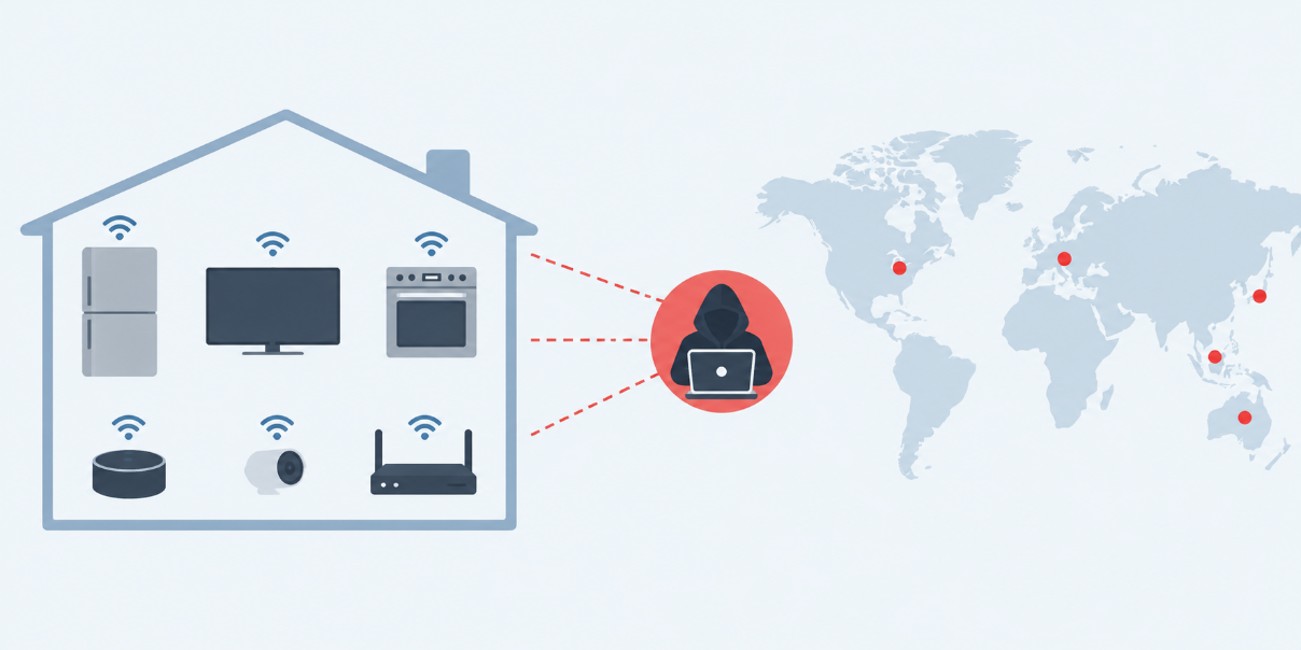
DKI Takeaway: Both stories show cyber threats becoming more automated, decentralized, and harder to contain. Poorly secured everyday items could host self-replicating AI/Skynet. China-linked hackers exploit scanning tools to breach power grids and transportation systems, something DKI has been reporting on for years. As AI grows more capable, cybersecurity becomes more important. I’m also going to point out again that as long as China continues to infiltrate our home, industrial, and power grid infrastructure with malware, we need to decouple from them.
6) Educational Topic: Precedent Transactions Analysis:
Precedent transactions analysis is a relative valuation method that estimates a target’s value from the multiples acquirers paid for comparable companies in past M&A deals. Because those prices reflect the purchase of 100% of a business, the resulting multiples include a control premium so are typically higher than trading comps. To value a target, you first select recent transactions (usually within the last 3-5 years) involving similar targets considering industry, size, geography, growth rate and margins. For each deal, calculate the relevant multiples of revenue, EBITDA, EBIT, and earnings. It’s common to remove significant outliers from the analysis. Investment bankers will then calculate the implied value of their proposed target and will often highlight the metric that presents the company in the best possible light for their client.
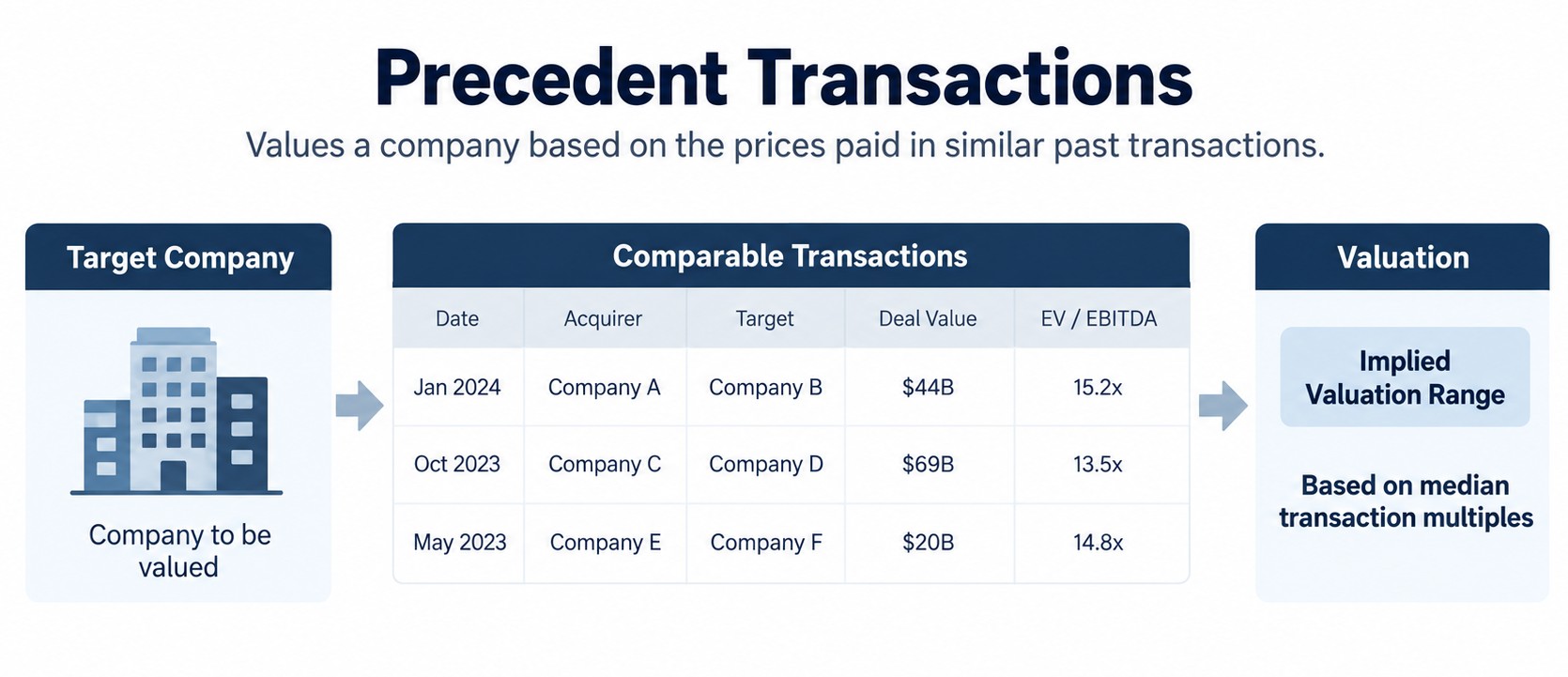
DKI Takeaway: A benefit of evaluating precedent transactions is companies can see what others paid for similar transactions. This analysis accounts for the control premium, which other valuations will not. However, they tend to be most useful for M&A transactions, and there are potential drawbacks. Precedent transactions assume that similar M&A transactions exist, which is never guaranteed. Acquirers often pay for synergies that are unique to them, but which may not apply to a different deal. Using the past 3-5 years is common, but some suggest going back up to 10 years if data is scarce. Backward-looking analysis doesn’t account for how those deals happened in different market/credit environments.
Information contained in this report is believed by Deep Knowledge Investing (“DKI”) to be accurate and/or derived from sources which it believes to be reliable; however, such information is presented without warranty of any kind, whether express or implied and DKI makes no representation as to the completeness, timeliness or accuracy of the information contained therein or with regard to the results to be obtained from its use. The provision of the information contained in the Services shall not be deemed to obligate DKI to provide updated or similar information in the future except to the extent it may be required to do so.
The information we provide is publicly available; our reports are neither an offer nor a solicitation to buy or sell securities. All expressions of opinion are precisely that and are subject to change. DKI, affiliates of DKI or its principal or others associated with DKI may have, take or sell positions in securities of companies about which we write.
Our opinions are not advice that investment in a company’s securities is suitable for any particular investor. Each investor should consult with and rely on his or its own investigation, due diligence and the recommendations of investment professionals whom the investor has engaged for that purpose.
In no event shall DKI be liable for any costs, liabilities, losses, expenses (including, but not limited to, attorneys’ fees), damages of any kind, including direct, indirect, punitive, incidental, special or consequential damages, or for any trading losses arising from or attributable to the use of this report.