Let’s go through why the market indexes have been down during part of the past couple of days and why some DKI positions aren’t currently performing like they’re “supposed” to perform. Right now, everything relates to the bond market. After years of interest rate suppression caused by the Federal Reserve and assisted by the US Treasury, the bond vigilantes have appeared. The most recent 10-year auction went well because the yield was higher than recent auctions. At some price, people will want to buy. A few years ago, I wrote a short eBook called Counter-Intuitive Inflation where I explained that expansion of the money supply caused by Congressional overspending would lead to price inflation. That would lead to higher interest rates which in turn, would lead to higher interest expense. Higher interest expense causes greater spending which is then paid for through more borrowing. Wash, rinse, and repeat a few times and you can see how this leads to a very bad outcome. As wise observers have said: “You can’t unwind a Ponzi scheme”.
As I was writing this, the market recovered. Part of the reason is the CEO of Nvidia gave a vote of confidence to CoreWeave, something I have more commentary on later in this piece. I’m still going to make the points I intended to make because it’s worthwhile to explain why Bitcoin and gold didn’t go up on a higher inflation report.
At the time, people asked me when the debt, interest expense, higher rates problem would occur. I said that I didn’t know, but that like the old saying about going bankrupt these things tend to happen slowly at first and then all of a sudden. I don’t think the dollar collapses into Project Zimbabwe next year, but we’re definitely seeing evidence of stress in the system that’s going to be difficult to reverse. Part of the issue is the Fed no longer has control over borrowing rates. The Powell Fed cut by 175bp (1.75%) and during that time, the yield on the 10-year rose by about 100bp (1.00%). All of that cutting didn’t get inflation under control and just steepened the yield curve. Mortgage rates are priced off of the 10-year which is why I find all of the cries for the Fed to lower mortgage rates to be nonsensical. The Fed is not in control.
The 10-year has/had moved well-above the 5% mark and I’m starting to see commentary about what might happen if/when it hits 6%. On a long timeframe, these are not unusually high numbers, but right now, we are right around 25-year highs. A whole generation has been trained to expect yield repression and that’s getting harder to do as the US adds another $2T – $3T in on-balance sheet debt every year.
For the past few years, almost all of the gains in the stock market have come from a very small number of companies in one industry. The AI buildout has been the most intense use of capital since the dot com boom of the late 1990s. The big hyperscalers have plans to spend about half a trillion dollars in cap-x. I’ve suggested many times that as of now, no one has a business model to earn a return on the hundreds of billions of dollars each company in the space is spending.
No company has benefitted more from AI investment than Nvidia. It’s an incredible company with best-in-class products, but they’re “investing” a lot in their customers with the stated intention that the invested cash be used to purchase Nvidia products. Squint and it looks a little like they’re buying their own revenue. They may be stuck when it comes to “customer” CoreWeave. CoreWeave has spent a fortune on Nvidia GPUs intending to rent them out by the hour over a multi-year period. If they get the depreciation schedule wrong, and the rental price of the GPUs falls faster than expected or can’t earn a return after data center infrastructure and electricity, CoreWeave is in trouble. Nvidia has been buying their stock and providing financing. At some point, they may need to provide more support or let the company fail. Either would be a disaster for Nvidia. CEO, Jensen Huang, provided verbal support to CoreWeave yesterday and the market believed him…for now.
I’ve also written about the possibility of OpenAI taking down the entire market on its own. The company had committed to $1.4T of spending. That then got cut to $600B which is a huge reduction, but even then, where are they going to get more than half a trillion dollars? It’s not going to come from operating cash flow. I think there’s a reasonable possibility the company either goes bankrupt or that it gets bailed out by the government. Earlier this week, I had an expert call with someone who’s spent decades in the semiconductor industry and has an incredible background in AI. Without any prompting from me, he said he thought the probability that OpenAI goes under is 40%. That’s a 40% probability of this entire capital intensive and market-overweight in equity indexes industry getting very uncomfortable for investors.
Now imagine what an OpenAI failure does to Oracle which is already spending money building data centers. Imagine what that would do to Nvidia which would get re-rated with a lower growth rate. The multiples for the entire tech sector would come down. Stated more simply, the entire stock market is leveraged to high valuations and trillions of dollars of invested capital with no idea of how they’ll earn a return. Even worse, the model is going to have to be some version of buying expensive capacity and selling tokens. But every new model comes with reduced token prices. Imagine spending billions of dollars building a luxury hotel and the rates you can charge for your room decline every few months. That’s what’s happening right now in the AI industry. Companies can’t get off the spending treadmill because their previously invested hundreds of billions of dollars will be worthless in months as competing models surpass them.
The AI trade only goes on while the market supplies these companies with unlimited amounts of capital. That’s why people are so concerned about bond yields. As borrowing costs rise, there’s more worry that the AI developers and hyperscalers will have to start paying more to access the money they need to build the next model or data center. The valuations are based on earning hoped-for massive returns years in the future. When those future expected cash flows get discounted back at a higher rate, the valuations of those companies get reduced by more than they do for companies where the cash flows are less back end loaded.
Your tl;dr version: The more of a company’s value is far in the future, the more affected that valuation is by changes in interest rates.
That’s a detailed description of how government overspending leads to higher bond yields and how those higher bond yields lead to lower equity indexes. Let’s get to gold and Bitcoin. One of the key reasons I own those assets is because money creation caused by governmental overspending (the correct definition of inflation) leads to dollar debasement. That’s just a fancy finance way of saying your dollar won’t purchase as much today as it did a year ago, and that prices are constantly rising. As the dollar loses purchasing power, it takes more of those dollars to buy harder assets which is why the dollar price of gold and Bitcoin tend to rise over time (while also displaying more volatility than fiat).
If the above is too long or too confusing, your tl;dr version is more inflation means higher long-term prices for Bitcoin and gold.
The dollar does have one thing in its favor; yield. If you own gold, it sits in a vault and earns nothing. A Bitcoin sits in your cold storage (hopefully) and earns nothing. If you buy Treasuries, your dollar will earn a return of additional dollars. At maturity, you’ll have more dollars although you might not have more purchasing power. This means that when interest rates are low, the holder of zero-yield assets like gold and Bitcoin take only a small penalty by forgoing the interest they could earn by holding dollars. When interest rates rise, there is a greater relative penalty to holding zero-yield assets.
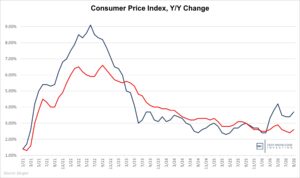
This explains Wednesday’s market action. The consumer price index (CPI) rose from last month and came in above expectations. This led people to believe that bond yields would rise. Some believe an increase in borrowing rates would be a function of Fed tightening. I believe it would be because bond holders begin to price in expectations for higher long-term inflation. The result was we saw equity indexes fall along with decreases in the prices of gold and Bitcoin.
The aspect of this that can be confusing and frustrating is the dual nature of inflation on the price of hard assets. In the long-run, the price of gold and Bitcoin should rise as the purchasing power of the dollar declines (the popular definition of inflation). But if inflation leads to higher bond yields and higher bond yields lead to lower prices for hard assets, then we have conflicting forces. I think the answer is in short-term trading, the change in bond yields has the larger impact on the prices of gold and Bitcoin. For long-term investing, the expansion of the money supply (inflation) will lead to higher zero-yield asset prices.
That’s a lot and this is a complicated topic. Feel free to send any questions to IR@DeepKnowledgeInvesting.com
Information contained in this report is believed by Deep Knowledge Investing (“DKI”) to be accurate and/or derived from sources which it believes to be reliable; however, such information is presented without warranty of any kind, whether express or implied and DKI makes no representation as to the completeness, timeliness or accuracy of the information contained therein or with regard to the results to be obtained from its use. The provision of the information contained in the Services shall not be deemed to obligate DKI to provide updated or similar information in the future except to the extent it may be required to do so.
The information we provide is publicly available; our reports are neither an offer nor a solicitation to buy or sell securities. All expressions of opinion are precisely that and are subject to change. DKI, affiliates of DKI or its principal or others associated with DKI may have, take or sell positions in securities of companies about which we write.
Our opinions are not advice that investment in a company’s securities is suitable for any particular investor. Each investor should consult with and rely on his or its own investigation, due diligence and the recommendations of investment professionals whom the investor has engaged for that purpose.
In no event shall DKI be liable for any costs, liabilities, losses, expenses (including, but not limited to, attorneys’ fees), damages of any kind, including direct, indirect, punitive, incidental, special or consequential damages, or for any trading losses arising from or attributable to the use of this report.