Forward:
Most DKI interns arrive with a clear understanding of macroeconomics and a justified suspicion of the failing fiat system. Even in that exceptional group, Alex Petrou stood apart. He was an early Bitcoiner and his pointed, polite, and reasonable questions of officials from the Bank of England have left them uncomfortable and unable to provide a response. I am pleased to co-author this piece with him. His knowledge of the history of Bitcoin in El Salvador exceeds my own and the section discussing that topic in this white paper reflects his work.
Introduction:
Almost two decades after its creation, there are still debates regarding the true nature of Bitcoin. Some claim it’s not a store of value while admitting that there is nothing on the planet that meets their definition of that term. Others claim it’s a Ponzi scheme, but that makes no sense as a Ponzi scheme relies on using cash collected from later investors to pay early investors. I suspect when people say “Ponzi scheme” they really mean Bitcoin investors are relying on the greater fool theory and expecting deluded future investors to bail them out at ever-higher prices. Many of these people also think bond and equity valuations are sensible despite the fact that those often represent an expansion of the money supply as opposed to real value creation. Some insist that Bitcoin is nothing and backed by nothing while ignoring that fiat currencies have an unbroken multi-thousand-year history of being debased into oblivion. The US dollar is backed by faith and the credit of a government with more than $40 trillion of debt and more than $200 trillion of off-balance sheet liabilities. They think Bitcoin is a fraud while keeping their money in a currency that needs the creation of a quarter of a quadrillion units to meet its obligations.
To me, the most interesting question is whether Bitcoin qualifies as a currency or not. Some claim it’s a commodity based on government regulations. Others advance convoluted and complicated definitions. For the purposes of this article, I’m going to define a currency as something we can use to pay for goods and services directly. The dollar, the yen, and the euro all qualify as currencies. Your grandmother’s fine china doesn’t because it has to be sold and converted into a currency to have usable value. Gold is definitely money, but isn’t a good currency as its value per usable unit is very high and you almost always have to convert it to fiat to use it. Somehow, the measure of a currency in these debates always comes down to “can you use it to buy a coffee”. It’s become a funny cliché, but I also think it’s a meaningful one because it asks the question, “can we use this asset to make a common daily purchase”.
I’m going to relay to you my personal experiences in El Salvador using Bitcoin as a currency. We’ll cover the benefits and drawbacks. I’ll give my opinion on who benefits the most from Bitcoin usage and who pays the highest relative price for it. Finally, I’ll walk you through my experiences with different apps and why I chose one in particular.
El Salvador’s Bitcoin Journey (by Alex Petrou):
Although many date the beginning of El Salvador’s relationship with Bitcoin to the election of President Nayib Bukele, who transformed the digital asset into a national project in an official announcement at the Bitcoin 2021 conference in Miami, the country’s adoption of Bitcoin actually began much earlier, in the coastal village of El Zonte.
An initiative that became known as Bitcoin Beach began experimenting with Bitcoin as a medium of exchange, with local businesses and residents using the cryptocurrency for everyday transactions. What began as a small, grassroots experiment would eventually become the template for the entire country.
Bukele himself did not campaign for the presidency in 2019 on a promise to make Bitcoin legal tender. His interest in Bitcoin did predate his presidency, and his government became receptive to the industry.
Just days after the Bitcoin conference in June, 2021, El Salvador’s Congress approved the Bitcoin Law with a vote of 62 to 19. Ninety days later, Bitcoin became legal tender alongside the US dollar, officially making El Salvador the first country in the world to give Bitcoin such status.
Concurrently, the government launched Chivo, its own Bitcoin and dollar wallet. This was intended to encourage adoption, with every Salvadoran who registered receiving $30 worth of Bitcoin. Bukele presented the policy as a way to increase financial inclusion, reduce the cost of remittances, and attract investment. This wasn’t a “car salesman’s pitch” to impose libertarian money on the populace. Remittances are crucial for the country as money sent home by Salvadorans abroad represented a quarter of the country’s GDP.
As with many new technologies, the rollout of Bitcoin in El Salvador contained controversy. Chivo suffered technical problems on launch day, and thousands of Salvadorans protested against the Bitcoin Law. Although the initial adoption numbers appeared impressive, the $30 incentive was a major driver of this uptake, with more than 60% of early users abandoning the app after spending their free Bitcoin, while only around 20% of adults continued using the application.
Bukele continued to embrace Bitcoin as a national asset. In November 2022, during the depths of the crypto bear market, he announced that El Salvador would begin buying one Bitcoin every day. The policy transformed Bitcoin from an alternative payment system into a sovereign treasury asset.
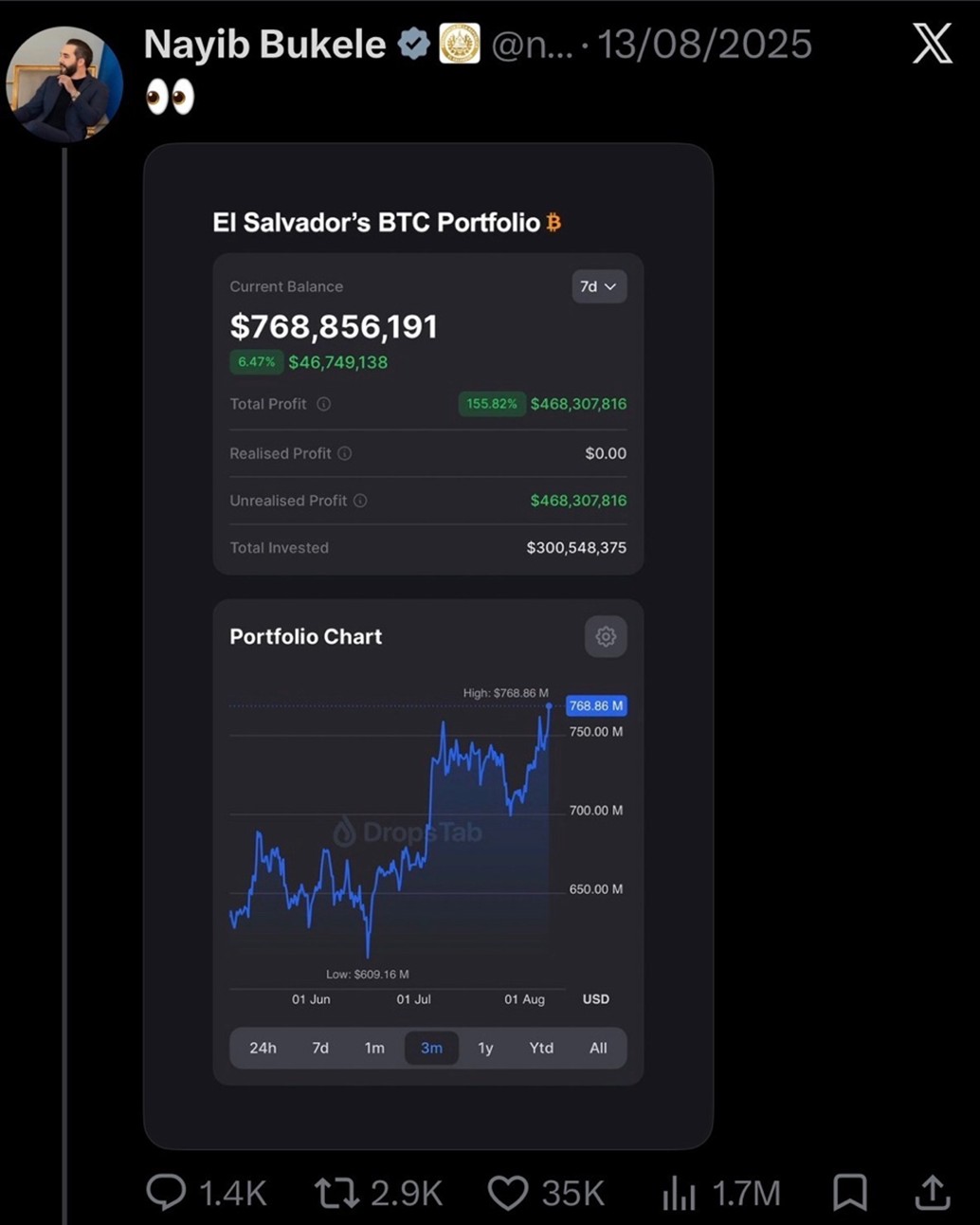
And the results speak for themselves…
The President’s rhetoric increasingly went beyond the practical benefits of cheaper remittances and financial inclusion and into a fundamental criticism of fiat money itself. At CPAC in 2024, he correctly proclaimed that the US government was financed through money creation, declaring: “You finance the government by printing money out of thin air.” He then posed the question: “If the government can print unlimited amounts of money out of thin air, why do they collect taxes?” His answer was that taxation served to maintain “the illusion that you are funding the government, which you are not.”
This whole experiment was on a collision course with the International Monetary Fund (IMF or the fiat Mafia). By 2024, El Salvador’s public debt had reached 88% of GDP, while the country faced billions of dollars in annual financing requirements for both a budget deficit and to refinance maturing debt. With borrowing costs high and its financing needs substantial, El Salvador turned to the IMF. The resulting $1.4 billion program was designed to restore fiscal sustainability while allowing the country to replace expensive borrowing with cheaper, longer-term financing. As with many IMF programs, the money came with strings attached. In return for its support, the IMF secured significant concessions on Bitcoin, most notably making its acceptance by the private sector voluntary and placing tighter constraints on the government’s involvement in Bitcoin-related activities. (Nice country you have there. It would be a shame if something happened to it.)
This didn’t mark the end of El Salvador’s ambitions in digital assets. If anything, the country is becoming a global hub for the broader Bitcoin economy. Perhaps the clearest example is Tether, the company behind USDT, the world’s largest dollar stablecoin. In 2025, Tether relocated its headquarters and subsidiaries to El Salvador after obtaining a local licence, explicitly citing the country’s Bitcoin-friendly regulatory environment and its potential as a hub for financial innovation. The move is particularly significant given Tether’s extraordinary scale, as the company reported more than $10 billion in net profit during 2025, while holding approximately 96,000 Bitcoin and more than $190B in total assets globally.
Five years later, Bitcoin’s trajectory in El Salvador is significant. What began with a small community in El Zonte has survived a spectacular bull market, a brutal crypto winter, scepticism at home, and intervention from the IMF. Bitcoin is still accepted by businesses across the country, while perhaps its most interesting legacy is being built in the classroom. Mi Primer Bitcoin’s programme grew from just 38 students in 2022 to more than 35,000 Salvadorans educated by 2024, with teachers trained to instruct students about Bitcoin, money, inflation, and monetary history.
It will take more than just the IMF to break Bitcoin’s stride across the Central American country.
Is Bitcoin A Currency:
Based on my definition above, Bitcoin is definitely a currency in El Salvador. It can be used just about anywhere in El Zonte and commonly in other locations to purchase goods and services (including coffee). In some cases, it can be better than cash or credit cards as many stores don’t take credit cards for purchases under $5 and won’t make change if you have larger bills. On multiple occasions, I haven’t been able to buy a bottle of water because I only had $10 or $20 bills, and most stores won’t give you that much change. Bitcoin can be used on the lightning network at any restaurant or store. You just scan their QR code and the network confirms the transfer almost instantly. It’s easier and faster than using a credit card.
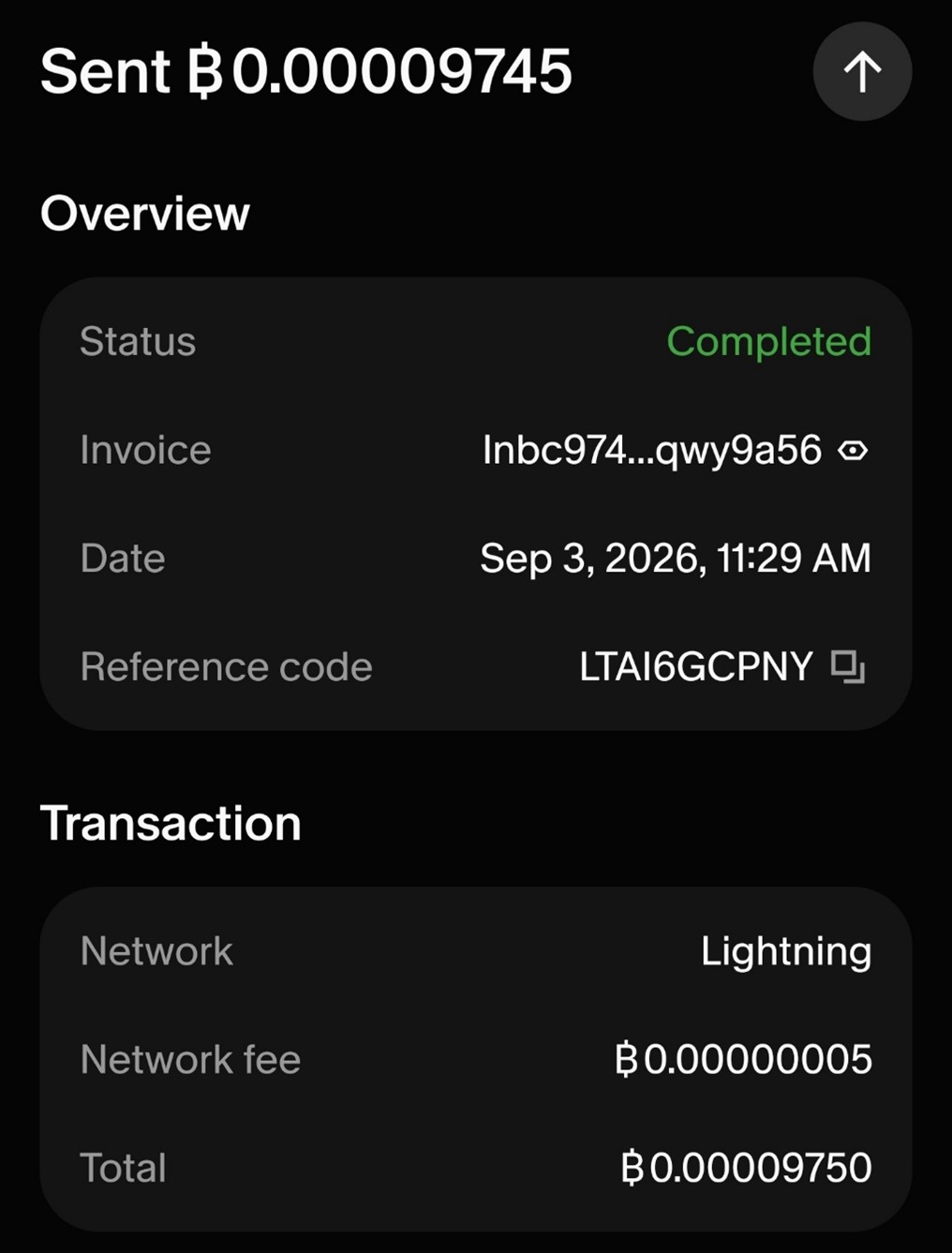
Even faster than a credit card approval. (Screenshot from River.)
El Salvador isn’t really a Bitcoin economy, even in El Zonte La Libertad (Bitcoin Beach). It’s a dollar economy. Prices everywhere are listed in US dollars and both cash and coins are US currency including nickels and dimes. The only currency difference between El Salvador and the US is you’re likely to get dollar coins here, while in the US, any use of coins with a value above one quarter is unusual. Bitcoin acts as a second currency for commerce.
I’ve seen some people claim that Bitcoin isn’t a real currency because prices are almost always in fiat and converted into sats. (A Bitcoin contains 100MM satoshis which are known as “sats”.) They’re correct that even in El Salvador, prices are listed in dollars and converted into sats when you scan the QR code from your lightning wallet app, but I disagree with their conclusion. I travel close to 100% of the time. When we reach July of 2027, I’ll have been away from home for 26 out of the previous 30 months. I’ll have lived in almost 20 countries on 5 continents over that 2 ½ year period. I get paid in dollars, invest in dollars, bank in dollars, and pay my mortgage and taxes in dollars.
However, most of the time, I am charged for goods and services in the currency of another country. I either convert dollars to a different fiat currency and pay in cash, or use my credit card and either American Express or Visa does the conversion for me. Why is it different if I get charged in dollars (or any fiat) and pay in sats at an exchange rate?
A few years ago, I was in Costa Rica where prices are typically listed in Costa Rican colon and sometimes dollars. There was no need to convert dollars to colon at the airport or at an ATM as almost every business was happy to receive dollars. You might get change in dollars or colon. Both physical currencies are used and everyone understands that there’s an accepted exchange rate.
Earlier this year, I was in Cambodia where prices are typically in Cambodian riel and sometimes in dollars. You can pay in dollars, riel, or a combination. The exchange rate is universally agreed to be 4,000 riel per dollar and you might pay or get change in both currencies. If your morning coffee costs 6,000 riel ($1.50), you can pay with one dollar and 2,000 riel. If you give the cashier a $10 bill, you might receive 14,000 riel and a $5 bill in change. The one quirk with using dollars in Cambodia is a dollar needs to be in pristine condition with no bending, tears, or marks on it to be accepted while riel can be in any condition. Everyone agrees on the amount owed, but rejecting each other’s paper currency as too crumpled, marked, or worn is like a sport there. When people rejected my perfectly good dollars as not pretty enough, I gave them a different bill and was sure to reject the bills they gave me in exchange. (While in Rome…)
So, if I go to another country, I pay them in their local fiat while I pay my American Express bill in dollars. In some cases, like Costa Rica and Cambodia, there’s an accepted dollar exchange rate and no need to carry local fiat. In places like Israel, they’re generally happy to accept US cash, and in places like Argentina, they’re thrilled to get dollars which they consider “hard” currency. ATMs in both Cambodia and El Salvador dispense dollars. No matter the local currency situation, prices in that country’s fiat gets converted into dollars when I pay. That conversion exercise doesn’t prevent either the dollar nor the local fiat from being considered a currency. So, if a price is listed in dollars, and I pay using Bitcoin at the current exchange rate, then I’m paying for my purchase using Bitcoin as a currency. An exchange rate doesn’t mean “not currency”.
Should YOU Use Bitcoin as a Currency:
The answer to whether you should use Bitcoin as a currency depends entirely on where you live and your personal financial circumstances. I’ve seen “Bitcoin accepted here” signs in the Philippines, Vietnam, Thailand, Guatemala, and of course, El Salvador. But El Salvador is the only place I’ve seen where Bitcoin is widely accepted. You can use Bitcoin in the US at Burger King and Chipolte, and when buying Miami Dolphin’s tickets. There are places where you can pay your taxes using Bitcoin including Colorado. For most of us, it can be fun to use a Bitcoin app to make a purchase, but you’re going to need traditional banking services in dollars.
Even if you live in El Salvador, the answer still depends on your circumstances. There has been a ton of digital ink spilled over the years regarding the huge fees that banks charge SOME customers. Whether you pay those fees or not depends almost entirely on how much money you have. Many Americans pay to have a checking account, and fees to use an ATM can be enormous. I regularly see ATM fees in the US in the $3 – $5 range, and that can be $8 in foreign countries where you’ll pay an additional huge fee if you make the mistake of accepting the conversion rate offered to you by that foreign bank. I’ve seen fees totaling $15 – $20 on a $100 withdrawal to access “your” money.
Many people pay additional fees to their credit card companies starting with annual charges to have a card. Debit cards deduct funds directly from your checking account and can charge a percentage for that convenience. Both banks and credit card companies charge a wide range of ancillary fees for dealing with overdrafts, sending a wire, or interest for late payments.
Now, let’s take a look at the experience of other people accessing the same banking services and payment networks. For those with greater financial resources, not only is there no fee for a checking account, they will get paid to deposit funds. Accounts of any significant size will receive interest even in a checking account. Annual fees on credit cards are waived as are wire fees for same-day transfers. All ATM fees get refunded including those expensive $8 ones from Guatemala. Credit cards will give customers 1% – 3% cash back on purchases.
Funding a Bitcoin wallet and using it isn’t free. I’ll go through some of those charges in the next section. The point I’m making is whether you’re willing to pay the moderate fees to buy Bitcoin and transfer it to a wallet depends entirely on your situation in the fiat world. If you’re someone who is a source of fees for your bank, then the Bitcoin fees are likely to be small in comparison. For those who are literally paid by their banks and credit card companies to use their services and networks, paying Bitcoin app fees looks like avoidable expense and friction. If you get paid 3% to use your credit card and a Bitcoin app charges you 2%, that’s a 5% difference and a negative incentive. Plus, most Bitcoiners would rather spend continually debased fiat and hodl their Bitcoin as long as possible.
The verdict: Just because Bitcoin can be used as a currency doesn’t mean you’ll want to use it as one.
I want to add one additional important point. If you are willing to spend a few hours learning, you can use Bitcoin to save, invest, pay for things, and to transfer funds almost instantly. You become your own permissionless bank at a time when banks are dangerous. Banks are making a habit of denying services to law-abiding people who express politically incorrect opinions in public. They are denying services to people who engage in the lawful sale of cannabis or firearms. They are making people argue and provide intrusive reasons to access their own cash. I recently received an unpleasant call from Morgan Stanley who wanted to know why I was sending a personal check to a person. The amount was far below the $10,000 reporting requirement. I refused to answer personal questions and my “platinum” service representative warned me that the bank might refuse to send a check which I wanted sent and which I confirmed on the phone call. What happens when “none of your business” becomes insufficient to recover “your” money from a bank?
Some of you might be thinking that you’re not a right-wing politician or commenter and that you don’t buy or sell firearms or cannabis. You might be thinking you have no reason for concern. But the Overton window for “acceptable” opinions and practices shifts wildly, widely, and quickly. Are you sure you’ll always have “acceptable” opinions? Do you want a bank teller or someone in a bank call center to start asking you who you’re sending a check to or to explain to them why you want access to your money? And how sure are you that there won’t be bank bail-ins or nationalizations? Greece did that just last decade.
For those who say bank bail-ins or nationalizations couldn’t happen in the US, it did happen. President Rosevelt made it illegal for US citizens to own gold in 1933 with a penalty of $10,000 and ten years in prison. Once he confiscated everyone’s gold at $20.67 per ounce, he revalued gold to $35.00 per ounce. That means the US government confiscated (stole) 41% of the value of the gold owned by US citizens.
The US government has official debt of $40T plus another $200T of off-balance sheet liabilities like pensions and Social Security. The EU is openly talking about accessing citizen funds on a voluntary basis. No word on what happens when the business recipients chosen by the government fail. Governments in both the US and other countries have previously worked with the banks to access the funds of their citizens. They will again. At the cost of a few hours of educating yourself, you have the ability to use Bitcoin to become your own bank and remove the threat of government control. You don’t have to use Bitcoin as a currency to see there’s a benefit to learning to use it. Alternatively, you could waste hours each year in pointless discussions with Morgan Stanley on whether they want to send the check I instructed them to send. You’re going to spend time dealing with financial issues in the next 12 months. It’s your choice whether that time serves the fiat banking system or allows you to take greater control of your money.
Which Apps to Use:
This section needs to come with an important disclaimer. It reflects my experience and my situation. My plan was to be in El Salvador for 3-4 weeks and I started looking at Bitcoin apps shortly prior to arriving. I also leaned heavily toward apps where I could both buy and use Bitcoin as I didn’t want to recommend a complicated multi-app process for readers. If you were living in El Salvador, or making frequent Bitcoin purchases over a longer time period, your decisions would likely be different and you might consider having multiple apps and multiple wallets. Bitcoin is an open system as opposed to a closed one like Visa or American Express. That means your specific app might not work everywhere. It’s normal for people here to have multiple apps and when one doesn’t work, they quickly transfer sats to a different wallet on a different app and use that one. When it comes to the capabilities of apps I didn’t personally download, I got my information from Grok. I didn’t personally verify it and app capabilities change. Again, I’m relaying my personal experience and this is not intended to be a comprehensive feature comparison for all Bitcoin wallet apps.
Muun, Phoenix, and Blink:
I didn’t use these because Grok told me they can only be used to spend Bitcoin. That means you’d have to buy Bitcoin on another platform and transfer it. if you live in El Salvador, it’s worthwhile to absorb the extra friction. As a short-term visitor and as someone who frequently explains Bitcoin to people who are new to the technology, I didn’t want to complicate things with multiple apps and have to transfer sats. I believe that Blink is widely used here and that it provides Bitcoin purchase functionality in some markets. According to Blink’s own website, that functionality is suspended at the time of this writing. These apps are probably good if you have sats in storage and want to transfer them for use (spending). They are not good options if you’re here for a couple of weeks, don’t want to use multiple apps, and aren’t comfortable transferring Bitcoin.
Strike:
Like Blink, Strike is widely used in El Salvador. I downloaded the app, quickly set up an account, and verified myself. Then, I went to buy sats and saw that there was a 17-day delay to access my funds. I know banks regularly hold funds for 2-3 days to earn extra interest, but 17 days is abusive. I could have avoided this by paying 2% to use a debit card, but was annoyed by the excessive hold time and didn’t want to give them my business. To their credit, a Strike representative responded to my email quickly and explained that if I made regular purchases, they would reduce the hold time. That might be fine if I were living in El Salvador, but wasn’t an option given that my plan was to spend two weeks at El Zonte (Bitcoin Beach). Again, the apps and options that appeal to you depend on your familiarity with Bitcoin, the amount of time you spend in places where Bitcoin can be used as a currency, and your personal financial situation.
Cash App:
This app was recommended to me by Americans who say it’s good for buying and spending Bitcoin. I downloaded the app, set up an account, and got myself verified. This didn’t take a long time to do, but the app has some user interface quirks. Some functionality was in different menus than the main one and due to a misunderstanding, I had to create a second wallet in the same account. It’s not awful, but it’s not easy or intuitive to use. The bigger problem came when I tried to make a Bitcoin purchase.
The app said I needed to verify my email address. I tried to do that four times using two different emails. Nothing worked. I sent a message to customer service and after a few messages, they informed me that I could only initiate a new account and buy Bitcoin from the US. As I was in El Salvador, the app wouldn’t work for either purchases or spending. It was not fooled by setting a VPN to a US server. Customer service suggested trying again when I’m back in the US which won’t happen for another 10 months and would be useless for making Bitcoin purchases in El Salvador. Not a good option!
Coinbase:
I have previously used Coinbase to buy Bitcoin, and then transferred those coins to self-custody. In the past, when I transferred funds to Coinbase and purchased Bitcoin, there was a 7-10 day delay to then transfer those coins out of my Coinbase account. I decided to try using my debit card to make a purchase on Coinbase. This would have cost me a small fee, but allowed me to transfer the new sats to a different wallet immediately. You might notice that this violated my “I don’t want to pay fees and I don’t want to use two apps” guidelines, but after wasting a couple of hours setting up accounts and trouble shooting with customer service at Strike and Cash App, I was willing to pay a couple of dollars as fees to be able to relay the experience of using Bitcoin to make purchases.
My newfound flexibility was not rewarded. For Coinbase to allow me to use my debit card, they had to send 1-2 tiny transactions to test the account. They didn’t do that. I deleted the debit card and re-entered everything. Still no test transaction. I called customer service and got a representative in India who told me to delete the debit card and then try again. He had difficulty understanding that I had done this multiple times. I did it again with him on the phone with the same lack of success. He told me I had to call my bank. I informed him that the bank had access to the same information I had and that calling them was a waste of time. He insisted that was the next step.
I called my bank and they told me what I already knew: There was no tiny transaction from Coinbase. I called customer service again, and got a woman from The Philippines. I told her everything that had happened. She asked me to try deleting the debit card and re-entering it. She then suggested calling my bank. I’m 100% certain that neither of these “customer service” representatives were listening to me and don’t care if they help me solve a problem or not. They just follow a script. Finally, she told me to wait for 24 hours and if there was no transaction, I could try re-entering everything again. So, the plan from Coinbase was to wait 24 hours and then do the same things that didn’t work the previous day. It’s 3 weeks later and I still haven’t seen the Coinbase micro-transaction.
River:
This app was the clear winner. I downloaded River, set up an account, and verified myself with photos of my identification and a live selfie in 12 minutes. I clicked “buy Bitcoin” and bought enough to buy dinner. The transaction was instant and cost me 1.25% including the bid/offer spread. The user interface was by far the best I’ve seen. The one downside was it took a week for my purchased Bitcoin to become usable. Using the app was incredibly easy; click “send”, click “scan a QR”, scan the code, enter the amount you want to spend. The merchant sees the transfer instantly. It’s faster and easier than using a credit card and allows you to enter the amount rather than the merchant. River was the one app with the functionality to buy and spend Bitcoin, with a hold time below 17 days, that actually worked. It had the lowest fees and the best user interface.
Disclosure: River sponsors DKI. My partner code with them is partner.river.com/dki. You might draw the conclusion that I’m biased. When I downloaded the app, set up my account, and purchased Bitcoin, I did that on my own. River did not know who was setting up the account or purchasing Bitcoin, and I did so without any assistance, special treatment, or reduced fees. I have relayed my personal experience with each app accurately. Your experience may vary from mine.
Conclusion:
Your tl;dr version:
- Bitcoin is a currency which can be used to purchase goods and services.
- Your decision to use Bitcoin or fiat depends on your personal financial circumstances.
- El Salvador is a dollar-based economy that has wide Bitcoin acceptance.
- If you’re in El Salvador for less than a few months and not comfortable using multiple apps, I found River to be the best combination of functionality, user interface, fees, and speed.
- Please do not keep your coins on an exchange like Coinbase. You do not own those coins. Learn to self-custody. I’ll be writing more about that in a future article.
Information contained in this report is believed by Deep Knowledge Investing (“DKI”) to be accurate and/or derived from sources which it believes to be reliable; however, such information is presented without warranty of any kind, whether express or implied and DKI makes no representation as to the completeness, timeliness or accuracy of the information contained therein or with regard to the results to be obtained from its use. The provision of the information contained in the Services shall not be deemed to obligate DKI to provide updated or similar information in the future except to the extent it may be required to do so.
The information we provide is publicly available; our reports are neither an offer nor a solicitation to buy or sell securities. All expressions of opinion are precisely that and are subject to change. DKI, affiliates of DKI or its principal or others associated with DKI may have, take or sell positions in securities of companies about which we write.
Our opinions are not advice that investment in a company’s securities is suitable for any particular investor. Each investor should consult with and rely on his or its own investigation, due diligence and the recommendations of investment professionals whom the investor has engaged for that purpose.
In no event shall DKI be liable for any costs, liabilities, losses, expenses (including, but not limited to, attorneys’ fees), damages of any kind, including direct, indirect, punitive, incidental, special or consequential damages, or for any trading losses arising from or attributable to the use of this report.