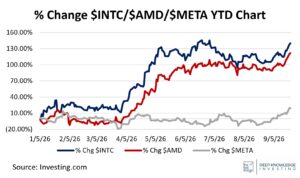
Yesterday, Nvidia $NVDA announced it would develop chips for Meta $META datacenters based on $ARM technology. Some analysts think this is a threat to Intel $INTC and $AMD. That concern is valid. There are a lot of moving parts so let’s go through the details.
1) Intel and AMD produce chips based on the x86 architecture. Many of you use computers with these chips in them and x86 has a near-monopoly on corporate desktops. ARM is a different technology that is more mobile-optimized and tends to have a longer battery life. If you have a Samsung phone, it probably has a Qualcomm $QCOM processor using ARM technology.
2) The downside to the ARM processors is compatibility. A few years ago, some manufacturers like Microsoft $MSFT started making laptops with ARM CPUs. They do have a long battery life, but also have some compatibility issues. The appeal for Meta is simple. Anything that reduces power draw in the ever-hungry AI datacenters is something that would be of interest.
3) In recent years, Intel has made excellent strides in power use with its Core Ultra line. (That’s the chip I have in all of my laptops.) These Core Ultra chips have a mix of E Cores and P Cores. The E Cores are for efficiency and handle basic computations without using much power. The P Cores are for power and can handle more advanced intensive needs, but with a higher power draw. While many laptops with Core Ultra chips claim a 20-25 hour battery life, I can attest that under anything resembling normal use, they don’t get 20 hours. However, the 10 hours they do get is more than sufficient. How often have you needed to use your laptop for more than 10 hours without a chance to recharge?
4) Some of the concern right now is that x86 will start losing share in the datacenter market. While that’s a possibility, the situation is far more complicated.
a. Nvidia is working with Intel to develop combined CPU/GPU chips.
b. Nvidia just invested $5B in Intel and wants a second supplier rather than be completely dependent on Taiwan Semiconductor.
c. Nvidia just sold its ARM stock.
5) Now arguing the other side, Nvidia’s sales of ARM stock totaled $140MM. That’s pocket change for one of the world’s largest companies. Even the $5B investment in Intel is modest for a $4.5T market cap company. Previously, I’ve noted that Nvidia agreed to make that $5B investment at a time when President Trump had just negotiated a large stake in Intel for the US and when Jensen Huang was trying to get the President to let him sell high-end AI accelerators to China. Huang is an astute political player and could have potentially made the investment in Intel to gain favor from President Trump when he wanted something.
6) I’ve been doing extensive research calls in the industry and have been talking to people who have worked in the semiconductor industry (including at Intel) every week. Many of them believe that the AI business will move from training to inference. In training, Nvidia has a massive lead and even if someone were to develop chips as good as the Nvidia ones, they won’t have the CUDA instruction set that has embedded Nvidia in everyone’s datacenters. However, if the market shifts to inference, Nvidia no longer has a lead. In addition, in inference, much of the workload will shift back to CPUs from GPU. So, while some are (reasonably) concerned that x86 could lose share to ARM, it’s also possible that Nvidia GPUs lose share to x86 CPUs.
There are a lot of moving parts here and multiple incentives for the key parties. This is one of the most fascinating investment situations I’ve ever seen. DKI will continue to research and track this. As of now, I’m not making any changes to the DKI portfolio and the team is currently looking at another semiconductor company as a possible long investment. I’ll keep DKI subscribers updated in real time. In the meantime, this is a complicated situation, so you’re welcome to reach out with any questions.
Information contained in this report is believed by Deep Knowledge Investing (“DKI”) to be accurate and/or derived from sources which it believes to be reliable; however, such information is presented without warranty of any kind, whether express or implied and DKI makes no representation as to the completeness, timeliness or accuracy of the information contained therein or with regard to the results to be obtained from its use. The provision of the information contained in the Services shall not be deemed to obligate DKI to provide updated or similar information in the future except to the extent it may be required to do so.
The information we provide is publicly available; our reports are neither an offer nor a solicitation to buy or sell securities. All expressions of opinion are precisely that and are subject to change. DKI, affiliates of DKI or its principal or others associated with DKI may have, take or sell positions in securities of companies about which we write.
Our opinions are not advice that investment in a company’s securities is suitable for any particular investor. Each investor should consult with and rely on his or its own investigation, due diligence and the recommendations of investment professionals whom the investor has engaged for that purpose.
In no event shall DKI be liable for any costs, liabilities, losses, expenses (including, but not limited to, attorneys’ fees), damages of any kind, including direct, indirect, punitive, incidental, special or consequential damages, or for any trading losses arising from or attributable to the use of this report.