The CPI rose again and cracked 4%. Energy is still expensive, but you already knew that. The big issue is Powell never got inflation under control. People panicked that Warsh would cut. He can’t and at this point, there’s nothing the Fed can do (something I’ve been saying for the past two years). Bitcoin has had a rough 2026. I write about the Michael Saylor factor in this week’s 5 Things and link to a blog post where I deal with the issue in greater detail. OpenAI files for an IPO. I’d rather bet on SpaceX and Anthropic. There’s a shortage of RAM (computer memory) so Micron is expanding production. It’s both necessary and a risk. Experienced investors have seen this move before. More detail below. Apple announces improvements to Siri AI powered by not Apple. This is an interesting move from a company that prides itself on home-grown tech. There’s a new quantum computer acquisition. Cue the usual panic that all cryptography will fail. Perhaps it will, but remember that if you bet on the end of the world, it only happens once and you don’t get paid. In this week’s educational topic, we show you why high-growth company valuations fall more when rates rise.
This week, we’ll address the following topics:
- The CPI rose 4.2% for the month. As expected, energy was the big culprit while shelter costs remain high and continue rising. Last year, people were panicked that Warsh would cut. Is anyone worried about that now?
- Let’s talk about what’s going on with Bitcoin. Part of it is Michael Saylor’s fault, but there’s a lot more happening. Some details here – more on the DKI Blog.
- OpenAI files for an IPO. I think the competition from SpaceX and Anthropic are a potential problem for the maker of ChatGPT.
- Faced with a lack of supply, DRAM maker, Micron is shifting production to high bandwidth memory and increasing capacity. Long-time tech investors have seen this film before.
- Apple announces improvements to Siri’s AI capabilities…all while not growing iPhone unit sales and while using AI capabilities developed elsewhere.
- IonQ Acquires SkyWater Technology for $1.8B. Every time there’s a quantum computer breakthrough, the world assumes all cryptography will fail.
- Want to know why high-growth companies see greater stock price decreases when interest rates rise? Read on and we’ll explain in this week’s educational topic.
Some of you may have noticed that this week’s 5 Things has 7 items. Either DKI Interns Kunal Arora and Eli Killorin have difficulty counting or they decided themselves to do extra work and deliver it a day early. I think you know my opinion of their capabilities. How do you think they’re doing?
Ready for a week of panicking because Bitcoin is down in dollars? Let’s dive in:
1) CPI Rises – Surprises No One:
CPI (Consumer Price Index) of 4.2% was in in line with expectations, but represented a big increase over last month’s 3.8%. The monthly change of 0.5% is both high and in line with estimates. (Annualizes to 6.2%.) Core CPI of 2.9% was consistent with expectations off of a high April base. The monthly change of 0.2% was much lower than last month and 0.1% below estimates. The huge difference between CPI and Core is due to energy which was not a surprise.
Food was up 3.1% and a more reasonable 0.2% for the month. I’ve been saying forever that this category has been understated and we’re starting to see larger increases. Note that fertilizer isn’t coming through the Strait of Hormuz and food depends on fuel for tractors and transportation. This is a geopolitical and energy-related increase. I’m still seeing constant posts from waiters that if you don’t want to tip 25% – 30%, you don’t deserve to eat out. Those statements will backfire as people don’t go where they don’t feel welcome and these complaints aren’t persuasive. They’ll get 100% of an empty table.
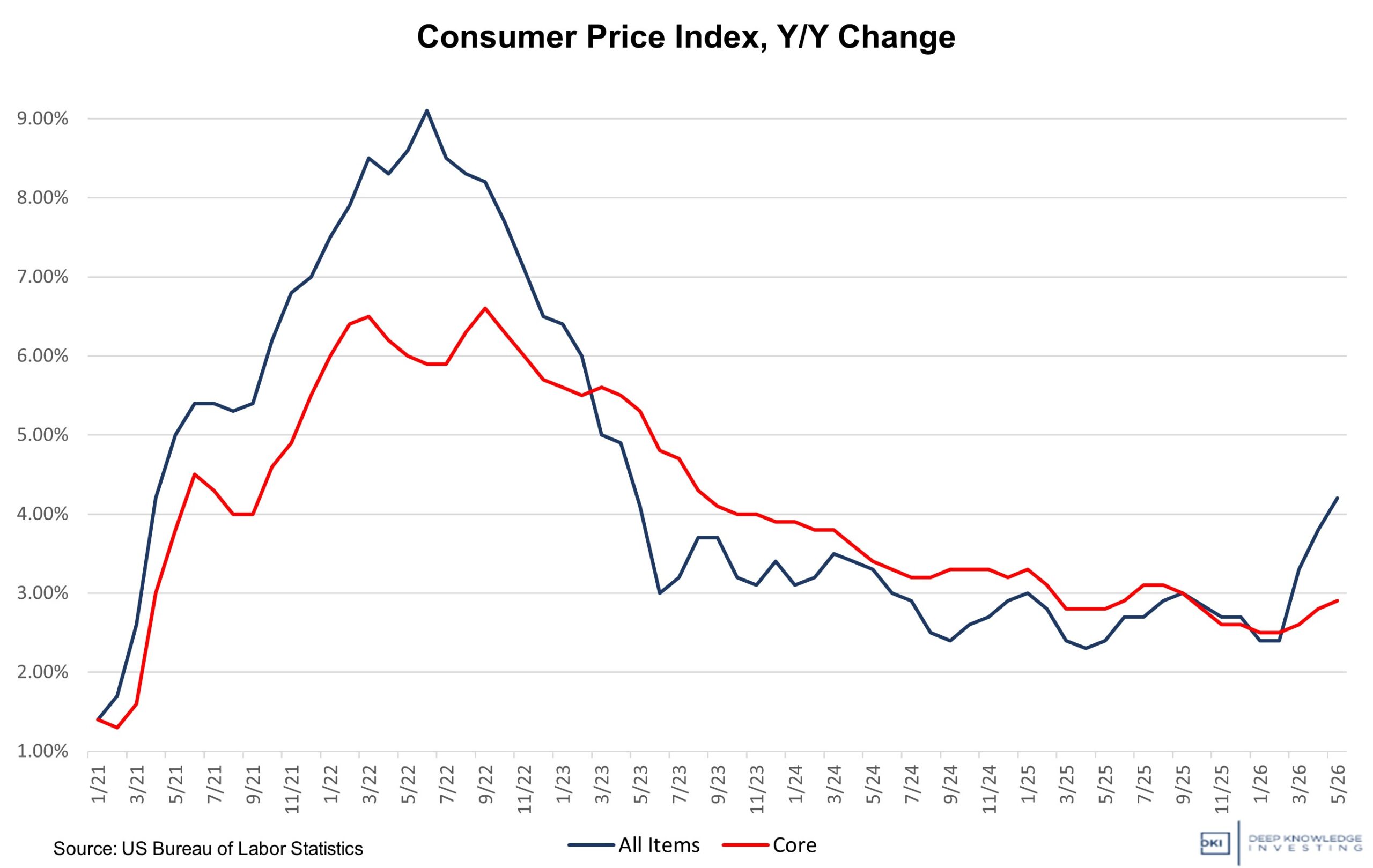
The Powell Fed never had this under control.
DKI Takeaway: energy was up almost 24% and remains the big story accounting for 60% of this month’s CPI increase. Shelter (housing) was up another 3.4% for the month and had energy not been up an attention-grabbing amount, we’d all still be focused on continued high and rising housing costs. Last month, several Fed Governors had a tightening bias. Expect more of them to advocate for a rate increase at the next meeting as we return to “higher for longer”. Much of the increase in the CPI relates to a war-related increase in energy costs. That will take some time to resolve so the Fed may not have the time they want. Either way, no one believes the Warsh Fed is about to cut right now.
2) The Concerns about Bitcoin:
I recently released a blog post explaining what I thought were the key reasons behind the recent decline in the price of Bitcoin. Here’s an excerpt from the Michael Saylor section:
Through Strategy, formerly MicroStrategy, Saylor controls more than 840k Bitcoin which is more than 4% of all Bitcoin currently mined. This week, he sold 32 Bitcoin. While that’s irrelevant based on Strategy’s total holdings, some are alarmed at the change in position from someone who has constantly preached to “never sell your Bitcoin”.
I have a mixed opinion of Saylor. He has been an effective evangelist for Bitcoin as non-fiat digital money. I also appreciate his idea that institutions with enough Bitcoin could act as fully-reserved banks in the future. The negative is that as the public face of Bitcoin for many people, it’s a risk that he’s used increasing leverage to continue buying. Leverage is great when the price rises and dangerous when it falls. He also has a tendency to make up nonsense financial metrics and has tried to convince shareholders that Strategy has provided them with a Bitcoin dividend when he’s simply used leverage to buy more.
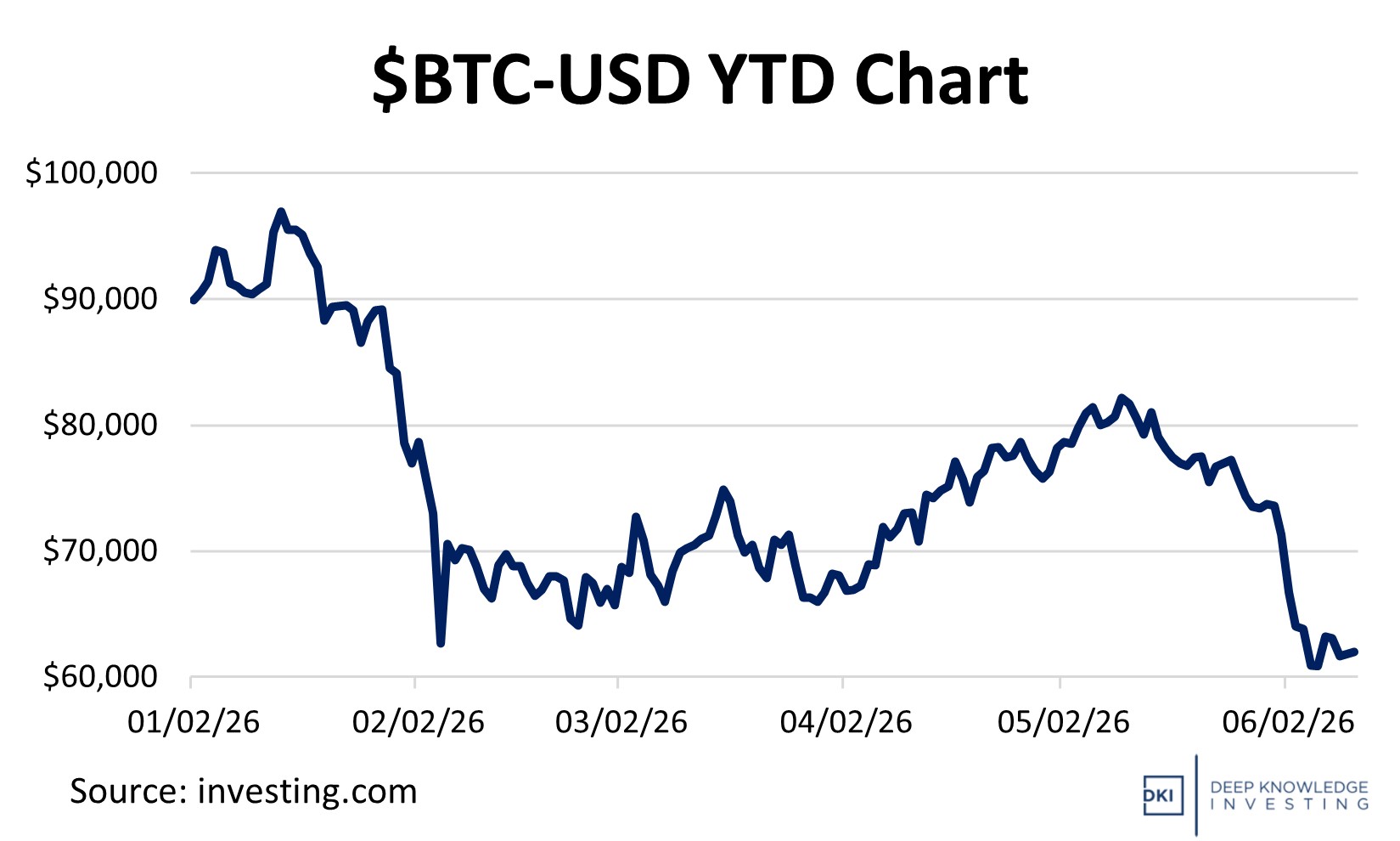
It’s been a rough year in dollars for Bitcoin hodlers.
DKI Takeaway: I think it was a strategic error for Saylor to tell people that he’d never sell, an absolute position he violated, although in a minor way followed by a much larger purchase. He’d have been better off saying he expected to be a net long-term buyer of Bitcoin, but investors should expect that he’d make some strategic timely sales from time to time.
Your tl/dr version: I don’t think Saylor selling 32 Bitcoin matters, but having one person use leverage to control 4% of the total float who is also a public evangelist was always a risk. We’re feeling that right now. For those of you who want to read the rest of the piece, it’s available on the DKI Blog (not paywalled).
3) OpenAI Files for IPO:
OpenAI has filed for an IPO with the SEC, marking the first formal step toward a public listing. Goldman Sachs and Morgan Stanley are leading the offering. The company’s last valuation was $852B, meaning rumors of a targeted $1T IPO valuation are reasonable. Management was careful to temper expectations, cautioning that the filing should not be read as a sign the listing is imminent and that the company has not decided on timing yet. Do any of you think they filed with the SEC with the intention of sitting on the paperwork?
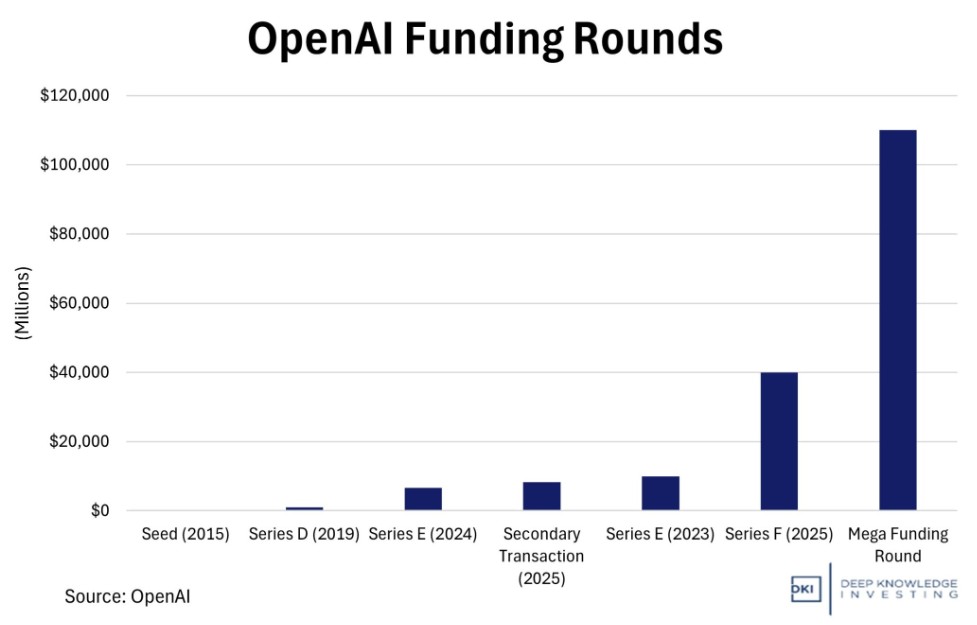
Even at the high-end of discussions, I still don’t think they have enough funding to build and buy what they say they will.
DKI Takeaway: OpenAI’s filing follows SpaceX and Anthropic, with SpaceX already public by the time you read this. A volatile market and tech landscape is about to absorb three of the largest IPOs in history in a matter of weeks. This will test if investor appetite runs deep enough to support all of them and their lofty valuations. It will be interesting to see what assets get sold to make room for almost $4T of equity offerings. Even with a cut in spending plans from $1.4T to “just” $600B, it’s not clear where OpenAI will access that much money.
4) Micron Investing in Capacity Increases to Match Demand:
Micron is operating in a market where demand exceeds what it can produce. The company has changed its cleanroom space to high-margin enterprise-grade HBM (High Bandwidth Memory), which sits at the top of the DRAM (Dynamic Random Access Memory) hierarchy and commands significantly higher average selling prices than traditional memory. That shift leaves conventional DRAM (short-term memory) and NAND (long-term storage) capacity underinvested, even as demand for both remains steady across PC, mobile, and data center markets. Demand from major companies like Google, Meta, and Microsoft has created more demand than Micron can ship. To combat this, Micron is aggressively spending. Capex in 2026 is projected to be above $25B, with new locations in Idaho, a newly acquired site in Taiwan, and a new cleanroom in Singapore.
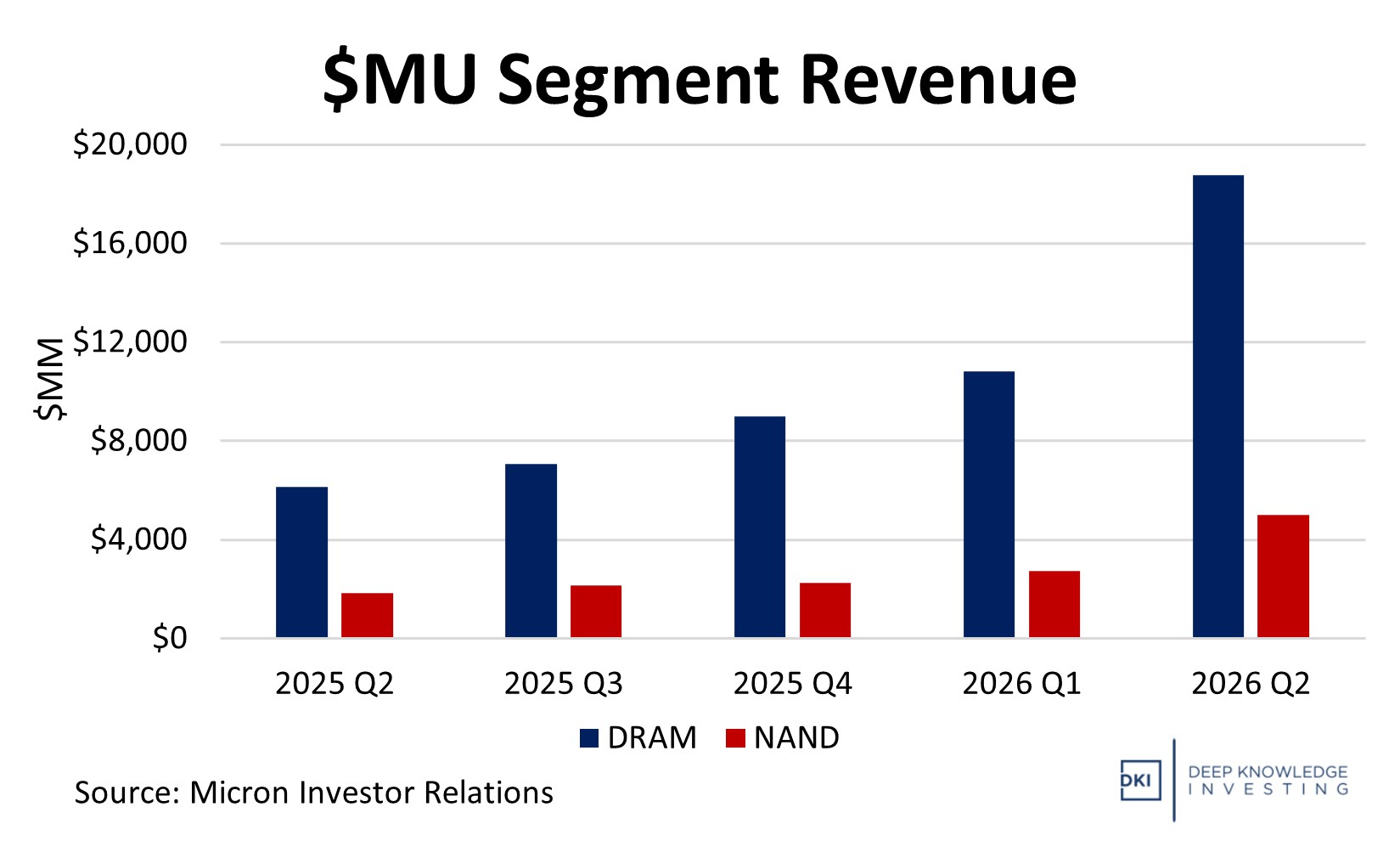
Much of this is related to price increases. All memory producers are at full capacity.
DKI Takeaway: Micron produces 20% of global DRAM behind SK Hynix and Samsung. Hyperscalers are signing long-term supply agreements with all three manufacturers, which means customers can’t route orders to SK Hynix when Micron can’t meet demand. On the investment side, the Taiwan acquisition and the Singapore cleanroom are adding production capacity outside its U.S. footprint which allows Micron to diversify its geography. The setback is that these new locations won’t meaningfully contribute until 2028. So, the industry is responding to higher demand by spending a lot on new capacity. Long-time tech investors have seen this one before. It always ends with lower prices.
5) Apple Unveils Siri AI at WWDC:
Apple kicked off its Worldwide Developers Conference this week outlining changes to iOS, unveiling long-awaited AI updates to Siri from its partnership with Google’s Gemini. The update will provide an assistant grounded in personal context awareness, with Apple claiming that it’ll be able to perform complex tasks across native and third-party apps. Apple also announced other updates to its Liquid Glass interface, Screen Time, and more.
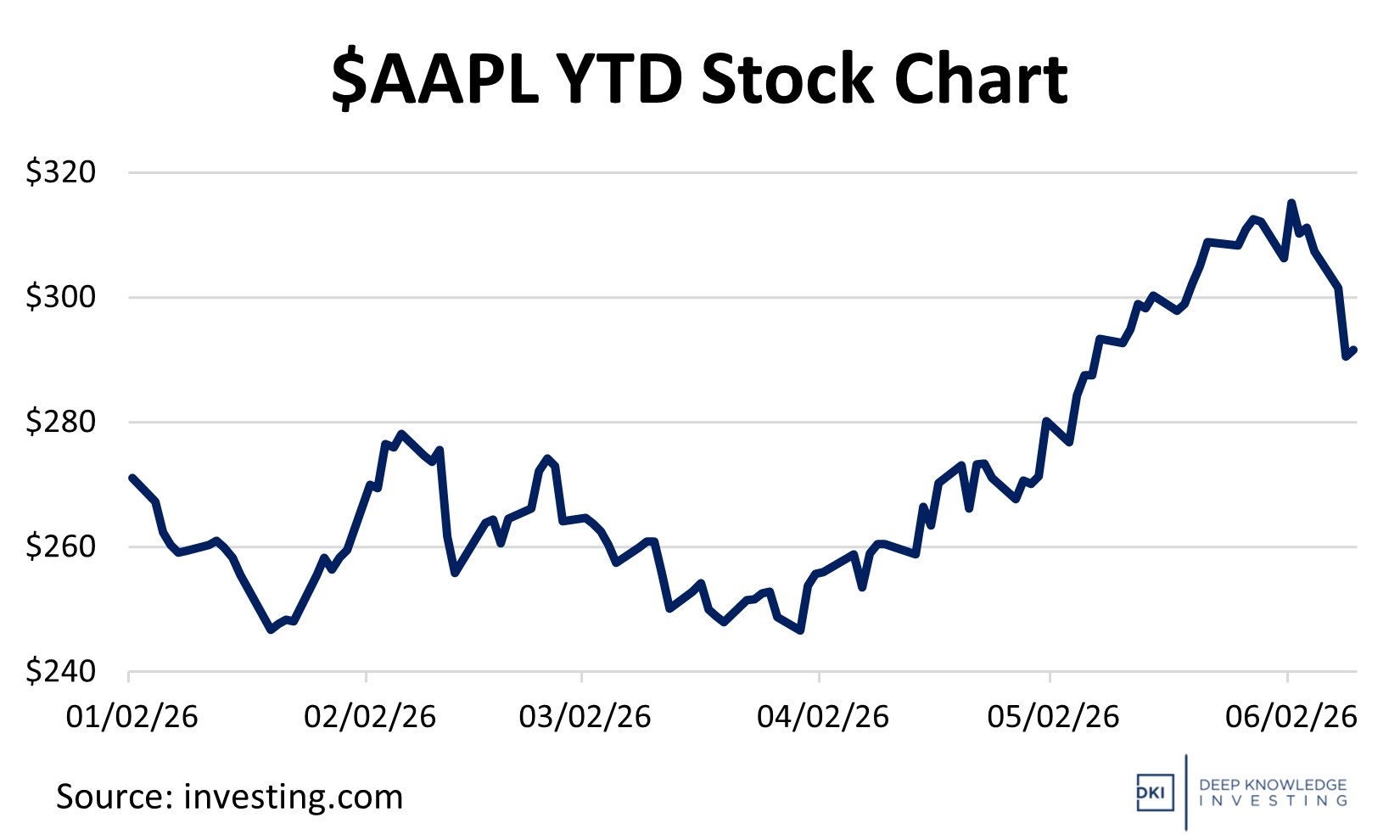
Incredible they’ve been able to do this without growing unit sales.
DKI Takeaway: Investors were underwhelmed by the announcement, with the stock dropping close to 2% after the presentation. After years of lagging in AI development and failing to deliver on promises to improve Siri, markets were expecting more significant improvements. An important note is that the company that built its identity on vertical integration is now outsourcing the AI layer of its most important product to a rival. The longer-term risk is that if Apple’s ecosystem shifts towards AI, Google may be better positioned to benefit as it’s Gemini AI would support an entire ecosystem on billions of Apple products worldwide.
6) IonQ Acquires SkyWater Technology for $1.8B:
IonQ announced an agreement to acquire SkyWater Technology for $1.8B. It positions IonQ as the first vertically integrated quantum platform company. SkyWater will continue as a wholly owned subsidiary under the leadership of current CEO, Thomas Sonderman. The SkyWater name will survive the merger as well. The deal is expected to accelerate the development of IonQ’s 2,000,000 qubit chip architecture by up to one year.
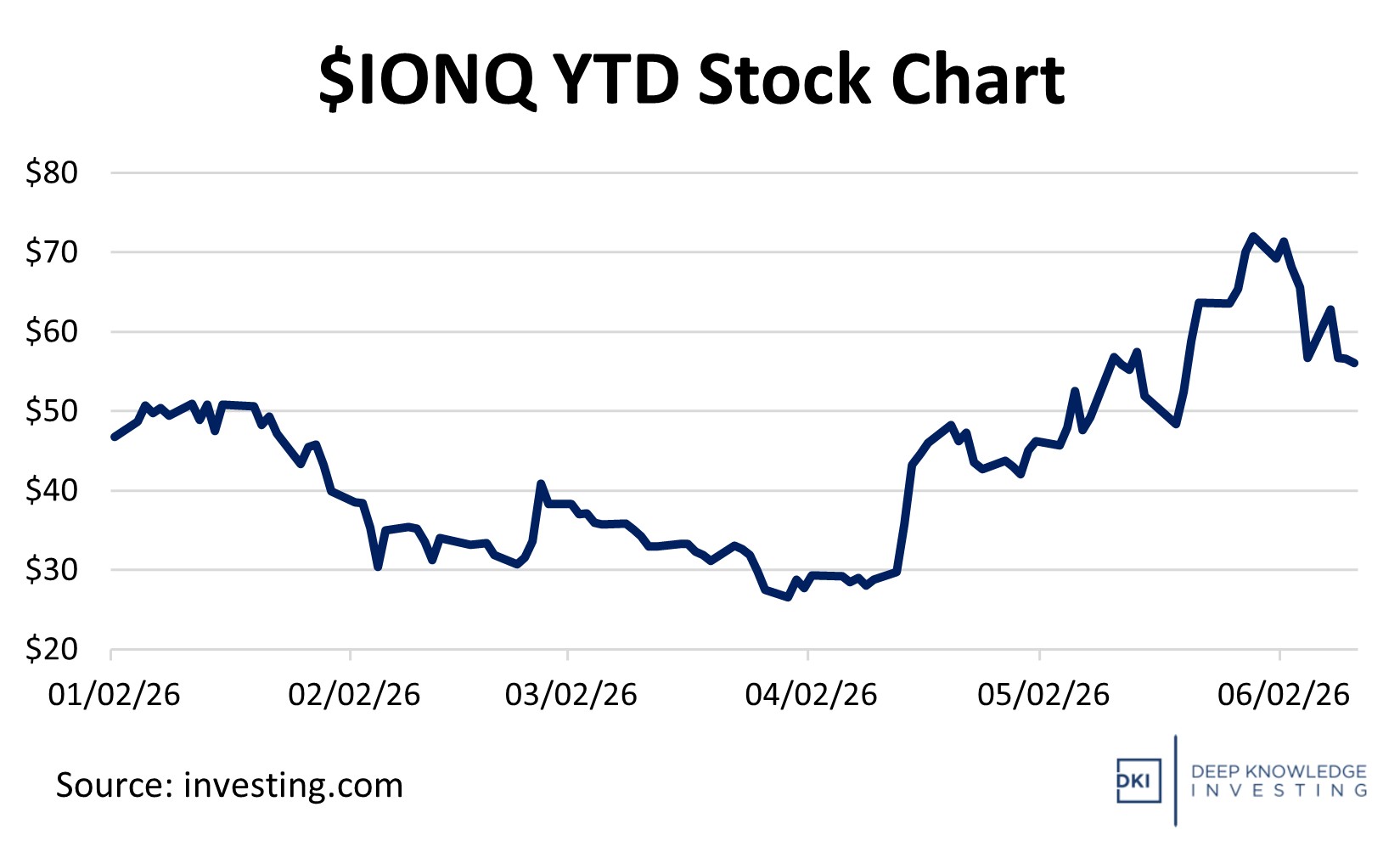
Quantum computing will save mankind or help the next Bond villain.
DKI Takeaway: IonQ has historically been a quantum computing software and hardware company that relied on third-party foundries. Acquiring SkyWater removes a bottleneck in scaling physical qubits. This allows IonQ to work towards a goal of hitting 200K-qubit systems by 2028. The major risk is execution. IonQ acquired 3 companies with a combined value north of $2B and with this current $1.8B acquisition, there is pressure on operating management to make it all work together.
7) Educational Topic: The Effect of Interest Rates on High vs. Low Growth Companies:
Interest rates are set by central banks the bond market. When rates fall, money available for investment is cheap and plentiful including for bad ideas. When inflation runs hot and rates rise, the cost of borrowing becomes more expensive which cools economic activity. These decisions ripple into equity markets by changing the discount rates investors use to value stocks. Higher discount rates affect high growth companies disproportionally. Their value is concentrated in cash flows expected years into the future, so each incremental rate hike means a greater discount for those future cash flows. Low growth companies generate more of their returns in the near term and carry reduced duration risk. This means the same rate change that leaves a minor dent in a mature business can have a major impact on the valuation of a high growth one.
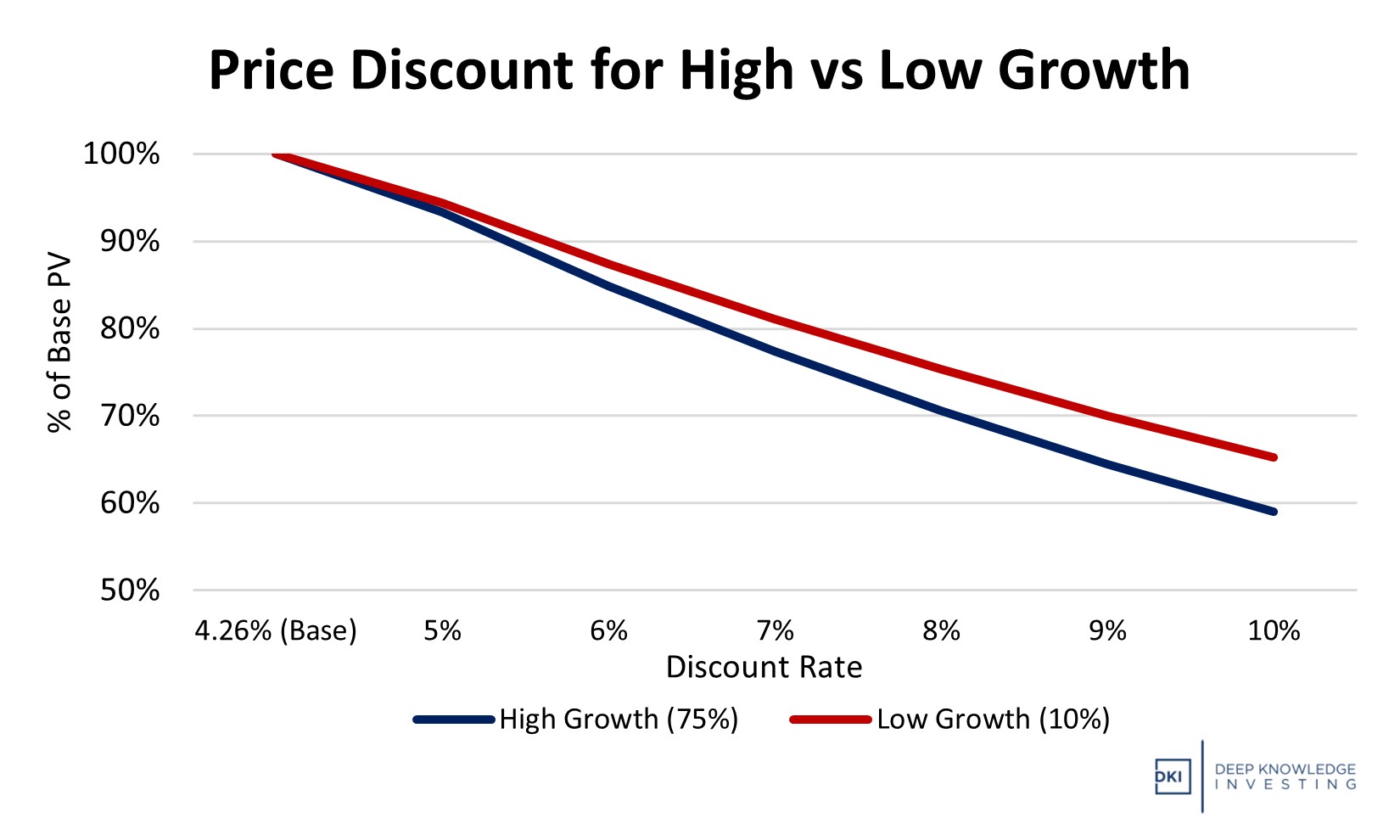
Higher growth companies are more negatively affected by higher interest rates.
DKI Takeaway: Interest rates don’t just impact valuations; but also, the ability for a business to grow. High growth companies are often need to take on debt to fund their growth. Higher interest rates mean it’s more expensive to borrow, leading to higher financing costs which can hinder future growth. While that’s a danger, cheap funding for negative return projects is a danger as well. At DKI, we like investing in high-growth high-quality companies and understand that interest rate and duration risk affect the outcome of those investments. That’s one reason we hedge our portfolio so carefully.
Information contained in this report is believed by Deep Knowledge Investing (“DKI”) to be accurate and/or derived from sources which it believes to be reliable; however, such information is presented without warranty of any kind, whether express or implied and DKI makes no representation as to the completeness, timeliness or accuracy of the information contained therein or with regard to the results to be obtained from its use. The provision of the information contained in the Services shall not be deemed to obligate DKI to provide updated or similar information in the future except to the extent it may be required to do so.
The information we provide is publicly available; our reports are neither an offer nor a solicitation to buy or sell securities. All expressions of opinion are precisely that and are subject to change. DKI, affiliates of DKI or its principal or others associated with DKI may have, take or sell positions in securities of companies about which we write.
Our opinions are not advice that investment in a company’s securities is suitable for any particular investor. Each investor should consult with and rely on his or its own investigation, due diligence and the recommendations of investment professionals whom the investor has engaged for that purpose.
In no event shall DKI be liable for any costs, liabilities, losses, expenses (including, but not limited to, attorneys’ fees), damages of any kind, including direct, indirect, punitive, incidental, special or consequential damages, or for any trading losses arising from or attributable to the use of this report.