I’m in Tokyo for the month of November. Heading to Okinawa for the weekend (Karate Kid 2 fan), but will be on my way back by the time you see this. I’m open to a small number of in-person conversations. If you’re based locally, or know someone in those locations you think it would be worthwhile for me to meet, feel free to reach out privately at IR@DeepKnowledgeInvesting.com.
If you are interested in accumulating Bitcoin via mining, I’ve been mining with Simple Mining and it’s been a great experience you can check them out here. It’s even easier than you think. On Wednesday at 7pm, they’re hosting a webinar titled The Purest AI Trade. I plan to attend. Please check it out for yourself.
This week, we’ll address the following topics:
- OpenAI tried to raise $30B at a $1.4T valuation. So far, they’re at $11B and a $1.25T valuation. The valuation range for the Anthropic IPO has fallen by 40% as well (so far).
- Private Credit Defaults rose to a record high. These assets are sold as safe because they’re “low-vol”. We suggest that just means the assets aren’t regularly valued.
- Tech Earnings were positive with Apple, AMD, and Palantir all beating expectations. The downside is revenue visibility at Palantir is declining and the Apple iPhone Duo has a huge problem with a hinge that leads to the screen cracking.
- Binance Gets Hacked for more than $6B and Bitcoin…shrugs. The asset is maturing and less reactive to these kinds of events. We link to Pomp who covered the topic well.
- A CVS Breakup was announced and the company intends to separate the insurance/pharmacy benefit management division from the retail stores.
- Educational Piece: VIX is a measure of expected volatility and has the nickname “the fear gauge”. Sounds scary. We explain.
DKI’s relentless interns heard I was heading to Okinawa and decided to help me get this issue done before I departed. They were on a call with me Wednesday evening NY time and delivered this week’s first draft at 2am. Credit to Kunal Arora and Eli Killorin for great work and constant effort. Enjoy this week’s issue!
Ready for a week of difficulty funding AI companies? Let’s dive in:
1) OpenAI Funding:
OpenAI fell short of its most recent fundraising goal. The company intended to raise $30B at a $1.4T valuation. Instead, it secured about $11B in commitments by the October 30th deadline. OpenAI then cut its valuation to $1.25T and lowered the fundraising target to $20B. This means the company has locked in just over half of the revised fundraising goal. OpenAI expects to raise more in the coming weeks. The news came after a market selloff as the NASDAQ plunged nearly 4% that Friday partly on concerns of AI funding and valuation issues.
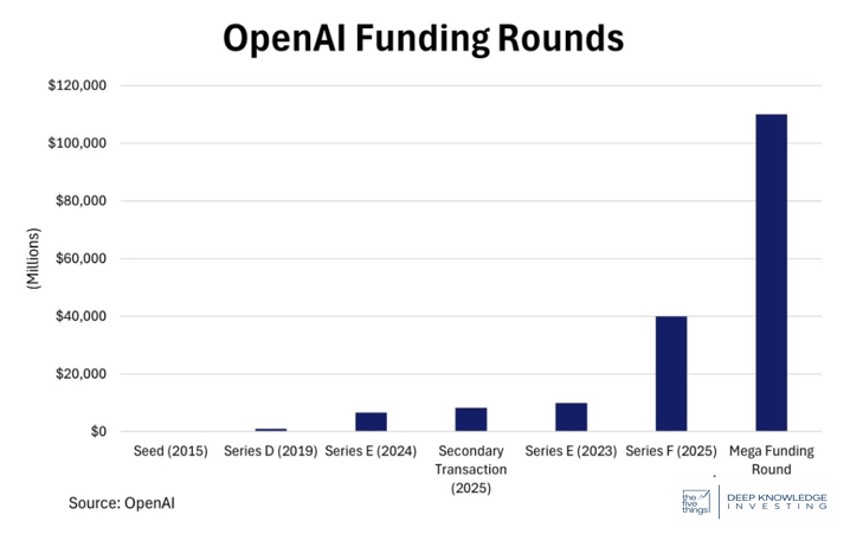
DKI Takeaway: OpenAI’s fundraising shortfall follows a declining valuation range for the Anthropic IPO, and shows that investor appetite for AI mega rounds is cooling. With the company preparing for an IPO, a discounted private valuation round raises questions about public-market demand for more AI-related investments. This scrutiny could also extend to other richly valued AI companies and to associated data center spending. DKI has been saying for two years that the hyperscalers and AI developers have no business plan to earn a return on invested capital. Complicating matters is many Democrats ran for office on opposition to data centers and will take control of Congress in January.
2) Private Credit Defaults Have Hit a Record:
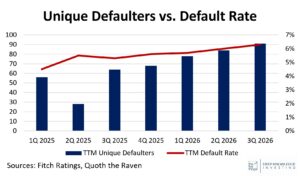
Fitch Ratings’ Private Credit Default Rate rose to a record high in August at 6.3% for the last 12 months. During the period, 89 unique defaulters generated 109 default events. (“Default event” is a fancy finance term for “didn’t pay their bills”.) There were 14 defaults in August alone, the highest of any month in the period. Issuers with less than $25MM in EBITDA recorded a 12.0% default rate. Issuers in the $26MM – $50MM EBITDA range showed the largest increase in defaults going from 3.9% to 5.2% in just one month. Healthcare, industrials, and consumer products led, while software continues to have the lowest default rate amongst the large sectors.
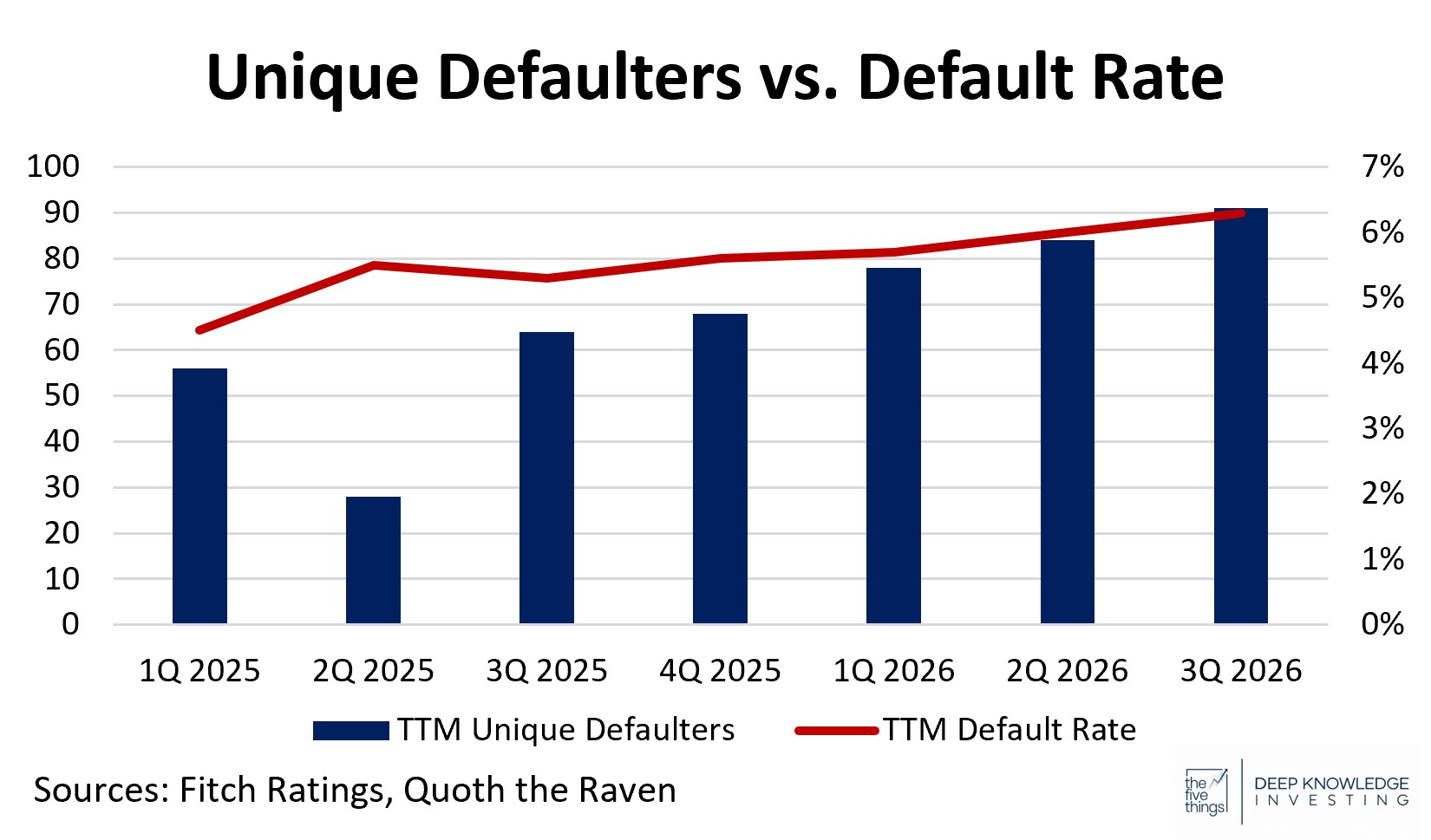
DKI Takeaway: In reality, many of these are “soft” defaults, meaning PIK interest or maturity extensions are increasingly necessary. Companies aren’t going bankrupt because private lenders don’t want to take the write-down. (The expression “extend and pretend” means the loan gets a longer life and the lender pretends the borrower is creditworthy.) Private credit loans are mostly variable rate, so rising rates over the past year have put increasing pressure on these middle-market borrowers. Rising risk premiums have also made it more difficult to refinance debt, which is why companies are choosing to increase the amount owed or to extend the maturity date. Low defaults in software may change with the upcoming debt wall which will test private credit even more. The main worry is how flexible lenders are willing to be and when they’ll start to demand payments instead of allowing extensions.
Private credit is often sold as a desirable product because of its “low volatility”. At DKI, we believe that these financial instruments aren’t actually low vol. It’s just that without a liquid public market, these securities don’t get marked to market regularly. The “feature” that makes people think these assets are safe and uncorrelated actually serves to increase the risk to private investors that their assets are mismarked. Remember, that if you never mark your book to market, your “measured volatility” will be zero.
3) Apple, AMD, and Palantir Earnings Hit Wall Street:
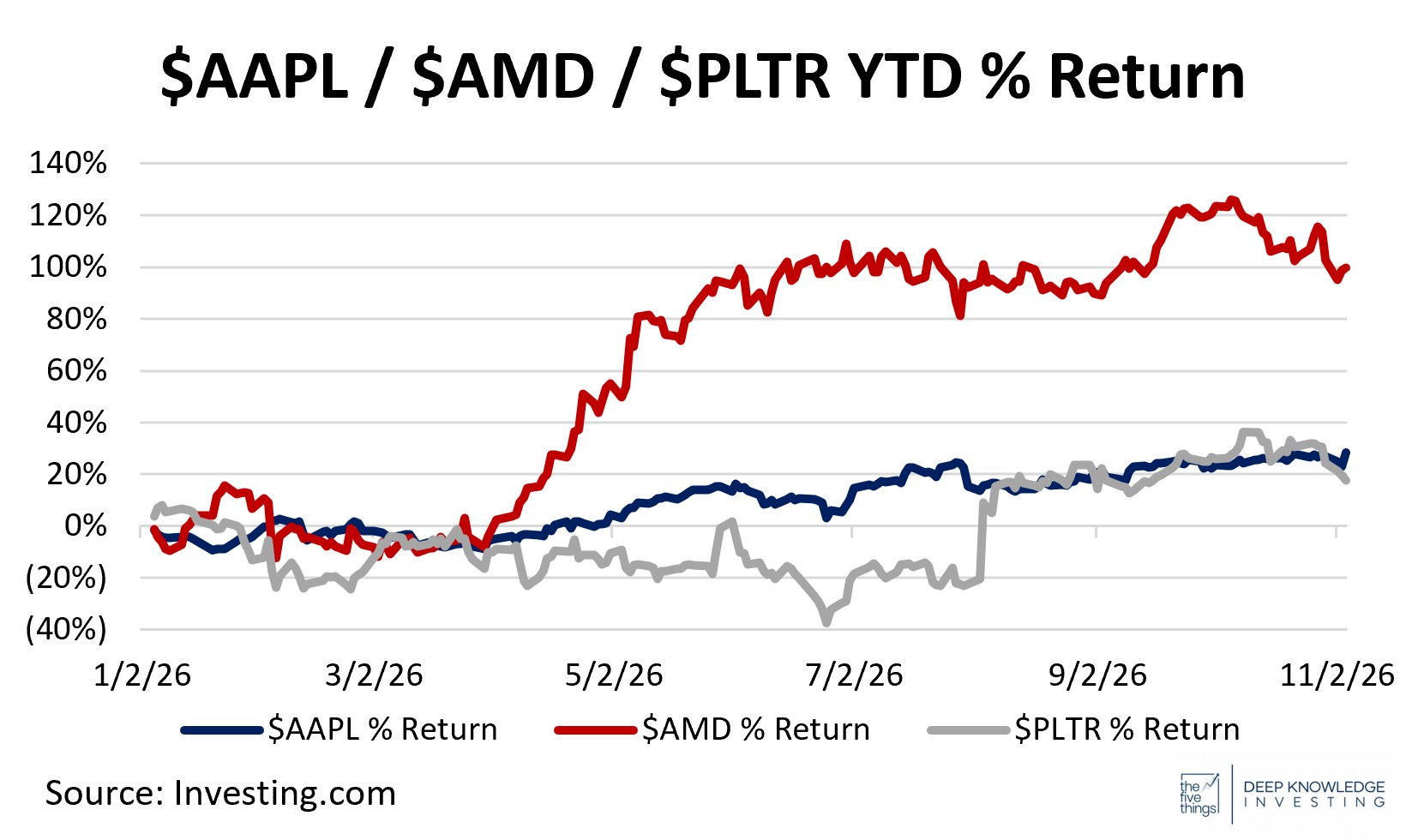
Apple, AMD, and Palantir all reported earnings this week, with different narratives playing out across the markets. Apple beat on both top and bottom lines with revenue of $115B beating estimates by $1B. EPS of $2.10 beat estimates of $2.00. Greater China revenue grew 21% YoY but was below expectations, while iPhone and Mac sales beat. Services were at consensus. AMD had a strong quarter with revenue of $13.4B above estimates of $13.1B and EPS of $2.09 beating the $1.97 expected. Data center revenue jumped 97% YoY while gaming sales fell 40%. Palantir’s revenue skyrocketed 96% YoY to $2.3B beating expectations of $2.2B. Adjusted EPS of $0.44 also beat the $0.40 estimate.
 Credit: Samsung Canada Instagram – Samsung making fun of iPhone Duo screen cracking issues
DKI Takeaway: On one side, Apple’s earnings were positive given strong revenue numbers and the launches of the iPhone Duo and touchscreen Macs. However, management noted supply constraints on Mac and iPad products in the coming quarter and like others in the consumer electronics space, higher DRAM cost is leading to price increases that suppress demand. The iPhone Duo’s launch has been overshadowed by widespread user complaints about the screen breaking upon opening it. (See image above.) At AMD, data center revenue growth was massive, and the company raised guidance to $17B for Q4. CPU demand is likely to continue soaring as AI moves into its agentic phase. At Palantir, investors were concerned with US Total Contract Value growth falling to 11% YoY after 153% the previous quarter. Management also noted that major enterprises opted for shorter contracts. This means that its visible revenue backlog is slowing, which is concerning as future earnings drive the stock’s high valuation.
4) Binance Gets Hacked for $6.3B – Bitcoin Shrugs:
Binance, the world’s largest crypto exchange, was robbed of $6.3B in the largest crypto hack on record. The hackers didn’t break down the front door. Binance says they used a fake job interview and tampered software to compromise two engineers’ computers. They then used a third computer to drain the exchange’s wallets. The attack has been tied to North Korea and shows how the weakest link in security is usually a person, not the code.
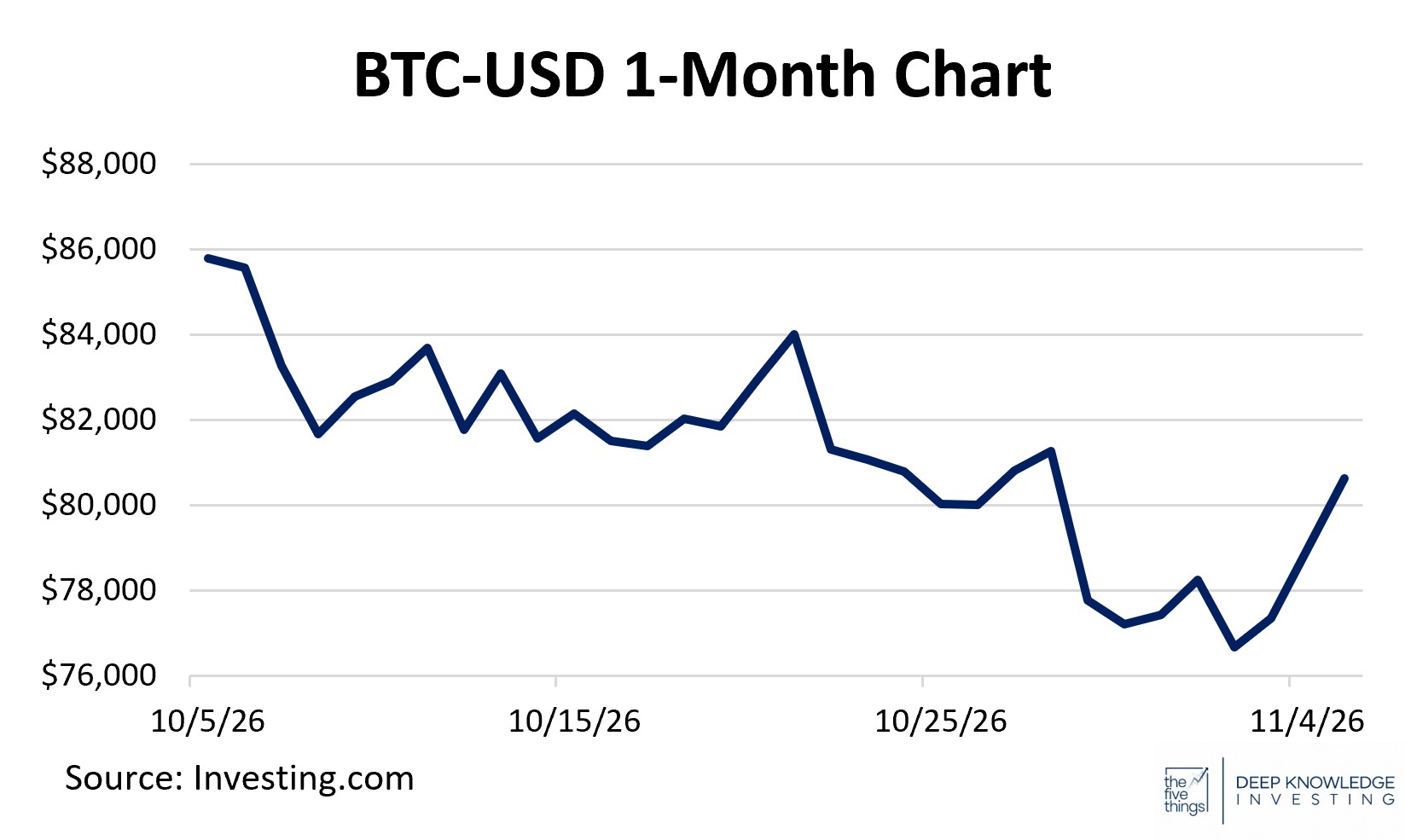
DKI Takeaway: Bitcoin fell only 5% on news of a $6.3B hack. Compare that to May 2022, when the collapse of the TerraUSD stablecoin sent Bitcoin sharply lower. The conclusion: Bitcoin is maturing as an asset. Institutional money, paired with investors who have previously been through hacks, has mitigated sharp swings in the asset. Binance also said that it will cover all of its customers’ losses from its own balance sheet. Anthony Pompliano wrote a great article on this topic. Check it out here.
5) CVS to Split Its Drugstore and Insurance Businesses:
CVS Health executives conducted a strategic review and decided to split up the healthcare giant’s drugstore and insurance businesses. CEO David Joyner rejected the idea of a split when he accepted the role in 2024. That’s changed, and the company plans a breakup to put Aetna Insurance and Caremark into one company, with the 9,000 pharmacies in another. Caremark is a pharmacy-benefit manager which is a third-party middleman between insurance companies, drugmakers, and pharmacies. The breakup is meant to make each segment more focused on its business. The split is expected to close by the first half of 2028, with $CVS shareholders owning shares in both companies.
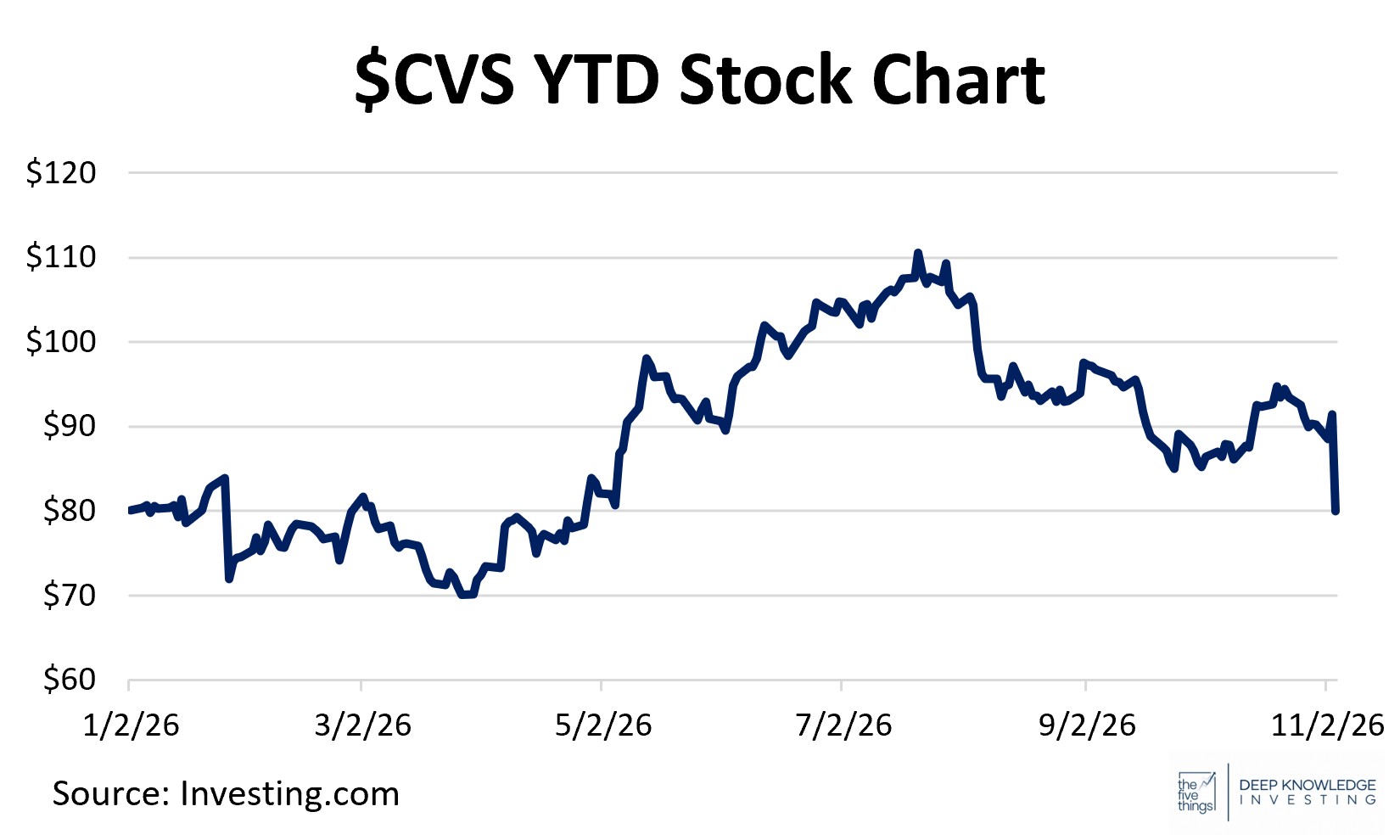
DKI Takeaway: CVS’ stock declined 12% after the news hit Wall Street. CVS acquired Caremark in 2007 and Aetna in 2018. At the time, management claimed that these moves would help bring down the cost of healthcare and increase access to care. It didn’t necessarily turn out that way. Lawmakers have been targeting pharmacy-benefit managers (like Caremark) more as costs have kept rising. Some analysts attribute the rationale of the split to taking some of this regulatory pressure off the company by breaking up the vertically integrated structure.
Both political parties in the US talk a lot about reducing the cost of healthcare, but that’s been a failure. Pharmacy benefit managers are an obvious place to look to reduce costs and mail order pharmacies are reducing the need for more people to set foot in the retail stores. There could be issues on both ends of this spin-off.
6) Educational Piece: The VIX:
The CBOE (Chicago Board Options Exchange) Volatility Index, or VIX, is a measure of the expected volatility in the market over the next 30 days calculated from S&P 500 options. A low VIX, typically below 20-25, suggests that investors expect calm markets. Above 25-30 signals fear and uncertainty. This is why the VIX is commonly referred to as Wall Street’s “Fear Gauge”. The VIX jumped to around 60 during the 2008 financial crisis and close to 45 in April 2025 when the tariff shock rippled through the economy.
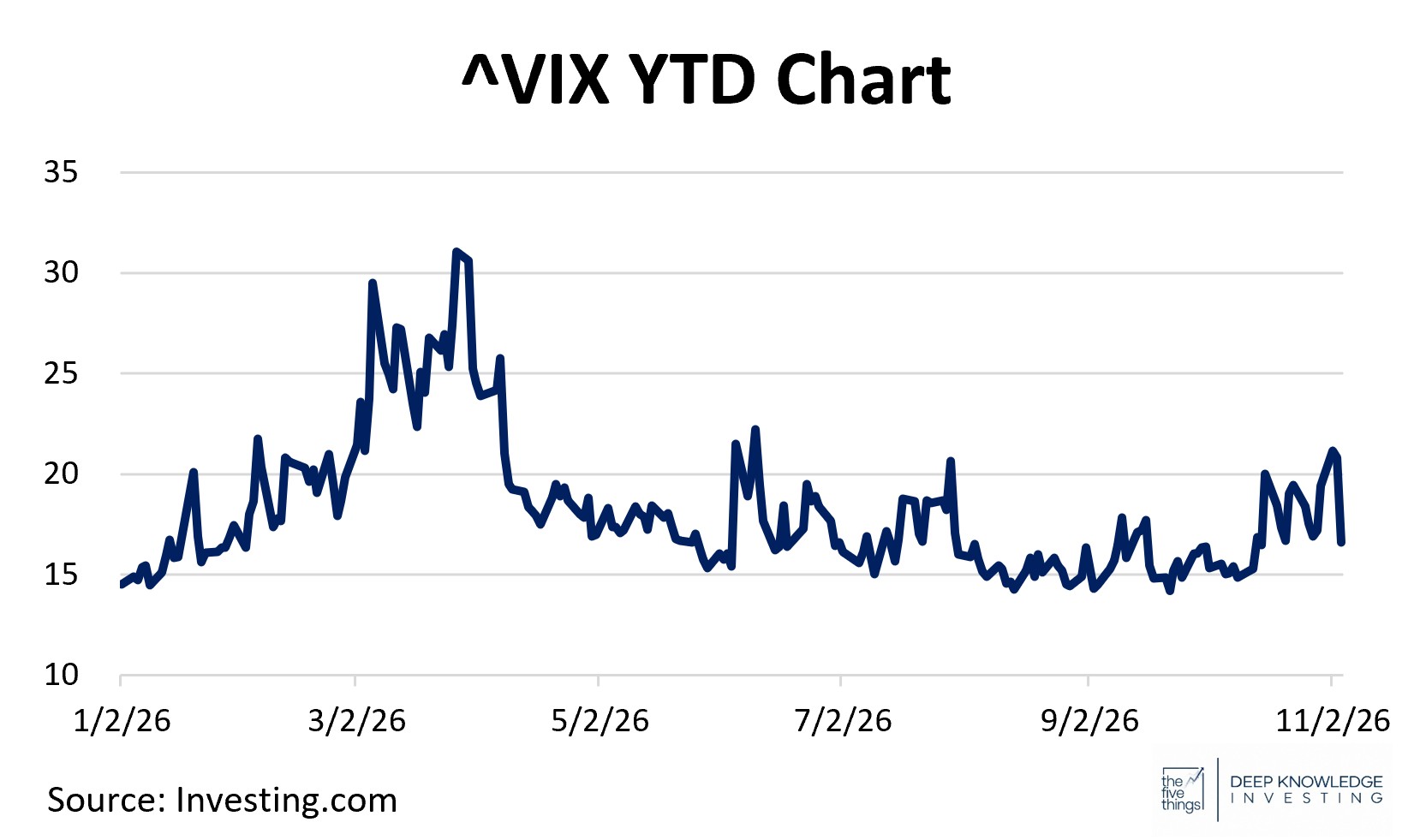
DKI Takeaway: The VIX measures expected volatility rather than past movement. It reflects what investors anticipate instead of a concrete action. It is useful for assessing projected risk, which can help portfolio managers hedge positions and make informed decisions. This is why during volatile times, we often see investor money flow into defensive sectors like healthcare and consumer staples at the same time the VIX rises. As with any tool, the VIX should be used in tandem with other factors. There’s also a decay factor in the ETFs that track the VIX so it’s possible to get the direction right and still lose money if the movement takes too long.
Information contained in this report is believed by Deep Knowledge Investing (“DKI”) to be accurate and/or derived from sources which it believes to be reliable; however, such information is presented without warranty of any kind, whether express or implied and DKI makes no representation as to the completeness, timeliness or accuracy of the information contained therein or with regard to the results to be obtained from its use. The provision of the information contained in the Services shall not be deemed to obligate DKI to provide updated or similar information in the future except to the extent it may be required to do so.
The information we provide is publicly available; our reports are neither an offer nor a solicitation to buy or sell securities. All expressions of opinion are precisely that and are subject to change. DKI, affiliates of DKI or its principal or others associated with DKI may have, take or sell positions in securities of companies about which we write.
Our opinions are not advice that investment in a company’s securities is suitable for any particular investor. Each investor should consult with and rely on his or its own investigation, due diligence and the recommendations of investment professionals whom the investor has engaged for that purpose.
In no event shall DKI be liable for any costs, liabilities, losses, expenses (including, but not limited to, attorneys’ fees), damages of any kind, including direct, indirect, punitive, incidental, special or consequential damages, or for any trading losses arising from or attributable to the use of this report.