Monday’s writeup on $BRR has already yielded some excellent subscriber questions. Let’s address them:
Phil asks: Was curious on how you view the convertible debt on their balance sheet. At $99MM it’s quite significant. There seems to be increased concern recently from other BTC companies about such debt and a concerted effort to remove or reduce it. Also, a move to use EV/Mnav when calculating the value relative to the BTC holdings for a more complete picture. I’m assuming you’re not too concerned about it but think it would be really value for the community to understand how you think about debt like this when assessing companies and companies of this size in particular. The market generally seems highly concerned when the BTC price is falling and in a bear market and completely unfazed or even encouraging of it when the price is rising as they benefit from the amplification. At what point does it become a real issue? Could it be fatal?
This is an excellent question and I suspect some of Phil’s concern stems from the leverage at Strategy where Michael Saylor has used a lot of debt to buy a lot of Bitcoin. That’s creating problems for both Strategy and for Bitcoin.
I think the situation at ProCap is different. First, the convert pays no interest which eliminates the need for the company to sell Bitcoin to service the debt. (That’s part of what’s creating stress at Strategy.) There’s also a material amount of time before the debt can become a problem. Page A-4 of the 2025 10-K says the debt matures on December 5, 2028. A lot can happen to both the price of Bitcoin and the value of CFO Silvia in just under 28 months.
I also think the company has done an excellent job at capital allocation. The original size of the convertible offering was $235MM. $BRR bought back $135MM of that at a discount which addresses Phil’s point about reducing debt in the industry. The place where the debt could potentially create a problem is if we get into 4Q of 2028, the stock price is low, and the dollar price of Bitcoin falls further.
In my full writeup, I noted that one risk to owning $BRR is the company has assets denominated in Bitcoin and expenses denominated in dollars. That mismatch could potentially create an issue. Phil is pointing out that there’s also a mismatch between the denomination of the assets (Bitcoin) and the liabilities (convertible debt in dollars). He’s correct to do so. I don’t see this as being significantly different than using dollars to buy Bitcoin. It could go well or badly, but we have almost 2 ½ years before the debt needs refinancing and I’m willing to take the bet that the dollar price of Bitcoin isn’t materially lower then and that CFO Silvia gains traction. There’s no risk-free investment and in this case, we understand the bet we’re making.
Phil asks about the EV/mNAV calculation. I included the preferred as debt in my calculation that we were paying 67% of the value of the Bitcoin on the balance sheet. That’s the most unattractive way to account for it. If I were to assume conversion at $13.00/share, the EV/mNAV falls to 50%. I believe treating the convert as debt right now is the correct and conservative approach, but I provide both below so you can make your own determination:
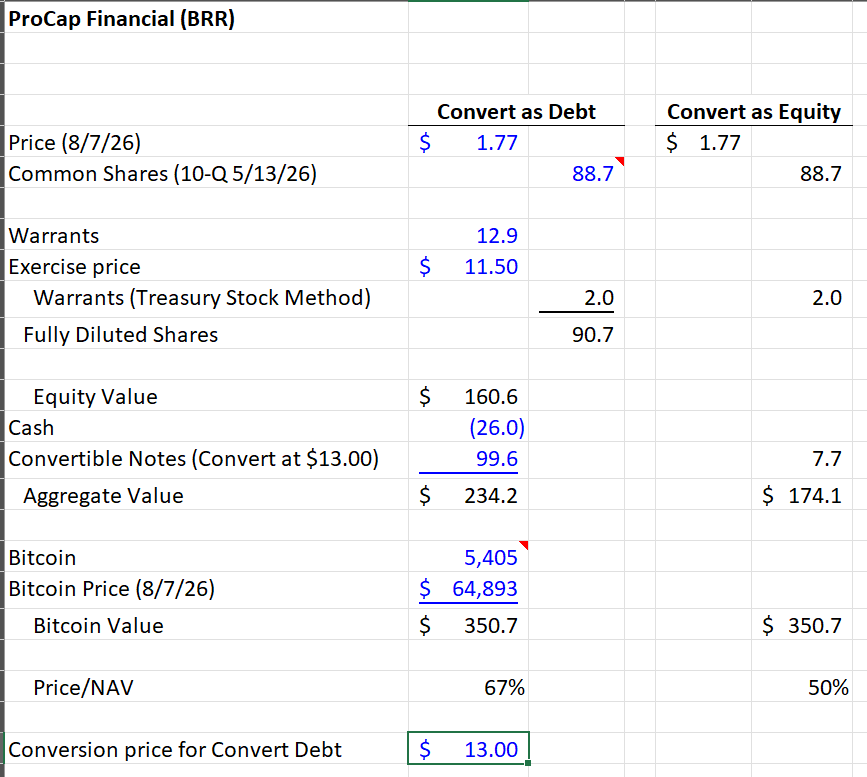
I suggest treating the convert as debt for now.
Here’s how I think about it: We’re paying 67% of the value of the Bitcoin including the cost of the debt. So, while there’s leverage, we are paying a discount to the value of the equity plus that debt. And because the convert doesn’t have interest payments, there’s no clock ticking against the company between now and maturity. That’s a good enough margin of safety for me.
Ryan writes in to ask: Hi Gary,
Curious if you think CFO Silvia has much of a moat? I know of a handle of other companies that have built very similar products. I haven’t used Silvia myself but struggle to see how it could be much different from the others. Seems like it will be difficult to monetize long term with all the competition.
I suppose your thesis is maybe half buying BTC at a discount and half the potential of the actual business?
Ryan is asking a great question. First, he’s correct about his conclusion. We’re paying negative 33% for the possibility that the team at $BRR can build a real competitor in the industry. It’s early, but the initial data is positive. In just a short time, Silvia has amassed $50B of assets on its platform. 15% of users have upgraded to the paid version and the average user has more than $4MM of assets listed. This is a sophisticated relatively-wealthy group of people who feel underserved by the current RIA/wealth management business and who have demonstrated a willingness to pay for access to Silvia. (I wrote in my initial writeup that I would have been impressed if the conversion rate to the paid version had been 5%. I reiterate that opinion now.) So yes, I am willing to pay a negative price for exposure to this business.
Let’s examine Ryan’s other point more thoroughly because the lack of a moat was something I considered before investing. We’ll start by stating the obvious: There are financial companies with vastly more financial resources and a much larger development team that could begin to disintermediate their own RIAs and wealth advisors and start to move investors towards less personal AI-based education and advice. There are also VC firms with greater resources that don’t have a personal-relationship-based business to cannibalize and could compete. As I was thinking about how to best address Ryan’s question, Pomp decided to do it for me.
Earlier this week, $BRR announced that Silvia had beaten the major US models in knowledge of the tax laws of the US government and of five different States. The conclusion was that while the big models like Claude, Grok, and ChatGPT were good for general knowledge, there is room for smaller subject-specific models to excel in areas of specialization. That’s what Silvia does. Pomp elaborates on his Substack. While he does acknowledge that more competition is coming, he points to Silvia’s large and growing userbase of wealthy people who are engaged enough to ask Silvia dozens of questions a week. Those questions give the team at ProCap valuable information to understand the questions and concerns of their community. That information is used to train the next version of the model and is a valuable advantage.
Again, I haven’t discussed this with management, but as Silvia demonstrates excellence in answering complicated questions in its specific domain and in encouraging continued engagement from the userbase, I expect companies will be interested in buying $BRR. That would be easier and make more sense than trying to build their own AI and attracting what will likely be hundreds of billions of dollars of assets on the platform at some future date.
Information contained in this report is believed by Deep Knowledge Investing (“DKI”) to be accurate and/or derived from sources which it believes to be reliable; however, such information is presented without warranty of any kind, whether express or implied and DKI makes no representation as to the completeness, timeliness or accuracy of the information contained therein or with regard to the results to be obtained from its use. The provision of the information contained in the Services shall not be deemed to obligate DKI to provide updated or similar information in the future except to the extent it may be required to do so.
The information we provide is publicly available; our reports are neither an offer nor a solicitation to buy or sell securities. All expressions of opinion are precisely that and are subject to change. DKI, affiliates of DKI or its principal or others associated with DKI may have, take or sell positions in securities of companies about which we write.
Our opinions are not advice that investment in a company’s securities is suitable for any particular investor. Each investor should consult with and rely on his or its own investigation, due diligence and the recommendations of investment professionals whom the investor has engaged for that purpose.
In no event shall DKI be liable for any costs, liabilities, losses, expenses (including, but not limited to, attorneys’ fees), damages of any kind, including direct, indirect, punitive, incidental, special or consequential damages, or for any trading losses arising from or attributable to the use of this report.