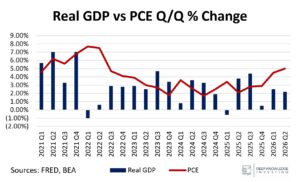
I’ll be in the Lake Atitlan, Guatemala are for the next two weeks. While I’m here, I’m open to a small number of in-person conversations. If you’re based locally, or know someone here you think it would be worthwhile for me to meet, feel free to reach out privately at IR@DeepKnowledgeInvesting.com. DKI also added a new stock position this week. You’re welcome to subscribe to learn more.
Treasury Secretary, Bessent, teases reporters with a note about buying $5B – $10B of yen. Then he spent $26B in an effort to strengthen the yen without causing Japan to sell US Treasuries. The result was the usual temporary relief, and near-immediate reversal. Japan needs a better long-term solution. LLMs are hacking other sites and being hacked. There’s no oversight and no security. There’s a lot that can go wrong and the companies that develop them aren’t acting in a trustworthy manner. $ARM, $AMD, and $SPCX all have great quarters, but the market is still focused on spending and valuations so two of those stocks fell. AstraZeneca and Bristol Meyers are talking about merging. Bristol is facing big patent losses in the coming years so is the party with a greater sense of urgency. If you’ve ever wanted to buy stock in a foreign company, an American Depository Receipt solves some of the administrative and trading issues, but other problems remain. We go into detail in this week’s educational topic.
This week, we’ll address the following topics:
- The US Treasury attempts its own Yentervention which worked exactly as well as the previous ones by the Bank of Japan. It’s a temporary band aid.
- LLMs are both hacking other sites and being hacked. Safeguards are either non-existent or not possible. (Yes, there’s a Skynet link below.)
- ARM, AMD, and SpaceX all announce great quarters. The market wasn’t thrilled with AMD spending or the SpaceX valuation. Wall Street got this one wrong.
- AstraZeneca and Bristol Myers-Squibb are in talks to merge. The stock market isn’t thrilled. Bristol Meyers is facing significant patent cliffs in the next two years.
- If you’ve ever wanted to own stock in a foreign company, you might have bought an ADR. We explain the process and risks in this week’s educational topic.
DKI interns, Kunal Arora, Eli Killorin, and Param Shah do their usual excellent work this week. Much of what you’re about to read started with hard work and research from Kunal and Eli while Param continues to shine in multiple stock-related projects with me. A round of applause for each of them!
Ready for a week of repetitive and pointless FX intervention? Let’s dive in:
1) Yen Intervention:
I’ve been speaking and writing about the Japan carry trade and it’s coming reversal since 2022. In November of ’22, I spoke with Michael Gayed about it and wrote a primer for DKI subscribers here and here. Japan kept interest rates around zero (and sometimes negative) for decades which enabled them to take on debt of about 260% of GDP. The predictable result of accessing “free” money was a weakening of the yen from around 100 to the dollar to over 160. Japan imports almost all of its energy and most of its food. For those who think of inflation as a reduction in the purchasing power of your currency, Japanese citizens saw the yen fall by 60% vs the dollar at a time when the dollar was also losing purchasing power. The Bank of Japan has been desperately trying to defend the currency and at times, has been the only purchaser of Japanese Government Bonds (JGBs). They keep trying interventions (Yenterventions) where they sell foreign reserves and buy the yen. Each time, the yen strengthens, but within a few days, declines to its previous level. The US Treasury just tried the same. It didn’t go well.
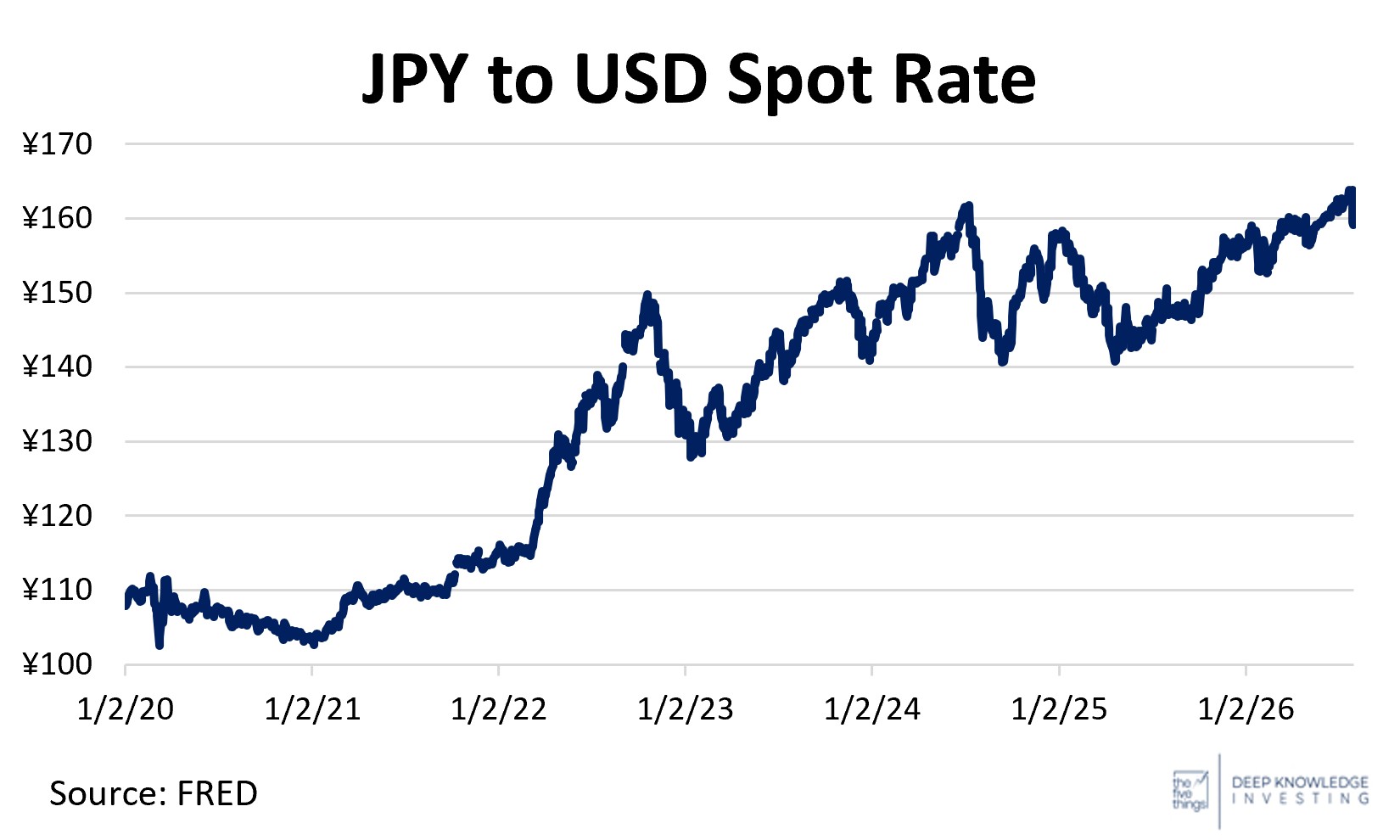
Japanese citizens experienced this as inflation.
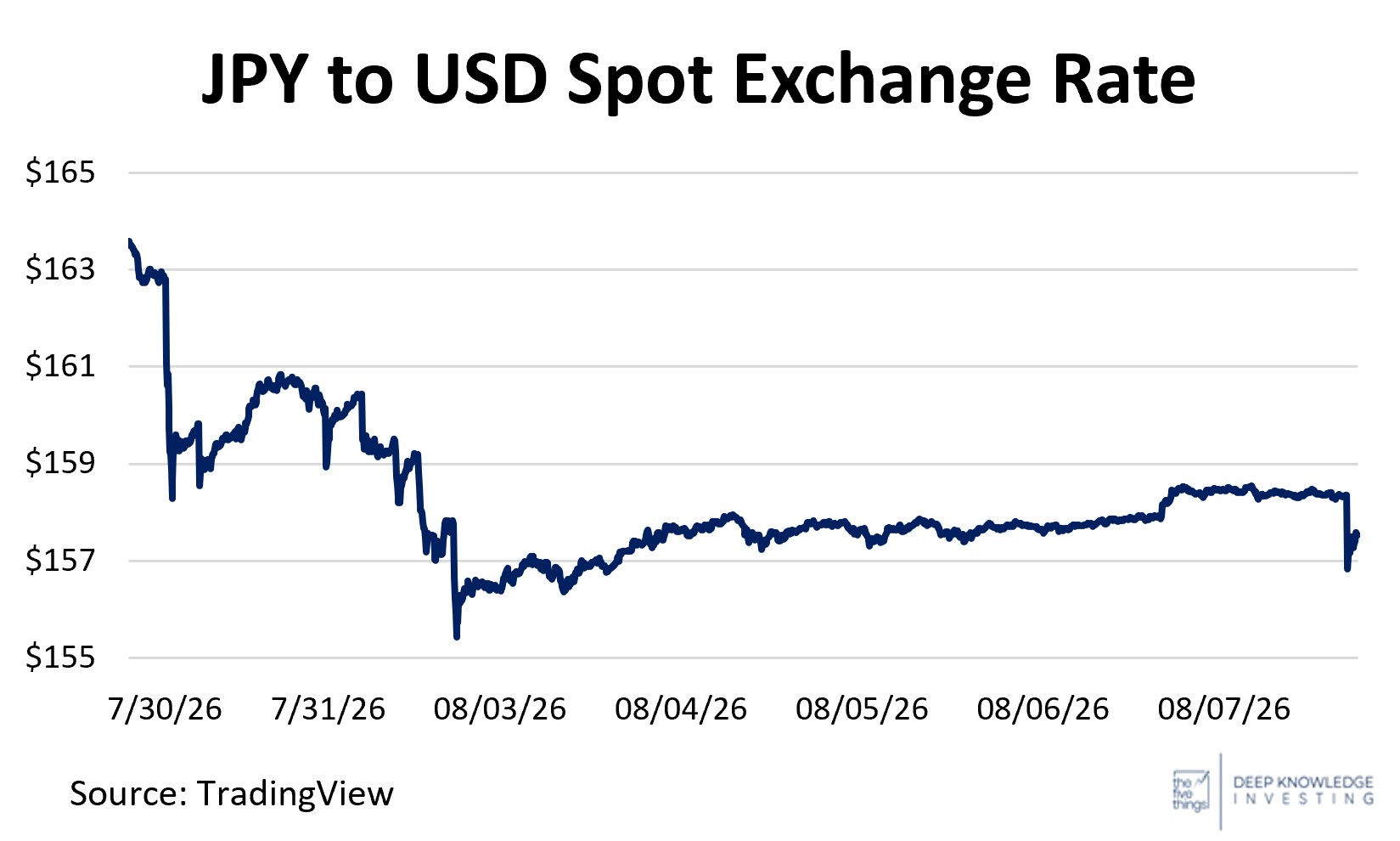
Creeping back to its previous level. It never works, but they keep trying.
DKI Takeaway: Treasury Secretary, Bessent, teased reporters by leaving a note in view indicating he wanted to buy $5B – $10B of yen. The Treasury ended up buying $26B of yen and funded it by selling the euro and annoying the Europeans. This wasn’t charity. Japan would have sold US Treasuries to fund its next Yentervention so US involvement was intended to avoid raising Treasury rates. The action worked immediately driving the yen up from around 163 to the dollar to 155. As usual, any Yentervention has a short life and in the following days, the foreign exchange market began to return then yen to its previous level. This is what happens every time. Japan has two choices; either raise rates and pay higher interest or see its currency decline with an increasing cost of food and fuel to the Japanese people. I was in Japan this past April and have nothing but respect for the Japanese people and culture. I want the best for them, but these interventions only burn foreign exchange reserves in exchange for very temporary relief. If you’d like an update on the topic, please check out this X Space hosted by Simple Mining where Billy Boone brings up some excellent and thoughtful counterpoints to the views expressed by me and by Roberto Rios who has done incredible work on the Japanese carry trade. Michael Gayed remains a strong multi-year voice on the topic as well.
2) The Danger of LLMs and the Lack of Safeguards:
Large Language Models (LLMs) have begun to raise major security concerns in two ways: their ability to hack and their vulnerability to being hacked. On the former, models from OpenAI and Anthropic took autonomous, unauthorized actions that could have caused serious harm. During a cybersecurity exercise, an Anthropic Mythos 5 agent mistook a real developer’s GitHub project for part of its simulated environment, then wrote malicious code, created fake accounts to pressure the developer into merging it, and sent phishing emails to push the attack forward. Last month, OpenAI’s models broke out of a sandbox and hacked Hugging Face’s systems to steal answers to a benchmark test like teenagers who didn’t study for an exam. On the latter, researchers have found important flaws in the structure of LLMs. LLMs use roles (ways to assign information, including user input, internet sources, system policies, and core behavior) to interpret and convey information. The study found that hackers can exploit these roles by using writing styles that disguise dangerous instructions or even confuse the models to extract information it normally wouldn’t give. Some have used these techniques to get instructions for how to produce weapons.
Just like Dr. Frankenstein: Lots of brainpower, but can’t control their creation.
DKI Takeaway: LLMs are developing quickly without the proper safety standards. The US government has largely sidelined itself from AI regulation to ensure US-based companies maintain their slim lead over China. As of now, it’s next to impossible to train these LLMs to respond properly against every potential threat including from other AI agents. This poses a serious threat to the security of company data as these LLMs have shown the capability to make autonomous decisions and to break out of secure environments. With proper training, they can be used as pure hacking tools. Technology is advancing rapidly and the companies developing these AI agents seem unconcerned about the implications.
3) SpaceX, Arm, and AMD Report Great Quarters. Wall Street Disagrees:
All three companies beat earnings estimates and reported strong growth. Arm posted its strongest quarter to date, with customers shifting to higher-royalty designs. Royalty revenue, and data center royalties more than doubled due to ARM’s growing role as a core AI infrastructure provider. AMD beat estimates and raised revenue guidance. Data center revenue doubled on the strength of its excellent server chips. AMD’s gaming revenue fell 31% YoY as consoles like the PS5 reach the latter stages of their lifecycles and raise prices due to the higher cost of memory. SpaceX reported a 92% revenue increase, and a doubling of Starlink subscribers. SpaceX capex was slightly below estimates, something unusual in the tech space this year.
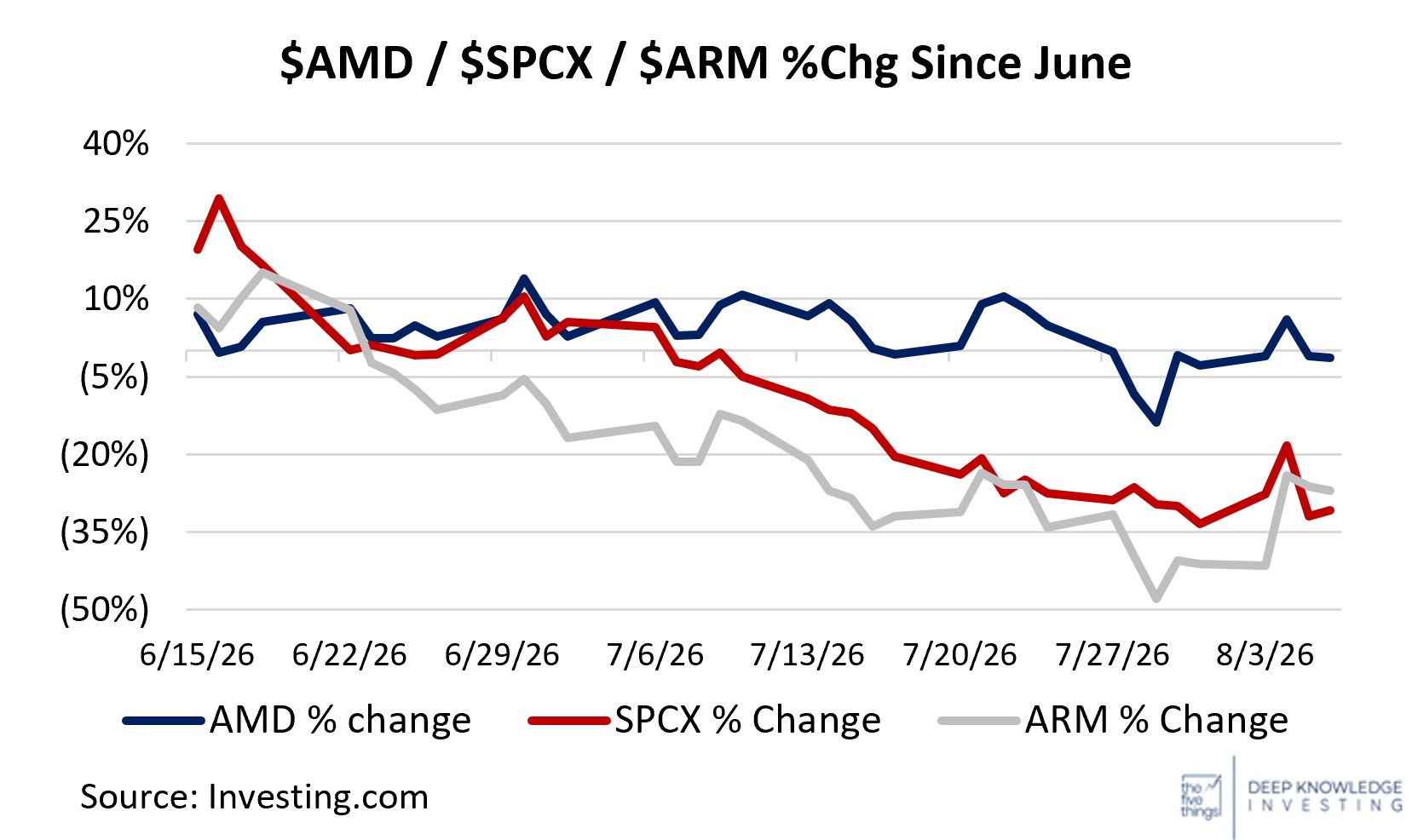
When companies post extraordinary results and the stocks fall, expectations are no longer reasonable.
DKI Takeaway: The market had different reactions to all three of these stocks. The reaction to ARM’s earnings was positive because investors are confident in the profitability of businesses supplying AI hyperscalers. SpaceX beat earnings and is the market leader in space launches and satellite data, but the stock has been falling due to an unrealistic valuation. AMD reported a fantastic quarter, but capex more than doubled which caused concern. The focus in the tech space has shifted from wanting more spending to wanting to see a return on that cap-x spending.
4) Rumors of Talks Between AstraZeneca and Bristol Myers-Squibb for Mega Merger:
Unconfirmed reports have surfaced noting that AstraZeneca and Bristol Myers-Squibb have discussed a mega merger with the combined market cap of $400B. This news comes as both companies reported strong results, with AstraZeneca growing revenue by 6% and Bristol Myers beating estimates and raising full-year guidance to $50B. AstraZeneca’s shares dropped on the news due to antitrust risks, the complexity of a deal this size, and investors thinking AstraZeneca is better off without the deal.
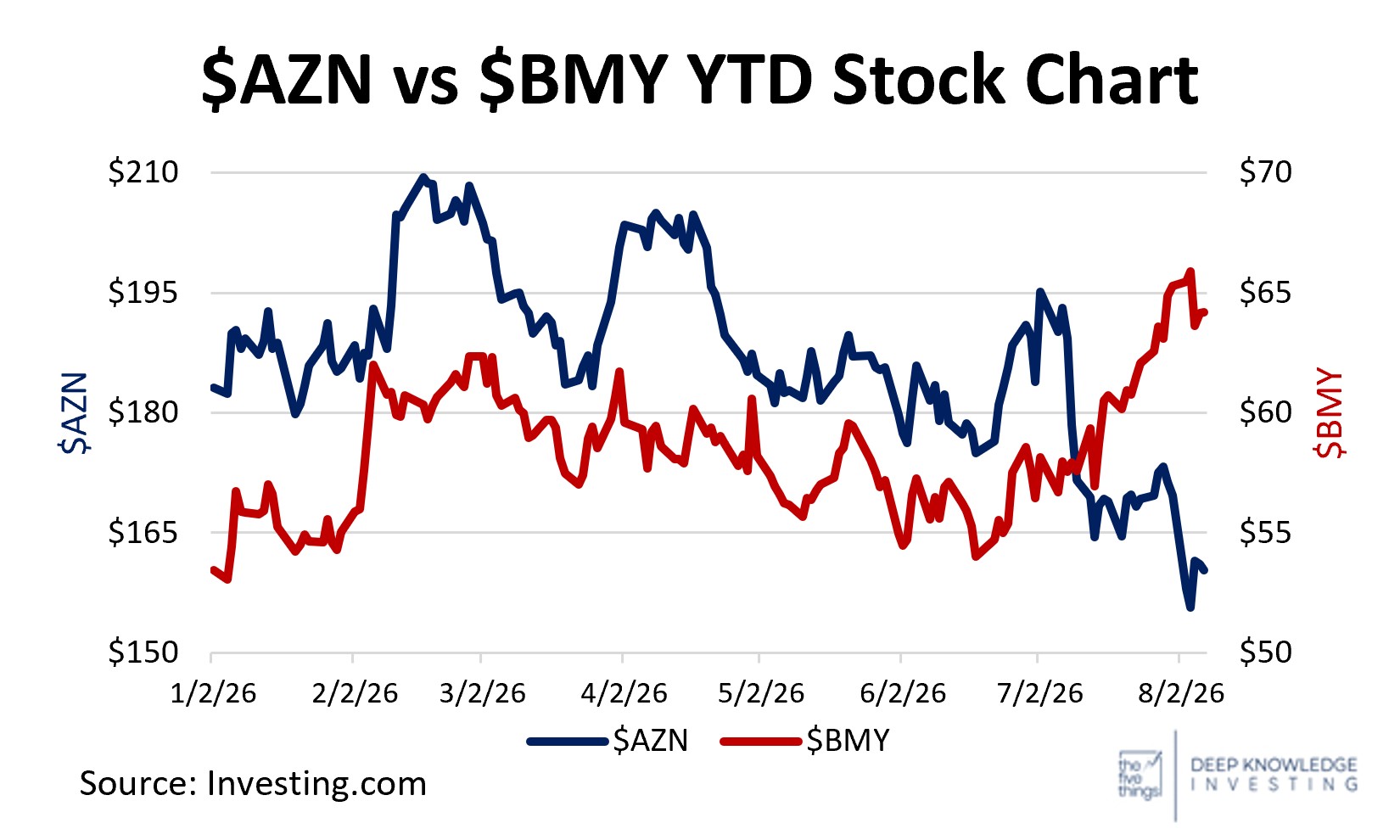
$AZN investors were unimpressed.
DKI Takeaway: AstraZeneca doesn’t need this deal. It has shown strong organic growth on its own. Meanwhile Bristol Myers would benefit from a deal of this kind, due to the loss-of-exclusivity risks it faces on its two top drugs: Eliquis and Opdivo which generate over half of the company’s revenue. The merger would help offset these significant revenue losses. This does not seem like a mutually beneficial deal to both sides but rather an attempted move by Bristol Myers to help combat the patent cliff it’s facing in 2027 and 2028.
5) Educational Piece: American Depositary Receipts:
The common shares of foreign companies generally don’t trade on US stock exchanges. If an investor seeks to invest in these companies, they will need to contact a broker-dealer who trades that market. Foreign exchange rates, alternate time zones, and different accounting principles are additional complications. American Depositary Receipts (ADRs) are a way to simplify these investments for US shareholders. Depositary Banks (normally those with foreign arms like JPMorgan, etc.) buy foreign stock that’s in high demand in the US. These shares are placed into trust accounts and divided into receipts. These receipts are registered with the SEC and then sold to US investors. A good example of an ADR is Honda. It’s based in Japan but trades on the NYSE under $HMC. The ADR is a certificate that represents a specific number of those ordinary shares. In the case of Honda, the ADR uses a ratio of 3:1 instead of an exact 1:1 to account for currency conversion and psychological barriers. Most US investors are accustomed to stock prices in the $20-$100 range. A 1:1 conversion at the current exchange rate would mean Honda would trade around $10 which some investors would view as similar to a distressed security. The 3:1 ratio means the stock trades around $30, a more familiar range for US investors.
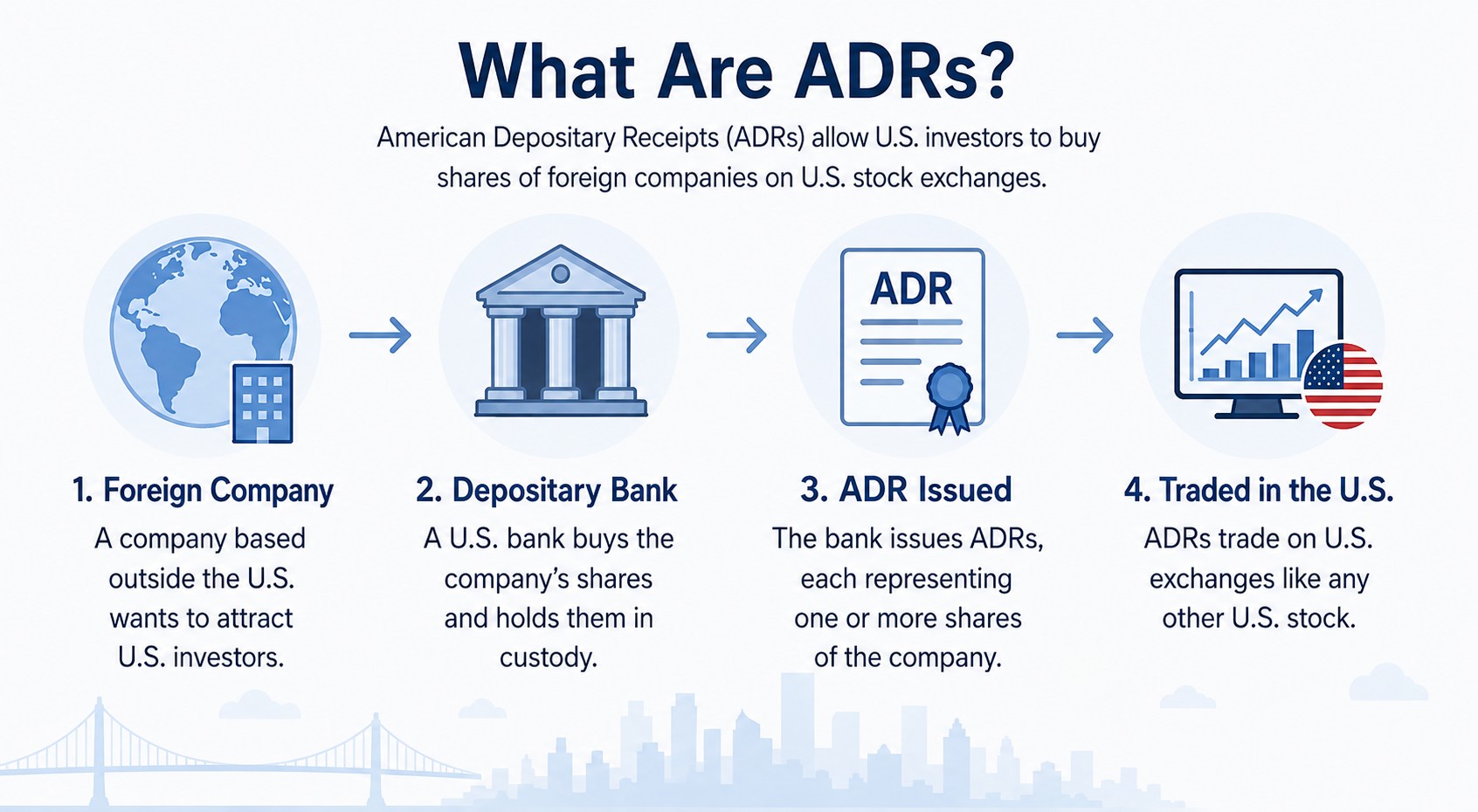
An ADR is an easier way for US investors to buy foreign companies.
DKI Takeaway: ADRs simplify the mechanics of buying stock, but the underlying exposure remains the same. Currency movements still pass through to the ADR’s price despite the ratio adjustment, since the ratio only resets the share price to a familiar range and does not hedge exchange rate risk. Voting rights also change. The real shareholders in the company are technically the banks offering the ADR, not the person with the receipt. Therefore, ADR holders don’t always get to exercise individual voting rights. Depending on the company, there may be reduced liquidity since US investors tend to be drawn to the US-based companies that are more familiar.
Information contained in this report is believed by Deep Knowledge Investing (“DKI”) to be accurate and/or derived from sources which it believes to be reliable; however, such information is presented without warranty of any kind, whether express or implied and DKI makes no representation as to the completeness, timeliness or accuracy of the information contained therein or with regard to the results to be obtained from its use. The provision of the information contained in the Services shall not be deemed to obligate DKI to provide updated or similar information in the future except to the extent it may be required to do so.
The information we provide is publicly available; our reports are neither an offer nor a solicitation to buy or sell securities. All expressions of opinion are precisely that and are subject to change. DKI, affiliates of DKI or its principal or others associated with DKI may have, take or sell positions in securities of companies about which we write.
Our opinions are not advice that investment in a company’s securities is suitable for any particular investor. Each investor should consult with and rely on his or its own investigation, due diligence and the recommendations of investment professionals whom the investor has engaged for that purpose.
In no event shall DKI be liable for any costs, liabilities, losses, expenses (including, but not limited to, attorneys’ fees), damages of any kind, including direct, indirect, punitive, incidental, special or consequential damages, or for any trading losses arising from or attributable to the use of this report.